ASML raises its 2026 forecast as AI drives demand for chipmaking equipment
ASML has improved its 2026 outlook: it now expects revenue of €36–40 billion, up from the previous range of €34–39 billion. The reason is steady demand for chipmaking equipment amid the AI infrastructure boom. In the first quarter, the company reported sales of €8.8 billion, net income of €2.8 billion and a margin of 53%, while customers are speeding up capacity expansion.
AI-processed from Bloomberg Tech; edited by Hamidun News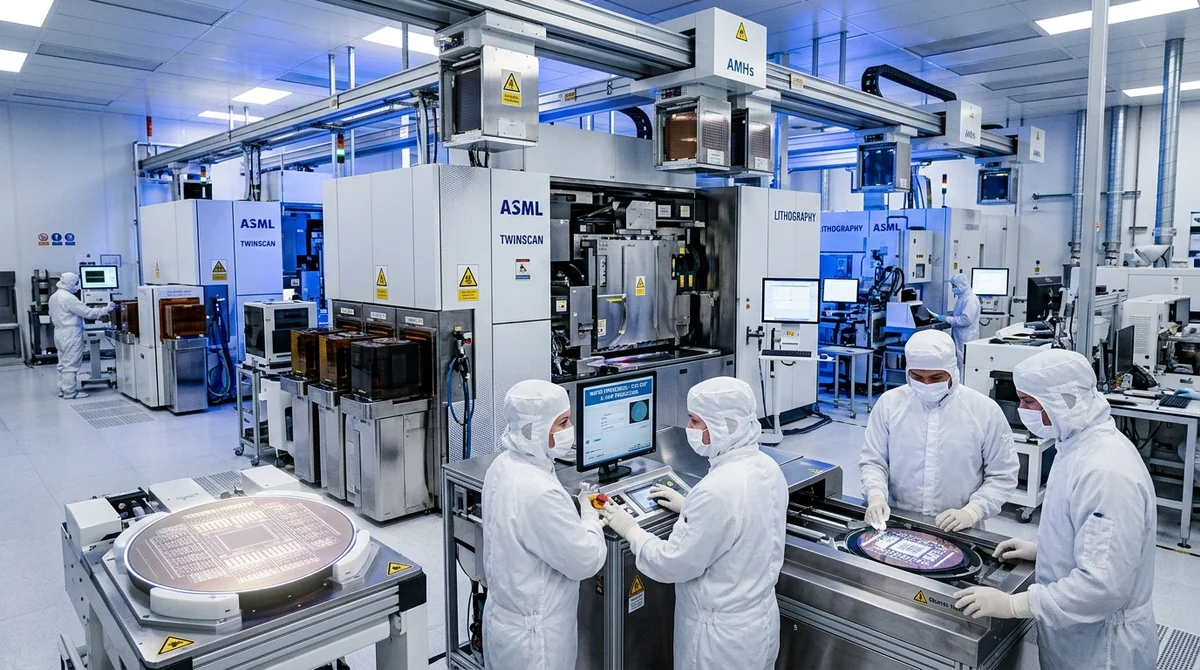
ASML has raised its 2026 revenue forecast, one of the clearest signals yet that the AI boom is driving not only model developers but the entire chip supply chain. The Dutch company now expects annual sales of €36 billion to €40 billion, against the previous range of €34–39 billion, while keeping its gross margin guidance at 51–53%.
The revision follows first-quarter results and firmer demand from customers. In the quarter, ASML booked €8.8 billion in revenue, a gross margin of 53% and net income of €2.8 billion. For the second quarter, it expects sales of €8.4–9 billion.
The reason matters as much as the number: chipmakers are expanding capacity because spending on AI infrastructure keeps growing and demand for the chips themselves outpaces supply.
ASML holds a special place in the industry. Its lithography machines, including EUV systems, are required to make the most advanced semiconductors, which then go into data center accelerators, server processors and modern memory. When major players increase their purchases of ASML equipment, it usually means they are planning for a longer investment cycle rather than a short-term spike. The company says directly that customers have improved their short- and medium-term demand expectations and are planning fab expansions for 2026 and beyond more actively.
Growth is also not coming only from new machine sales. Revenue in the Installed Base Management segment, which covers service and upgrades of systems already installed, rose to €2.488 billion from €2.134 billion a quarter earlier. That points to two things: customers already have a large base of working equipment, and they are willing to invest in improving the performance of existing lines rather than just waiting for new deliveries.
Meanwhile, the number of new lithography systems sold fell from 94 in the fourth quarter of 2025 to 67 in the first quarter of 2026, yet the margin stayed high. For ASML, that is an important sign of demand quality and pricing power.
The context also favors this story. Back in January, when it published its 2025 results, ASML gave a 2026 revenue forecast of €34–39 billion. At the same time it reported a record 2025: €32.7 billion in sales, €9.6 billion in net income and a backlog of €38.8 billion at year-end. Fourth-quarter orders alone came to €13.2 billion, of which €7.4 billion was for EUV. Now, less than three months later, the top of the range is unchanged, while the bottom has risen by €2 billion. This is usually read as management being less cautious and as confirmation that demand has become more predictable.
The company does not pretend there are no risks. In the new outlook, ASML notes that the range should account for possible outcomes of the ongoing discussions around export restrictions. For an equipment maker of this caliber, that is a sensitive topic: shipments of advanced systems depend not only on commercial demand but also on politics, licenses and technology controls. Still, management's tone is noticeably more confident than at the start of the year: even allowing for external restrictions, the company believes 2026 will be a growth year for all of its main business areas.
For the market, this is an important marker. ASML's higher forecast shows that the AI investment wave still runs into physical infrastructure: fabs, lithography, memory, packaging and service. And if the supplier of the most critical equipment in the chain sees demand accelerating, the largest chipmakers are not yet preparing for a cooldown. For Europe, it is also a reminder of the strategic value of companies that control narrow but irreplaceable links in the global technology stack.
Test Frontier LLMs & Autonomous Agents in One Workspace
Run Claude Opus 5.5, GPT-6, Gemini 3.1, and DeepSeek side-by-side in Nomad AI (nomadnet.ai) — unified model routing, deep research, and multimodal workflows under one subscription.
The AI world, distilled — once a week
Seven stories that actually mattered, hand-picked. No noise, no reposts, no press releases.
Done! Check your inbox for a confirmation.