ASML raises 2026 sales forecast as demand for Nvidia's AI chips holds up
ASML has raised its 2026 sales forecast to €36–40 billion, a sign that AI investment keeps driving demand across the semiconductor chain. The company's equipment is used to make advanced chips, including Nvidia's data center products, which train and run today's AI models. For the market, it is one more signal that the AI infrastructure spending cycle remains strong.
AI-processed from Bloomberg Tech; edited by Hamidun News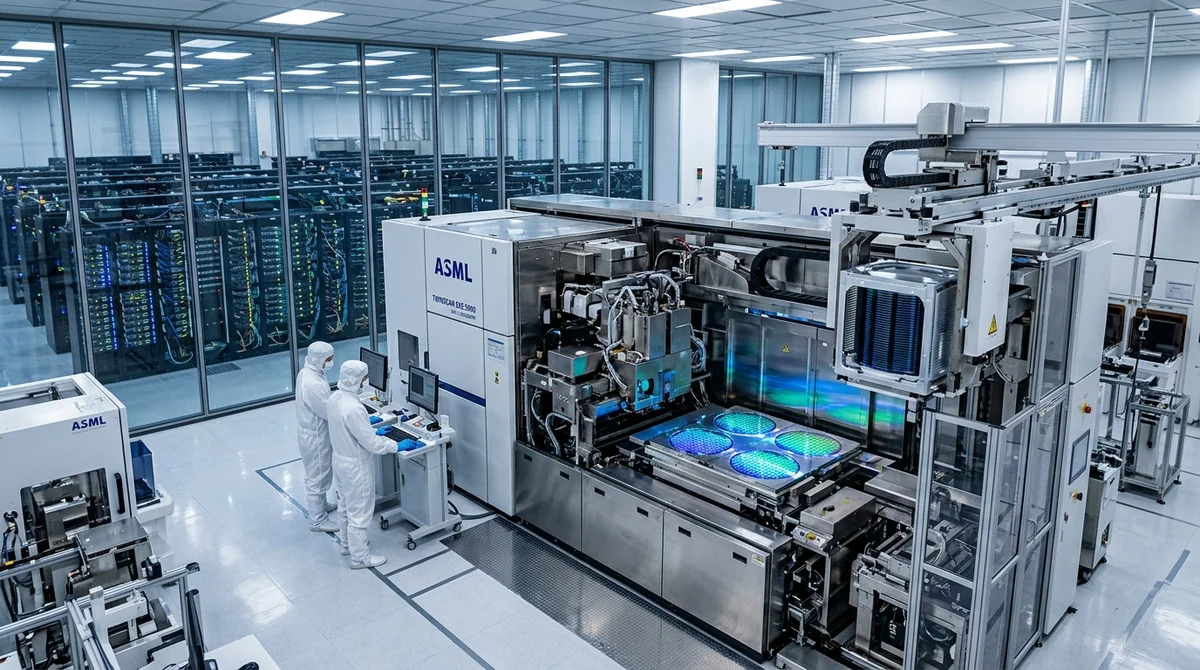
ASML has raised its 2026 sales forecast to a range of €36–40 billion, another signal that the artificial intelligence boom continues to directly support makers of critical equipment. The market usually watches Nvidia, model developers and cloud platforms, but ASML's updated outlook shows that money is still flowing into deeper layers of the technology chain, where the physical foundation of AI infrastructure is built.
The Dutch company ASML is a key supplier of lithography systems, without which the most complex modern chips cannot be mass-produced. Semiconductor manufacturers use this equipment to make processors and accelerators for data centers. ASML's link to Nvidia chip production deserves a separate mention: the company's machines are critical for making the components on which AI models are trained and run. This is an important nuance, because ASML does not make chips itself and does not build data centers, yet it sits at a point in the chain where further AI growth would simply run into physical limits.
It is no accident that the company is called one of the most strategically important suppliers in the global semiconductor industry, and its status as Europe's most valuable public company only increases market attention to every forecast update.
The new sales target, from €36 billion to €40 billion for the year, means management sees stronger demand than previously expected. Such revisions are especially telling in the semiconductor equipment market: customers do not buy these tools on impulse. They are expensive, long-term investments tied to plans for expanding fabs and utilizing capacity years ahead. If chipmakers are ready to confirm or increase purchases, they expect demand for AI computing to last beyond the next quarter and over a longer horizon. In other words, ASML's forecast is not just a story about quarterly reporting but an indirect indicator of how confident the industry is about future needs for advanced computing.
Growth in AI demand is not driven by a single category of workload. It covers training large models, running finished systems in production, and expanding data centers for inference, where the load is constant. All of this requires more and more accelerators, memory, networking infrastructure and, ultimately, new batches of advanced chips. For cloud providers and infrastructure operators the implication is simple: without sustained expansion of production capacity, keeping up the pace of AI service adoption will get harder. That is why the ASML news matters not only to investors in European industrial companies but to the whole AI ecosystem: if equipment suppliers are raising forecasts, the capital spending cycle is not running out of steam yet.
At the same time, the €36–40 billion range itself shows that uncertainty has not gone away. The semiconductor market remains cyclical, and delivery schedules, approvals of large orders and the commissioning of new capacity often shift between quarters. In such an industry, even strong demand does not guarantee a perfectly smooth revenue trajectory. But a forecast increase in this situation is usually read unambiguously: the company sees enough confirmed signals from customers to be more confident about its annual result, despite unavoidable volatility in timing and contracts. For investors this matters more than the bottom or top of the range: an upward revision says more about demand strength than any cautious management comment.
The main takeaway is that the AI boom continues to work not only for the most visible players, such as model developers or makers of finished accelerators. It also supports the fundamental links of the supply chain, where ASML holds an almost irreplaceable position. For the market, it confirms that the AI growth story is not yet reduced to a single brand or a single type of company.
For Europe, it is a reminder that one of its most valuable technology assets remains at the center of the global race for computing power. And for the whole industry, it is a signal that scaling AI depends not only on algorithms but also on how fast the world can produce the required number of complex chips.
- Nov 1, 2026Local models lose to Opus and Codex: 0.21 on a MacBook versus 1.00 for Codex
- Nov 1, 2026Habr author fine-tunes YOLOv8l on dental X-rays and pushes mAP50 to 0.642
- Nov 1, 2026Voice bots built on LLMs turn to Jev, a fast classifier, for decisions in 200–500 ms
- Nov 1, 2026MoneyGate safety layer blocked all 42 fraudulent requests to local AI models
Test Frontier LLMs & Autonomous Agents in One Workspace
Run Claude Opus 5.5, GPT-6, Gemini 3.1, and DeepSeek side-by-side in Nomad AI (nomadnet.ai) — unified model routing, deep research, and multimodal workflows under one subscription.
The AI world, distilled — once a week
Seven stories that actually mattered, hand-picked. No noise, no reposts, no press releases.
Done! Check your inbox for a confirmation.