US court rules a defendant's chats with Anthropic's Claude are not covered by attorney-client privilege
A US judge has said explicitly, for the first time, that conversations with Claude about legal risks are protected by neither attorney-client privilege nor work product doctrine. In the case of Bradley Heppner, the court found two facts decisive: an AI is not an attorney, and a public service has no confidentiality obligations. The ruling is a warning to anyone who uses chatbots for legal advice.
AI-processed from TNW; edited by Hamidun News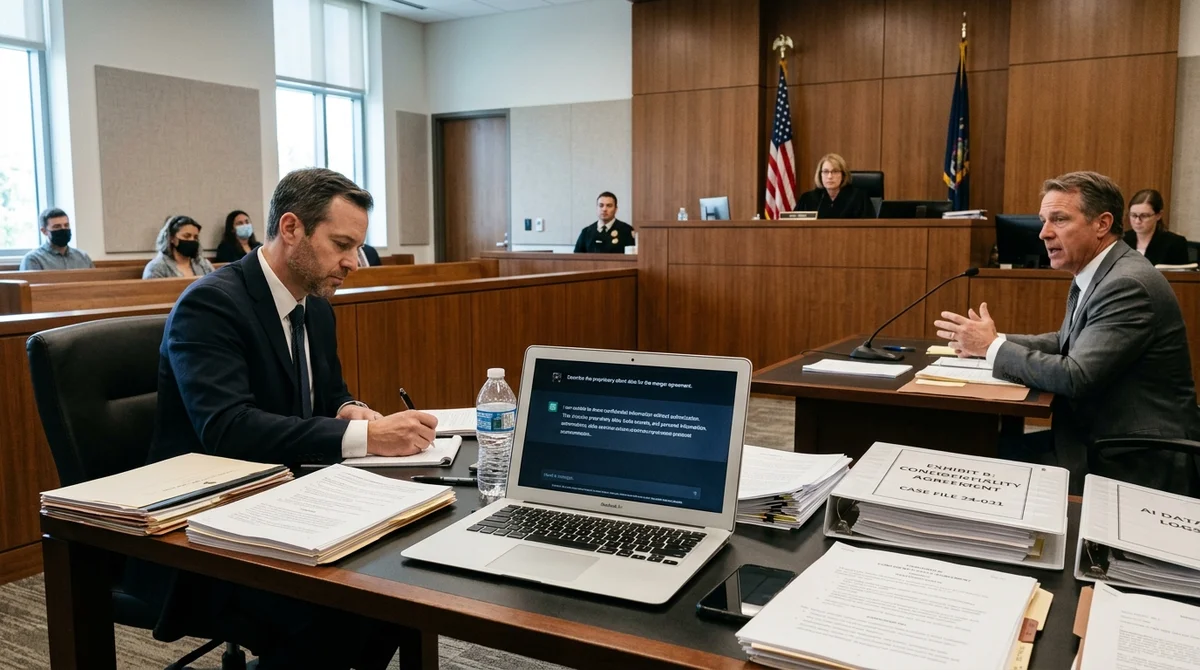
A US court has effectively drawn a hard line between consulting a lawyer and talking to a chatbot: if a person discusses their legal risks with Claude, those conversations do not, on their own, receive attorney-client privilege. For users of generative AI, this is one of the most important legal signals in recent times: a convenient service is not a confidential adviser.
The decision was issued in February 2026 by Judge Jed Rakoff in the case of Bradley Heppner, who is accused of fraud. The court concluded that his dialogues with Anthropic's Claude about possible legal liability are covered by neither attorney-client privilege nor work product protection. In essence, the court treated these chats not as professional interaction with defense counsel but as communication with an external digital tool that has no status as a lawyer.
The first part of the court's position is straightforward: attorney-client privilege arises where a client communicates with a licensed lawyer in order to obtain legal help. Claude, like any other public AI service, is not such a lawyer.
The second part is no less important: the court declined to treat such materials as defense work product. Work-product protection normally covers preparation for litigation, strategies and analytical materials created for a case. But in the court's view, feeding such reasoning into a public AI system destroys the expectation of confidentiality.
The court also did not assess the quality of the model's answers, only the status of the communication channel. Even if a bot helps formulate arguments, assemble questions for a lawyer or outline possible consequences, that does not make the service a participant in protected legal communication. In other words, the problem is not that the AI makes mistakes or gives overly generic advice, but that the user discloses sensitive information to a third party that is under no professional duty to keep a client's secrets.
The key argument in the ruling is that a publicly available AI platform has no duty of confidentiality of the kind a lawyer or law firm has. That is what makes this story bigger than a single case. Many users are already used to discussing sensitive topics with models: disputes with an employer, tax questions, contract terms, business risks. The court effectively reminded them that if data goes to a service not bound by professional secrecy, they cannot count on the same level of protection.
The practical effect may be felt well beyond criminal cases. For companies, the ruling shows that internal legal strategies uploaded to an external chatbot without special contractual and technical safeguards can become a potential weak point in a dispute. For individuals, it sets a new discipline: AI can be used to structure questions, translate legalese into plain language or prepare a list of topics for a meeting with a lawyer, but not as a safe replacement for the lawyer. It is especially risky to send such services confessions, the facts of a dispute, drafts of a position and details that may have procedural significance.
For AI companies, this is also an unpleasant but useful precedent. It boosts demand for enterprise modes, private deployments, stricter contract terms and clear limits on data use. The more models move into legal, financial and HR processes, the more often businesses will ask not only about answer quality but about which rights remain after sensitive information is uploaded to a system.
The fact that this ruling is described as the first of its kind in the US makes it a reference point for future proceedings, even if the final rules for handling AI chats will still be refined in other courts. As generative models move deeper into workflows, the legal system is starting to answer a question that long sat in a gray area: is a conversation with an AI a user's private thinking, or is it already disclosure of information to a third party? In this case, the court chose the second option.
The main takeaway is simple: a chatbot can help you think, but it cannot provide the same legal protection as a live lawyer. For the AI market this is not a ban but a firm reminder of the product's limits. For users, it is a rule of hygiene: anything involving litigation risks, confessions and defense strategy is better discussed with a lawyer than with a public model.
- Nov 2, 2026Faros: median code review time up 441% in teams using AI agents
- Nov 2, 2026The "no gold documents" label lost accuracy, from 0.68 to 0.10, on strong retrievers
- Nov 2, 2026Karpathy builds a YouTube clone with 6454 videos from Hacker News recommendations in two hours
- Nov 2, 2026Karpathy used Claude to build HackerTube from 6,454 videos recommended on Hacker News
Test Frontier LLMs & Autonomous Agents in One Workspace
Run Claude Opus 5.5, GPT-6, Gemini 3.1, and DeepSeek side-by-side in Nomad AI (nomadnet.ai) — unified model routing, deep research, and multimodal workflows under one subscription.
The AI world, distilled — once a week
Seven stories that actually mattered, hand-picked. No noise, no reposts, no press releases.
Done! Check your inbox for a confirmation.