Amazon and Microsoft are turning Aragon into an AI hub, but locals are taking the authorities to court
Aragon, in northeastern Spain, is rapidly becoming one of Europe's main AI hubs. Amazon, Microsoft and other companies have already announced more than €80 billion in investments there. The authorities see jobs and cheap green energy. Residents see something else: the risk of forced land purchases, pressure on water supplies, and tax breaks that do little for the towns themselves.
AI-processed from Bloomberg Tech; edited by Hamidun News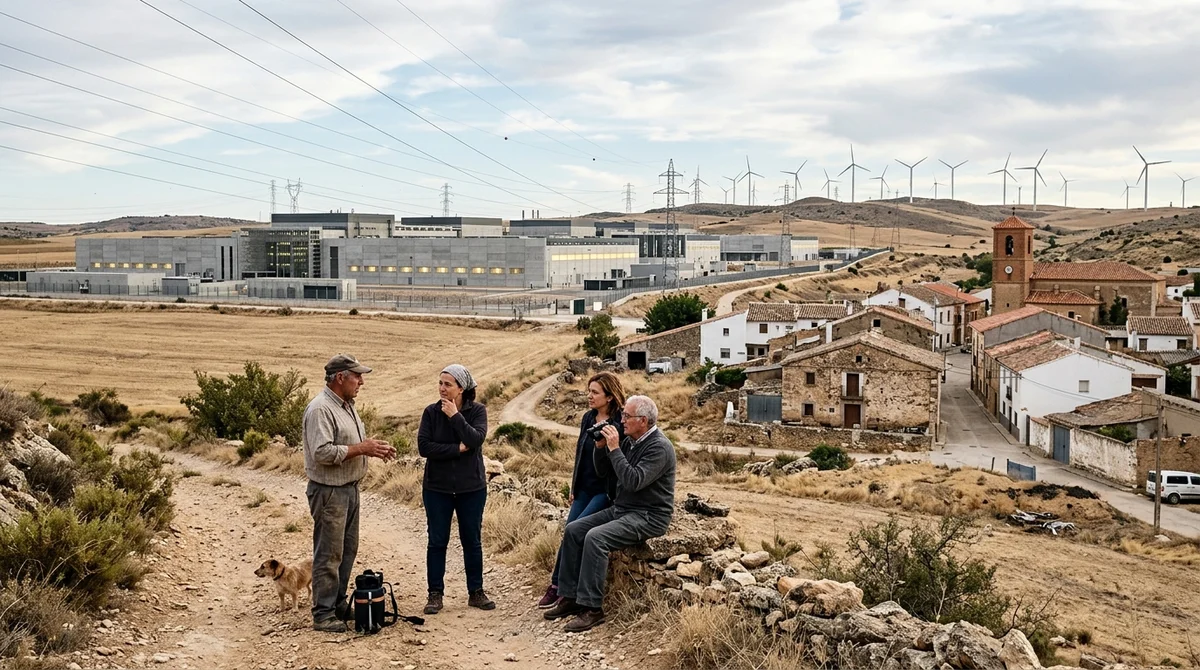
Aragon, a region in northeastern Spain, has become one of the most prominent sites in Europe's race to build AI infrastructure. Tech giants pitch it as proof that Europe can build data centers for cloud services and artificial intelligence quickly. Local residents tell a different story.
Along with billions in investment came disputes over land, water and taxes, and over who actually benefits from the boom. By current estimates, Amazon, Microsoft and other companies have already announced more than €80 billion, or roughly $90 billion, in investments in Aragon. Several factors make the region a good fit for this kind of buildout: large stretches of undeveloped land, relatively low electricity prices, a high share of renewables, and cheaper labor than in many Western European countries.
For Brussels and the big cloud providers, that is an almost ideal combination. The EU plans to at least triple its data center capacity over the next five to seven years, and Aragon's experience is already being promoted as a possible model for other countries. The key tool is PIGA, a mechanism adopted in 2015.
It lets regional authorities speed up approvals, cut red tape and grant projects "general interest" status. In practice, that means more than fast permits. It also brings serious side effects: dedicated tax breaks for developers, the ability to bypass local zoning restrictions and, if no deal can be reached with landowners, the forced purchase of their plots.
That is why several municipalities, including Villamayor de Gállego and Villanueva de Gállego, have gone to court, challenging the regional government's decisions and the construction's impact on land, water and local budgets. AWS is currently the largest player in the region. The company launched its first three data centers in Aragon back in 2022, and in March 2026 it announced it would raise its investment to €33.
7 billion by 2035. Amazon talks about tens of thousands of jobs, including through contractors and related businesses, while regional officials hope to turn Aragon into "Europe's Virginia," the continent's main data center cluster. On the ground, though, the picture is far less tidy.
AWS's first three facilities created roughly 700–950 jobs, and more than three quarters of them are tied to construction rather than ongoing operations. Meanwhile, residents argue over who sold their land, who tried to hold out to the end, and why land went for €2 per square meter in some places but reached €23 and more in others. Resources are another front in the conflict.
AI data centers need more power and cooling than traditional computing infrastructure. In Spain's dry regions, that immediately raises the question of water, especially when residents already face power outages or restrictions during the hot months. Amazon insists that it uses renewable energy, invests in water projects and makes its cooling as efficient as possible.
But some residents don't believe the real burden will be that small, particularly since government documents included requests to raise permitted water consumption because of rising temperatures. Against this backdrop, another question is getting louder: if municipalities lose part of their tax revenue to these breaks, and the main benefits go to large companies and contractors, why should local communities be the ones to absorb the environmental and social costs? The main lesson from Aragon is that the AI race now runs up against more than chips and models.
It also depends on far more down-to-earth things: land, grids, water, permits and public trust. For Big Tech, Aragon may well look like a model case of fast-tracked construction. But when such projects start dividing small towns, triggering lawsuits and leaving doubts about whether the benefits are shared fairly, the case is no longer only about the success of the AI economy.
It is also about the price that specific places pay for it.
- Nov 1, 2026Google's StreamVibe video agent beats other models by 10.7% on response timing and quality
- Oct 30, 2026Mistral opens Large 4 weights: strong at code, but Chinese models score 32 to its 26
- Oct 30, 2026128 AI Agents With No Boss Passed 49% More Tests Than One
- Oct 29, 2026Stanford AI tool verifies part of Signal's code in half a day for under $500, versus five months of expert work
Test Frontier LLMs & Autonomous Agents in One Workspace
Run Claude Opus 5.5, GPT-6, Gemini 3.1, and DeepSeek side-by-side in Nomad AI (nomadnet.ai) — unified model routing, deep research, and multimodal workflows under one subscription.
The AI world, distilled — once a week
Seven stories that actually mattered, hand-picked. No noise, no reposts, no press releases.
Done! Check your inbox for a confirmation.