Not for Any Price: Electricians Are Turning Down Big Tech Data Center Work
Big Tech is pouring trillions into data center construction, but not every worker is willing to build them. American electricians are caught in the middle: on one side, record pay rates and years of guaranteed work; on the other, pressure from neighbors worn down by noise, strained power grids and water shortages. Some workers are starting to be selective about which jobs they take.
AI-processed from Wired; edited by Hamidun News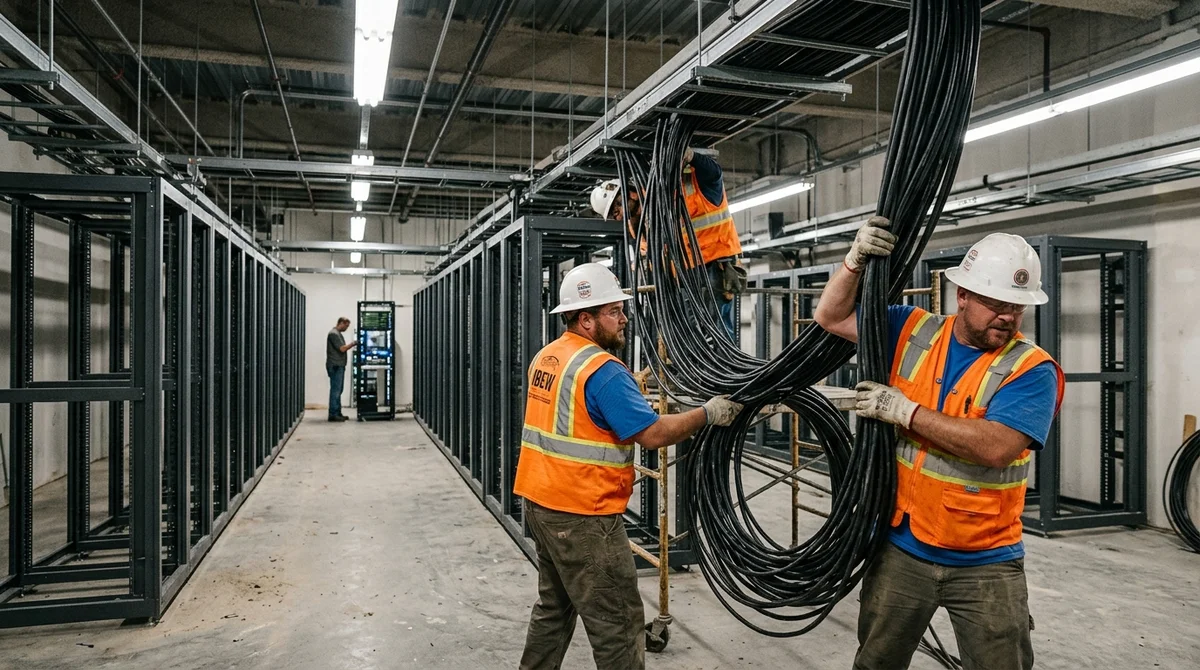
The rapid growth in the number of data centers has given American electricians years of steady, well-paid work. Now some of them are asking an uncomfortable question: is it worth it?
The boom everyone was waiting for
Amazon, Microsoft, Google and Meta are investing hundreds of billions of dollars in new data centers. Demand is fueled by the explosive growth of AI workloads: ChatGPT, Gemini and Copilot need ever more computing power, which means more server halls, cooling systems and miles of cable.
For electricians, that has meant a steady backlog of jobs and pay rates they could once only dream of. Union crews from dozens of states have converged on the growth hotspots: Northern Virginia, Texas, Iowa and Georgia. There was work for years ahead, and nobody asked many questions.
Protests that won't die down
But as data centers multiplied, so did the resistance. Residents in several states have begun organizing against new facilities, and their complaints are specific:
- A large campus consumes two to five million liters of water a day just to cool its servers
- New facilities strain local power grids more than entire residential neighborhoods
- The round-the-clock hum of equipment keeps nearby residents awake
- Tax breaks for corporations cut local government revenue
- Despite the scale of construction, permanent jobs for locals are minimal
In Virginia, long considered the data center capital of the US, activists have won moratoriums on new facilities in several counties. In Iowa, environmental groups are suing companies over damage to water resources. In Texas, politicians are demanding a review of energy subsidies.
The worker at the center of the controversy
This is where electricians found themselves in an awkward position. Their names don't appear in headlines, and they don't sit on Big Tech boards, but they are the ones running the cables and connecting the server racks. And they are the ones their neighbors, union colleagues and relatives talk to.
"I build these facilities, and then my neighbors ask me why we have
water problems."
Some workers have begun choosing contracts selectively: favoring companies with public environmental commitments, or turning down sites in areas with active opposition. Others keep working, separating their personal views from their professional ones. The unions have not yet settled on a common line, because the economic incentives are too strong.
What this means
The AI infrastructure boom has for the first time run into serious opposition from within, not only from environmentalists or local activists but from the builders themselves. When the people who literally lay the foundation of AI start asking uncomfortable questions about the price of that growth, the nature of the conversation changes.
Big Tech has been used to treating workers as just a resource. That calculation seems to be starting to fail.
Meta has been designated an extremist organization and is banned in Russia.
- Nov 1, 2026Local models lose to Opus and Codex: 0.21 on a MacBook versus 1.00 for Codex
- Nov 1, 2026Kimi scores 96.2% on a 1C database analytics test and emerges as a fallback if Claude access is blocked
- Nov 1, 2026OpenAI Rewrites GPT Behavior Rules: Five Values and a Chain of Command
- Nov 1, 2026Google admits AI Mode cuts search revenue, shares fall 15%
Key Questions Answered
What are the key details on The boom everyone was waiting for?
Amazon, Microsoft, Google and Meta are investing hundreds of billions of dollars in new data centers. Demand is fueled by the explosive growth of AI workloads: ChatGPT, Gemini and Copilot need ever more computing power, which means more server halls, cooling systems and miles of cable. For electricians, that has meant a steady backlog of jobs and pay rates they could once only dream of. Union crews from dozens of states have converged on the growth hotspots: Northern Virginia, Texas, Iowa and Georgia. There was work for years ahead, and nobody asked many questions.
What are the key details on Protests that won't die down?
But as data centers multiplied, so did the resistance. Residents in several states have begun organizing against new facilities, and their complaints are specific: A large campus consumes two to five million liters of water a day just to cool its servers New facilities strain local power grids more than entire residential neighborhoods The round-the-clock hum of equipment keeps nearby residents awake Tax breaks for corporations cut local government revenue Despite the scale of construction, permanent jobs for locals are minimal In Virginia, long considered the data center c
What are the key details on The worker at the center of the controversy?
This is where electricians found themselves in an awkward position. Their names don't appear in headlines, and they don't sit on Big Tech boards, but they are the ones running the cables and connecting the server racks. And they are the ones their neighbors, union colleagues and relatives talk to. "I build these facilities, and then my neighbors ask me why we have water problems." Some workers have begun choosing contracts selectively: favoring companies with public environmental commitments, or turning down sites in areas with active opposition. Others keep working, separa
Test Frontier LLMs & Autonomous Agents in One Workspace
Run Claude Opus 5.5, GPT-6, Gemini 3.1, and DeepSeek side-by-side in Nomad AI (nomadnet.ai) — unified model routing, deep research, and multimodal workflows under one subscription.
The AI world, distilled — once a week
Seven stories that actually mattered, hand-picked. No noise, no reposts, no press releases.
Done! Check your inbox for a confirmation.