Midjourney in 2026: Why a Strong Visual Style Doesn't Make It a Universal Tool
In 2026, Midjourney no longer looks like the undisputed leader among image generators, but it keeps a real strength: an expressive visual style and a sense of authorial control. The catch is that the model performs poorly on lazy prompts. Treat it as a "make it pretty" button, and the gap with simpler services disappears almost immediately.
AI-processed from Habr AI; edited by Hamidun News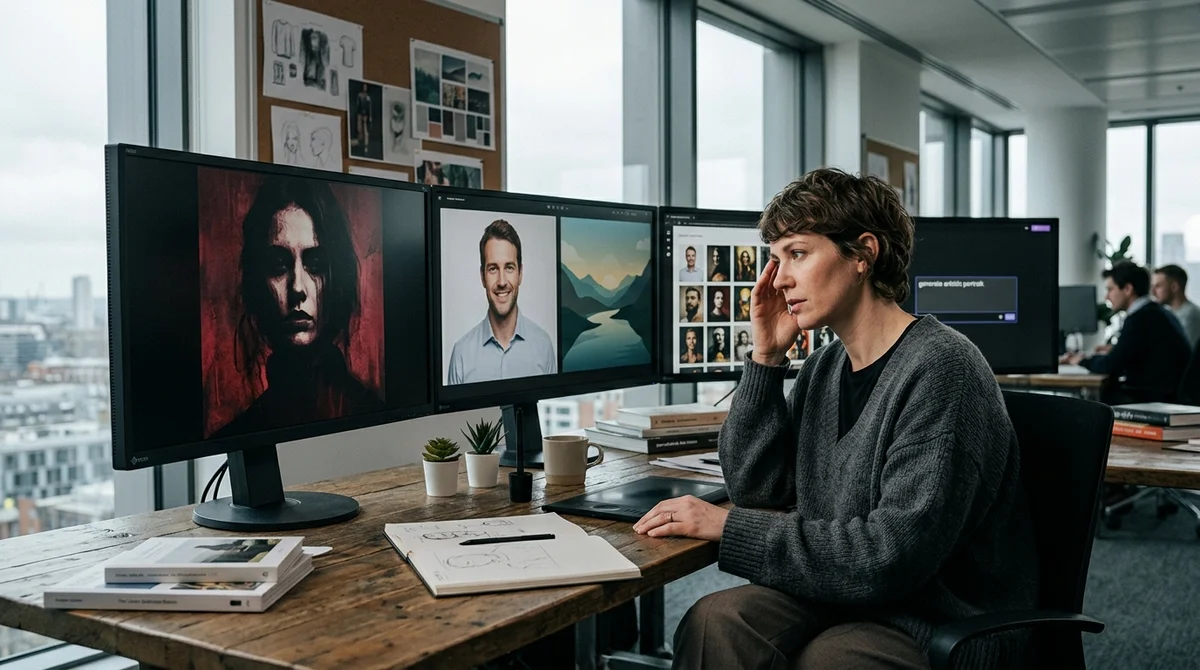
Midjourney remains a strong tool in 2026 not because it consistently beats every other image generator head to head, but because it offers a distinctive visual signature to those willing to learn its logic. It is not a "make it pretty" button. It is an environment where the result depends on visual literacy, precise requests and the ability to steer style. Approach Midjourney as a universal vending machine for pictures and you can quickly end up disappointed. Use it as a tool for visual direction and the impression is very different.
The main difficulty in assessing Midjourney is that its strengths are hard to measure with familiar metrics. When it comes to speed, price, prompt adherence or the quality of text in the frame, competitors can be compared fairly directly. But once the conversation turns to taste, atmosphere, stylistic coherence and the "feel of an image," objectivity ends. To one user, Midjourney's output looks more expensive and polished; to another, merely more mannered. So the debate over whether it is better or worse than the others often comes down not to technology but to expectations of creative work and personal preference.
For this reason, many people start out with Midjourney the wrong way. The user takes a template prompt like beautiful girl portrait 8k cinematic, which gives an acceptable result in more straightforward models, and expects the same recipe to work here. Formally, the image does come out pretty, but it is a very shallow win. In this mode Midjourney is like a professional camera left on standard auto mode: expensive gear, high potential, a nice-looking frame, but most of its capabilities go unused. If the picture is no better than what a simpler service produces, the obvious question follows: why use this tool at all?
Midjourney is at its strongest where the goal is not a single lucky render but sustained artistic work. It is still good at holding the mood of a series, building an expressive composition and making a frame feel more "editorial" rather than merely technically neat. That helps with covers, visual concepts, fashion aesthetics, moodboard-style work, stylized scenes and situations where literal realism matters less than a controlled impression. But this effect costs time: you have to pick wording, test variations, shift emphasis, and refine angle, lighting, texture and scene density. Midjourney forgives a lazy prompt less readily and less often delivers its best result on the first try.
This leads to a slightly sad conclusion. Over the past few years the image generation market has become far more democratic: many models have learned to produce a very decent result quickly, without lengthy tuning, complex terminology or deep immersion in the process. The barrier to entry has dropped, and baseline quality is now high enough almost everywhere for most practical tasks. Against this backdrop, Midjourney no longer looks like the unconditional leader "for everyone." Its advantage has become narrower and less obvious in mass use. It has not disappeared, but it is no longer taken for granted: it is now more a tool for people who want character in an image, not just the image itself.
Hence the practical takeaway for users. Midjourney should not be tested on one random prompt or by the principle of "who draws a pretty girl faster." It makes sense to evaluate it on your own scenarios: brand visuals, illustration series, concepts, covers, art direction, complex mood in a frame.
If the task is to quickly make a clear picture for a post, a product card or an internal presentation, simpler generators will often be the more rational choice. But if you need a tool that lets you build a recognizable aesthetic and feel like the director of an image rather than just the client who ordered it, Midjourney in 2026 is still a very strong choice. Its value just has to be proven in practice now, not guessed from the hype.
- Oct 25, 2026Shadow AI in the Enterprise: Why 90% of Security Officers Break Their Own Bans and How a 3-Zone Traffic Light System Works
- Oct 19, 2026Black Forest Labs: A 70-Person Team Takes On Silicon Valley's Giants
- Oct 11, 2026BBC: AI Is Devaluing Images and Raising the Price of Human-Made Work
- Oct 9, 2026Midjourney Adds Thinking Mode for V8.2 and Shared Folders in Alpha
Test Frontier LLMs & Autonomous Agents in One Workspace
Run Claude Opus 5.5, GPT-6, Gemini 3.1, and DeepSeek side-by-side in Nomad AI (nomadnet.ai) — unified model routing, deep research, and multimodal workflows under one subscription.
The AI world, distilled — once a week
Seven stories that actually mattered, hand-picked. No noise, no reposts, no press releases.
Done! Check your inbox for a confirmation.