OpenAI unveils GPT-Rosalind for drug discovery and life-sciences research
OpenAI has unveiled GPT-Rosalind, its first specialized model series for biochemistry, genomics and protein engineering. It is built for drug discovery and life-sciences research, and access is currently limited to a trusted-access program for vetted companies such as Amgen, Moderna and Thermo Fisher Scientific. The launch is an important step toward vertical AI products for science, where accuracy, validation and the handling of sensitive data are critical.
AI-processed from TNW; edited by Hamidun News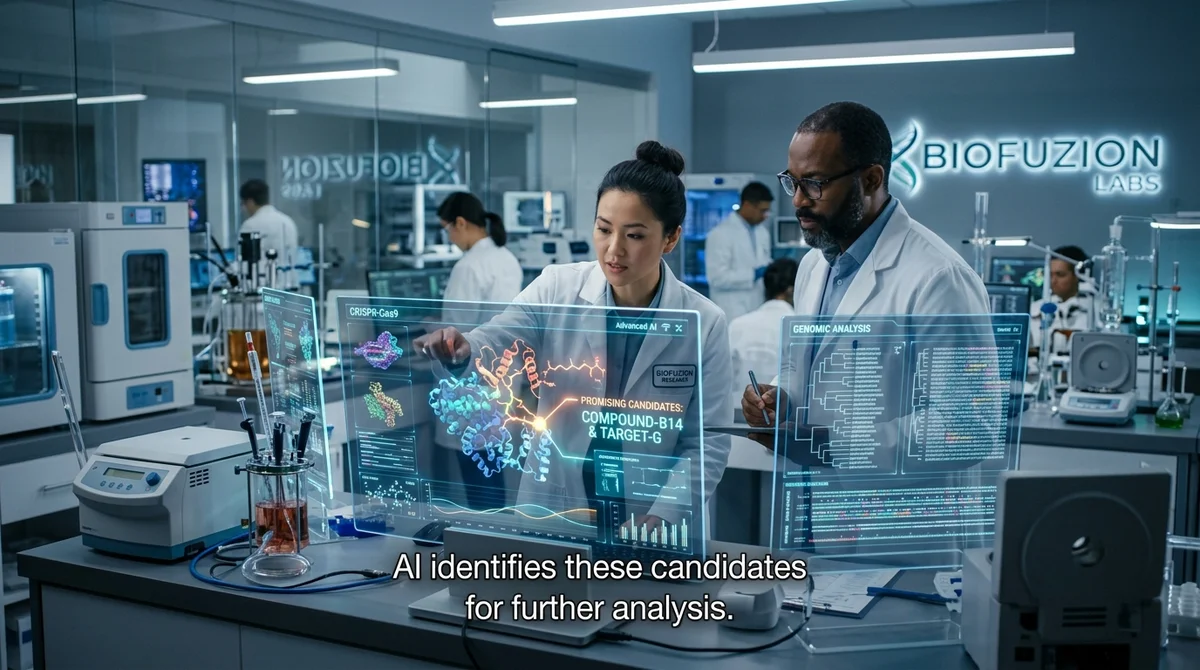
For the first time, OpenAI is releasing a dedicated AI line not as a general-purpose assistant but as a tool for a specific scientific field. The launch of GPT-Rosalind suggests the next phase of AI competition is shifting from general models to systems tuned for expensive, complex professional workflows. Here, that means biomedicine, drug development and life-sciences research, where mistakes are costly and even a small speedup can be worth months of work, millions of dollars and vast preclinical development budgets.
OpenAI describes GPT-Rosalind as the company's first specialized model series. It is tuned for biochemistry, genomics and protein engineering, three areas where researchers deal with huge datasets, intricate interdependencies and a large number of hypotheses. The name nods to the researcher whose work helped reveal the structure of DNA, which captures the product's positioning well: not just another chatbot, but a model for scientific reasoning about living systems. In effect, OpenAI is trying to show that frontier models can be useful not only for office tasks and programming but also for deeply domain-specific research.
The practical focus is on the early stages of drug discovery and the evaluation of promising candidates. In these processes, teams need to quickly cross-reference scientific publications, experimental data, molecular properties, genetic dependencies and likely directions for further testing. A specialized model can cut the time spent on preliminary analysis, help teams discard weak hypotheses faster and frame strong ones better. Even if it does not make final scientific decisions, the savings start at the stage of navigating a huge volume of information, where a human team typically spends many weeks comparing options and preparing the next round of experiments.
OpenAI is not opening GPT-Rosalind to mass use. Access is restricted to a trusted-access program that includes only vetted enterprise customers. The first named clients are Amgen, Moderna and Thermo Fisher Scientific. The format looks logical: in biopharma and adjacent fields, the data itself, the possible consequences of errors and the validation of results are all sensitive. A limited launch lets OpenAI collect feedback in a controlled environment, test the model's real usefulness on applied cases and reduce the reputational and operational risks that an immediate public release would heighten.
It is also a strategic shift for OpenAI. Until now the company has been associated mainly with general-purpose models that customers then adapt to different industries themselves. GPT-Rosalind takes a different approach: the base model is prepared for the subject area from the start, where good answers are not enough and the model must handle specialized language, scientific entities and research workflows. If this format delivers results, it is reasonable to expect other vertical series for law, finance, materials science, industrial research and other segments where general-purpose AI often falls short on domain accuracy.
The main takeaway is simple: the AI market is moving steadily toward specialization. The launch of GPT-Rosalind matters not only as a new OpenAI product but also as a signal to the whole industry. Large models are becoming not just a text interface but part of the research loop in fields where decisions rest on complex data and costly experiments. If OpenAI can prove the practical value of this approach with pharma and scientific-infrastructure customers, industry-specific AI models will quickly face a new standard of expectations across the sector, in quality, accountability and real benefit to science.
- Nov 1, 2026Local models lose to Opus and Codex: 0.21 on a MacBook versus 1.00 for Codex
- Nov 1, 2026Kimi scores 96.2% on a 1C database analytics test and emerges as a fallback if Claude access is blocked
- Nov 1, 2026OpenAI Rewrites GPT Behavior Rules: Five Values and a Chain of Command
- Nov 1, 2026Google admits AI Mode cuts search revenue, shares fall 15%
Test Frontier LLMs & Autonomous Agents in One Workspace
Run Claude Opus 5.5, GPT-6, Gemini 3.1, and DeepSeek side-by-side in Nomad AI (nomadnet.ai) — unified model routing, deep research, and multimodal workflows under one subscription.
The AI world, distilled — once a week
Seven stories that actually mattered, hand-picked. No noise, no reposts, no press releases.
Done! Check your inbox for a confirmation.