Three OpenAI executives leave as Sora shuts down and side projects wind down
OpenAI is pushing ahead with a hard restructuring. On April 17, 2026, Kevin Weil, Sora head Bill Peebles and enterprise applications CTO Srinivas Narayanan all left the company at once. Soon after, OpenAI shut down the consumer version of Sora, began breaking up OpenAI for Science and sharpened its focus on ChatGPT, the API and enterprise revenue. For the market, it signals that the era of expensive side experiments inside the company is ending.
AI-processed from TNW; edited by Hamidun News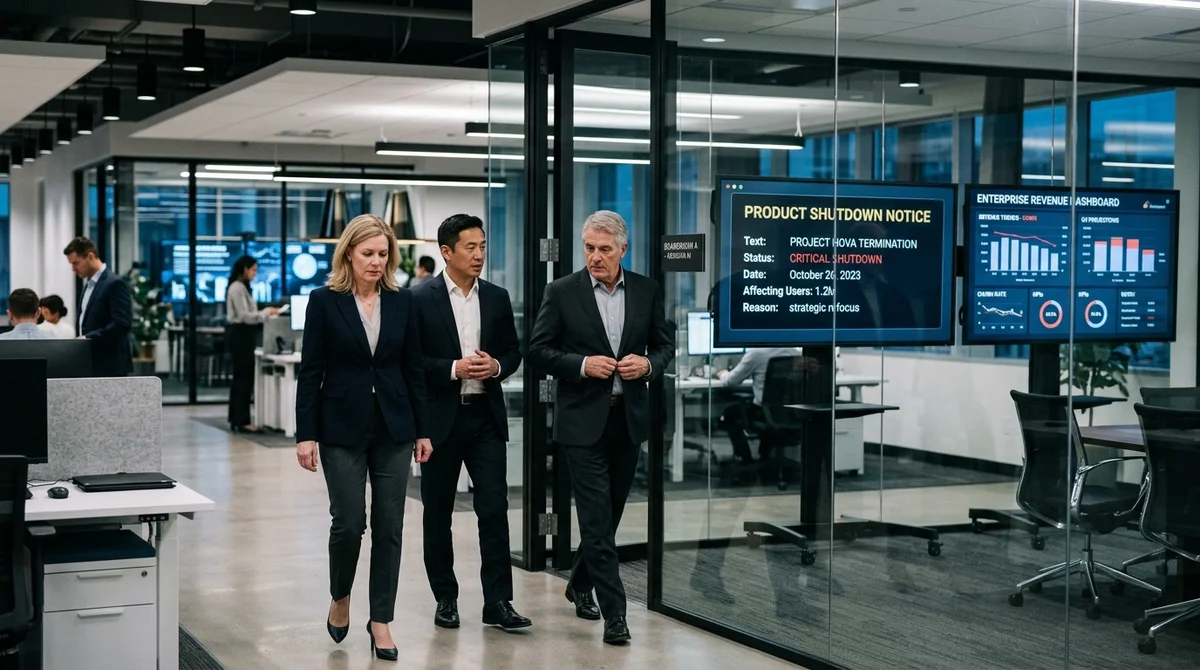
OpenAI is entering another phase of hard restructuring. On April 17, 2026, three prominent executives left the company at the same time, and shortly afterward it permanently shut down the consumer version of Sora and began dismantling research initiatives outside its main revenue line. For the market, this is more than a string of personnel news. It suggests that the maker of ChatGPT is turning faster from a lab of ambitious experiments into a company that subordinates almost every decision to one goal: growing enterprise revenue.
The departures were announced together: former chief product officer Kevin Weil, Sora head Bill Peebles and enterprise applications CTO Srinivas Narayanan. Weil joined OpenAI about two years ago from Instagram, where he ran product, and later led OpenAI for Science, a unit that applied AI to science and biomedicine. The day before the announcement of his departure, the unit released GPT-Rosalind, a model for life-sciences research and drug development. OpenAI for Science no longer exists as a standalone structure: its team is being distributed across other research groups.
Peebles was one of the key people who built Sora from scratch. Over three years, Narayanan helped bring ChatGPT and the API to market and scaled the applied-products engineering team from roughly 40 people to a large, business-critical division.
These departures are hard to separate from the company's broader turn. Inside OpenAI, some non-core initiatives are already called side quests: attractive but expensive offshoots of the main business. The most visible example is Sora. Its web and mobile versions were shut down on April 26, 2026, and the API is scheduled to close on September 24, 2026. At its peak the product reached roughly 1 million users, then fell below 500,000 and cost the company about $1 million a day. Intellectual-property complaints from the Motion Picture Association added pressure. Against that backdrop, the Sora shutdown looks less like a rejection of generative video itself and more like an admission that OpenAI could not make the product's economics sustainable.
At the same time, the company is winding down more research-oriented side tracks. Formally, OpenAI for Science is not being closed but decentralized, meaning spread across other teams. In practice, that ends the standalone initiative Weil was hired to run. The logic is clear: OpenAI is concentrating on ChatGPT and the API, the products that can already monetize at scale in the enterprise segment. The higher the cost of compute and the stronger the pressure from competitors, the less room such a company has for long experiments with no direct link to revenue.
Against this backdrop, the triple departure looks less like a coincidence than a continuation of a two-year exodus. Of OpenAI's 11 co-founders, only Sam Altman and Greg Brockman remain. Over the past two years, Ilya Sutskever, Mira Murati, Bob McGrew, John Schulman, Barret Zoph and other leaders who defined OpenAI's early identity have left. In 2025 alone, at least 12 senior executives departed. Some went to Anthropic, some to Google DeepMind and Meta Superintelligence Labs, and some to new startups. The reasons given varied: from ethical questions around the contract with the US Department of Defense to a sense that the work was shifting from big research bets to operational polishing of ChatGPT for Microsoft and enterprise customers.
The business context makes the choice understandable, but no less risky. OpenAI's monthly revenue has reached roughly $2 billion, its annual run rate has passed $25 billion, and in April 2026 the company closed a $122 billion funding round at an $852 billion valuation. ChatGPT has more than 900 million weekly active users, and the enterprise business already generates over 40% of revenue and may match the consumer business by the end of 2026.
But OpenAI also expects a loss of about $14 billion on $25 billion of revenue in 2026, and its total spending through 2029 is estimated at $115 billion. Meanwhile, Anthropic, Google and Meta are raising the pressure: Anthropic already has comparable revenue, Google is embedding Gemini in the enterprise stack, and Meta is actively poaching former OpenAI researchers.
The main takeaway is simple: OpenAI is not falling apart, but it is quickly changing its nature. The company that symbolized the generative AI era as a research vanguard is increasingly becoming a machine for converting market leadership into predictable enterprise revenue. The Sora shutdown, the dismantling of OpenAI for Science and the exit of the people who built those units show that discipline around money-making products now matters more inside the company than breadth of ambition. For customers, this may mean more stable, practical services. For the industry, it means fewer attractive side experiments and a tougher fight for the enterprise market.
*Meta has been designated an extremist organization and is banned in Russia.
- Nov 1, 2026Local models lose to Opus and Codex: 0.21 on a MacBook versus 1.00 for Codex
- Nov 1, 2026Kimi scores 96.2% on a 1C database analytics test and emerges as a fallback if Claude access is blocked
- Nov 1, 2026OpenAI Rewrites GPT Behavior Rules: Five Values and a Chain of Command
- Nov 1, 2026Google admits AI Mode cuts search revenue, shares fall 15%
Test Frontier LLMs & Autonomous Agents in One Workspace
Run Claude Opus 5.5, GPT-6, Gemini 3.1, and DeepSeek side-by-side in Nomad AI (nomadnet.ai) — unified model routing, deep research, and multimodal workflows under one subscription.
The AI world, distilled — once a week
Seven stories that actually mattered, hand-picked. No noise, no reposts, no press releases.
Done! Check your inbox for a confirmation.