Canva builds its design engine into Claude through a partnership with Anthropic
Canva and Anthropic have unveiled Claude Design, a new tool that generates editable, on-brand layouts straight from a text prompt. Claude Opus 4.7 does the reasoning, while Canva Design Engine supplies the visual layer. The launch coincides with the release of Canva AI 2.0, where the company is betting on a conversational interface and an agentic approach to creating designs.
AI-processed from TNW; edited by Hamidun News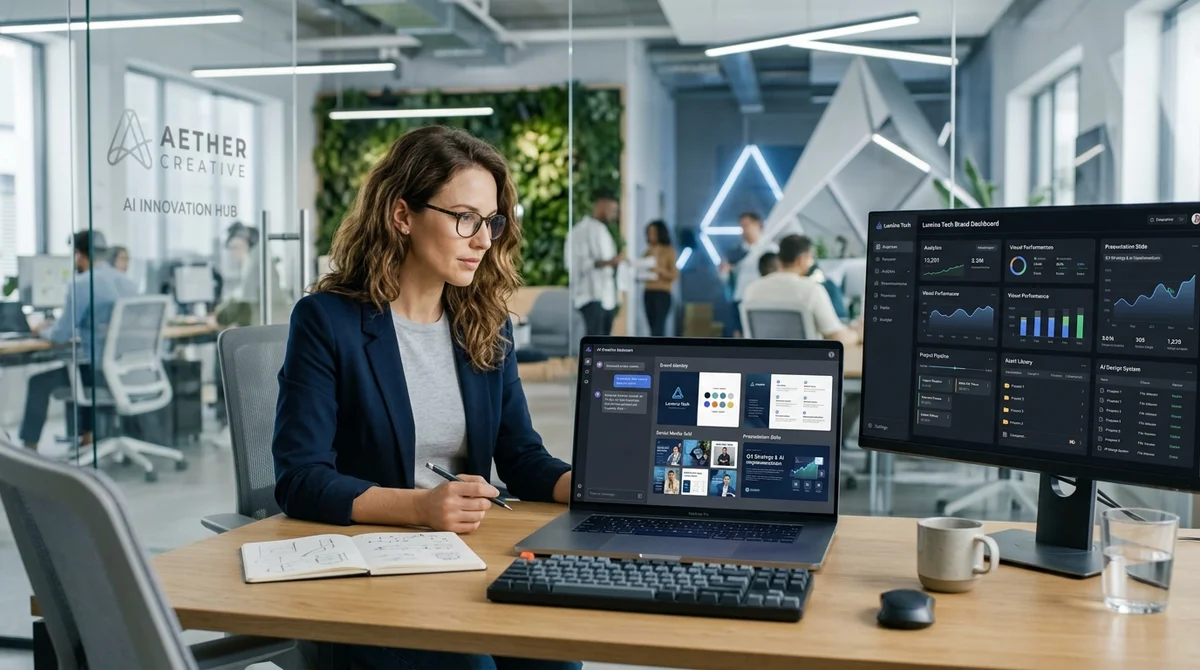
Canva and Anthropic are betting on a tighter merger of generative AI and everyday visual work. The companies have introduced Claude Design, a new Anthropic Labs product that creates ready-to-use, on-brand layouts from a text description right inside Claude. The key idea: the user talks to the AI in plain language and gets back not a static image but a fully editable design that can be adjusted for a specific task.
Technically, Claude Design runs on the Claude Opus 4.7 model and uses Canva Design Engine as its visual layer. Claude handles understanding the intent, the structure of the request and the logic of assembling the result, while Canva provides the design system itself, the layout and the editable elements.
For users, the pairing looks like a move from plain image generation to a more practical workflow. You can ask for a presentation slide, a social media post, a banner or another branded visual, and then change the text, colors, sizes, composition and individual blocks without rebuilding from scratch. This matters especially for teams that need to turn out dozens of variants for different channels quickly, without losing control or a consistent visual style.
For Canva, this is an important step beyond its own editor. The company has long been moving toward a model in which design starts not with a blank canvas but with a natural-language request. Alongside the partnership, it announced Canva AI 2.0, which the company itself calls the biggest product launch in its history. The package includes conversational design, agentic orchestration and deeper automation of creative tasks.
In other words, Canva wants users not to pick a tool by hand at every step but to describe the whole task: what needs to be done, in what style, for which audience and on which medium. That shifts the product from a set of templates and manual actions toward a creative operating system, where the AI proposes the structure, breaks the task into stages and assembles a first working result.
The launch looks strategic for Anthropic too. Claude has long been used for more than text and code, including as a working interface for business tasks. Adding a full visual layer brings it closer to a universal assistant that can not only write a campaign plan or ad copy but immediately turn it into a finished, formatted asset.
The focus on on-brand content is especially important here: companies need not just a good-looking result but layouts that match the brand style, the tone of communication and the requirements of a specific team. If Claude Design really does simplify producing such materials, that raises its value for marketing, sales and internal communications.
It also matters that the product ships under the Anthropic Labs banner. That hints at a fast experimentation cycle and at the company's willingness to test new applied formats on top of the base model.
For the market, it is one more signal that competition is no longer only about model quality but also about the interface in which that model becomes useful. Image generation by itself is quickly becoming a baseline feature. The next level is when the AI understands the task in the context of a workflow and delivers a result you don't have to throw away after the first draft. Editability, brand control and the ability to quickly scale one idea across different formats are becoming more important than a merely striking visual.
In that sense, the Canva–Anthropic partnership can be seen as an attempt to claim the role of the "design layer" inside an AI assistant.
The takeaway for users and teams is simple: generation tools are gradually ceasing to be separate services for experimentation and turning into working infrastructure for content creation. If the Claude and Canva combination proves convenient in real-world use, the market will get one more strong argument for interfaces where a text prompt becomes the entry point not only to searching for information but also to producing finished visual materials.
- Nov 1, 2026Local models lose to Opus and Codex: 0.21 on a MacBook versus 1.00 for Codex
- Nov 1, 2026Kimi scores 96.2% on a 1C database analytics test and emerges as a fallback if Claude access is blocked
- Nov 1, 2026OpenAI Rewrites GPT Behavior Rules: Five Values and a Chain of Command
- Nov 1, 2026Google admits AI Mode cuts search revenue, shares fall 15%
Test Frontier LLMs & Autonomous Agents in One Workspace
Run Claude Opus 5.5, GPT-6, Gemini 3.1, and DeepSeek side-by-side in Nomad AI (nomadnet.ai) — unified model routing, deep research, and multimodal workflows under one subscription.
The AI world, distilled — once a week
Seven stories that actually mattered, hand-picked. No noise, no reposts, no press releases.
Done! Check your inbox for a confirmation.