AWS shows how to cut the cost of semantic video search with Amazon Nova on Bedrock
AWS has described how to move the semantic routing logic of a video search system from Amazon Nova Premier to the smaller Nova Micro through model distillation in Bedrock. According to the company, the approach cuts inference cost by more than 95% and latency by 50%. AWS says it keeps the quality needed to understand user queries accurately and route searches correctly.
AI-processed from AWS Machine Learning Blog; edited by Hamidun News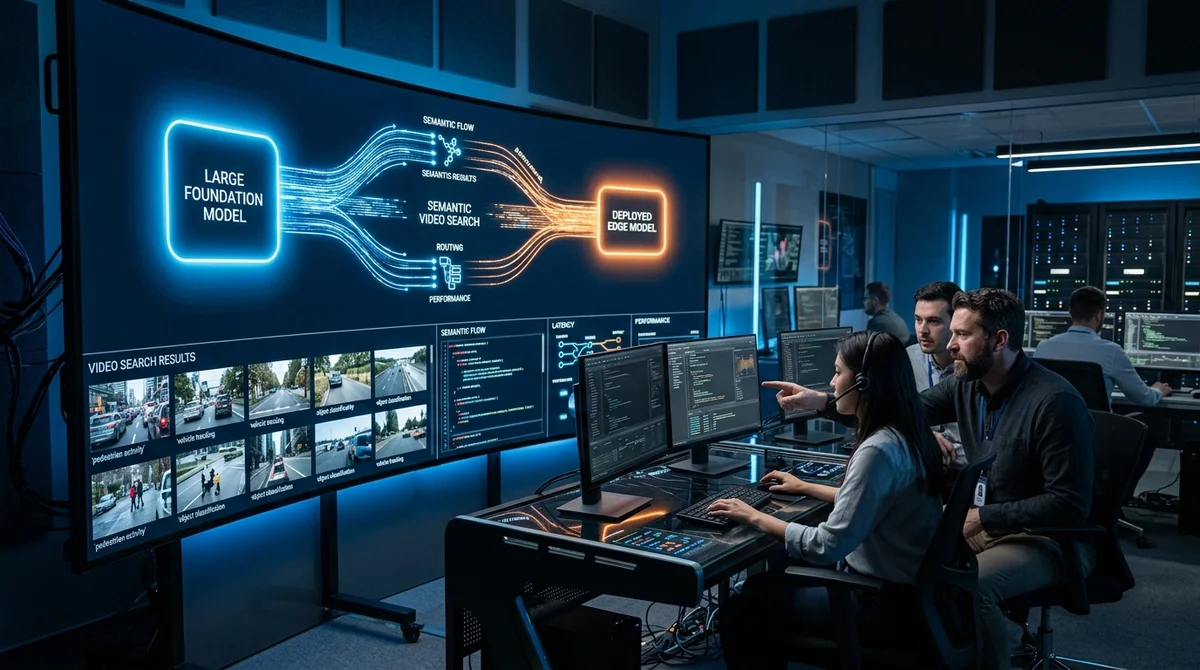
AWS has shown a practical way to make semantic video search much cheaper and faster without a noticeable loss in quality. The company suggests using model distillation in Amazon Bedrock to transfer the "routing intelligence" of the large Amazon Nova Premier into the compact Amazon Nova Micro. The result: inference cost drops by more than 95% and latency by roughly 50%.
The task looks simple only on the surface. Semantic video search has to understand not just the individual words in a query but the user's intent: whether they are looking for a specific episode, a topic, an object in the frame, an emotional moment or a clip with a particular action. Large models handle this kind of query routing better because they pick up nuance more precisely. In production, though, this quickly becomes a trade-off between quality, response time and the cost of each request, especially when a service handles a large video catalog and heavy request volume.
AWS proposes resolving this trade-off with Model Distillation in Amazon Bedrock. The scheme is standard for modern ML, but here it is shown on a fairly applied case. The teacher model, Amazon Nova Premier, first demonstrates how to interpret queries and choose the correct processing path, and these behavior patterns are then passed to the smaller Amazon Nova Micro. The idea is to preserve not a literal match of answers but the subtle decision-making logic that affects the relevance of search results.
This matters for business. In many systems the weak spot is not text generation as such but the classification and orchestration stage, where the model must quickly work out what the user wants and which pipeline to launch next. Keeping a large model permanently in the loop for this task makes costs grow too fast. Switching straight to a small model without training can degrade routing quality. Distillation lets teams take the strengths of a large model and package them into a cheaper serving setup.
The stated figures look especially significant for teams that calculate economics at scale. A more than 95% reduction in inference cost makes scenarios with frequent queries over video, media libraries, learning platforms, broadcast archives and internal corporate libraries noticeably more realistic budget-wise. At the same time, the 50% latency reduction matters for user experience: in video search, extra seconds are particularly painful, because people expect near-instant navigation through a large body of content, not a long wait before results appear.
Another important point is that AWS is promoting not just a single model but a development pattern on Bedrock. For companies, it is a signal that customizing foundation models is gradually ceasing to be an exotic practice for research teams and becoming a working tool for product engineers. Instead of choosing between "very smart or cheap," a middle path emerges: use the large model as a carrier of expertise, then transfer that expertise into compact models for a specific task. For video semantics this is especially logical, because user queries repeat the same classes of intent, so these skills transfer well.
The takeaway is simple: AWS shows how to turn expensive intelligent routing into a more mainstream and economically sustainable service. If the approach really keeps quality at a level sufficient for real production, teams get a practical recipe for AI video search: train the logic on a strong model, and serve traffic on a small, fast one.
- Oct 31, 2026Worldwide Express hands disputed invoices to AI agents and cuts unresolved disputes by 75%
- Oct 30, 2026AWS gives coding agents a live site preview straight from an isolated session
- Oct 30, 2026MoEngage Opens 400 Private APIs to AI Agents Through AgentCore Gateway, Without Building Its Own MCP Servers
- Oct 29, 2026NVIDIA Nemotron 3.5 Super VL: 120B Parameters, 12B Active, Running on AWS
Test Frontier LLMs & Autonomous Agents in One Workspace
Run Claude Opus 5.5, GPT-6, Gemini 3.1, and DeepSeek side-by-side in Nomad AI (nomadnet.ai) — unified model routing, deep research, and multimodal workflows under one subscription.
The AI world, distilled — once a week
Seven stories that actually mattered, hand-picked. No noise, no reposts, no press releases.
Done! Check your inbox for a confirmation.