Palantir, Thales and Air Space Intelligence compete for FAA AI contract for airspace management
FAA seeks to shift air traffic management from reactive to predictive mode, launching SMART—an AI system intended to identify conflicts two hours ahead instead of the current 15 minutes. Palantir, Thales and Air Space Intelligence are contending for the contract. The March incident at LaGuardia, which exposed dispatcher overload and aging systems, has added urgency to the project.
AI-processed from TNW; edited by Hamidun News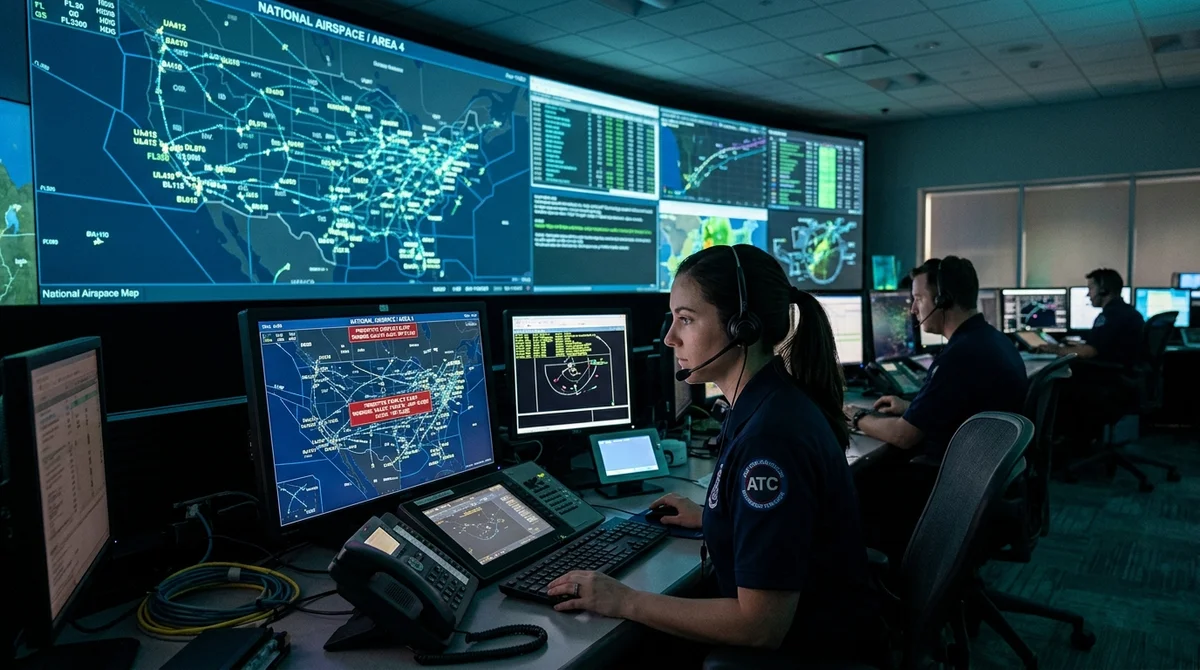
FAA launches competition for one of the most sensitive AI systems for critical US infrastructure: the SMART platform should help air traffic controllers see potential conflicts in the air not 15 minutes ahead as it does now, but straight for two hours. Three companies—Palantir, Thales, and Air Space Intelligence—are competing for the contract, and at stake is not only a new government order but also an attempt to reshape the very logic of American airspace management. SMART stands for Strategic Management of Airspace Routing Trajectories.
The idea is to shift from a reactive model, where controllers solve problems almost in real time, to a predictive one, where the system calculates bottlenecks, route conflicts, and capacity restrictions in advance before aircraft depart. The FAA plans to use high-precision 4D modeling for this—analyzing trajectory not only in space but also in time. If the project goes as planned, even in limited form, SMART could go operational as early as 2026.
Each of the three contenders has its own strong suit. Palantir comes with a powerful portfolio of government contracts and experience building platforms that can process massive volumes of operational data and turn them into decision-making interfaces. For the company, a victory in SMART would be an important entry into yet another civilian agency of national scale.
Thales is betting on industry expertise: the company has spent decades supplying aviation systems, and its equipment is already deeply embedded in American infrastructure. According to FAA data, Thales solutions are used in more than 99% of the instrument landing systems at US airports, giving it an advantage in integration. The third player, Air Space Intelligence, is noticeably smaller in size but looks like the most specialized competitor in the race.
The Boston startup develops the Flyways AI platform, which is already used by airlines and helps manage more than 40% of US air traffic through partnerships with major carriers. This is exactly what makes ASI a dangerous competitor for the giants: the company has not just an AI team but a product that already works in a live aviation environment. Recently, the startup also announced a partnership with Joby Aviation to prepare the integration of electric air taxis into national airspace.
The project's urgency surged sharply after the March 22 incident at LaGuardia Airport, where an Air Canada Express aircraft collided on the runway with a fire truck. The investigation showed that the controller was handling two functions simultaneously, and the automated runway safety system did not issue a warning because it failed to reliably track the situation when equipment converged near the runway. This episode was a painful reminder of two longstanding problems with American aviation: chronic overload of air traffic controllers and infrastructure that has long since failed to keep pace with flight volume.
Against this backdrop, SMART is part of a much broader modernization. The FAA has already received $12.5 billion from Congress for air traffic management modernization and estimates that another $20 billion will be needed to complete the program. The agency is replacing 612 outdated radar systems, moving the NOTAM system to cloud architecture, and accelerating hiring: in fiscal year 2026, approximately 1,200 new controllers have already been hired, representing roughly half the annual target. Meanwhile, Transportation Secretary Sean Duffy confirmed on April 17 both the SMART project itself and the list of three participants, with the FAA promising to reveal additional details at a separate event on April 21.
But even with political support and obvious necessity, a rapid launch is not guaranteed. The FAA has a poor track record with major technological reforms: the previous NextGen program stretched for more than a decade and cost billions above initial estimates. Moreover, any automation in the air traffic control environment inevitably runs up against not just algorithms but people's trust, training, regulatory procedures, and compatibility with already installed systems. Therefore, the promise to launch SMART as early as this year looks either like a very tight schedule or like the rollout of a pilot version rather than a full nationwide deployment.
The main point of this story is that the FAA is no longer trying to simply patch the old system with incremental updates. The agency is testing whether AI can become a new layer of decision-making in the infrastructure through which approximately 45,000 flights pass per day. If SMART truly learns to reliably see conflicts two hours ahead and suggest safer routes in advance, it will reduce the burden on controllers and give the industry operational margin. But if the project runs into a prolonged procurement, poor integration, or overestimated AI capabilities, it risks joining the long list of expensive but unfinished reforms in American aviation.
Want to stop reading about AI and start using it?
AI News is a curated feed of AI/tech news. Hamidun Academy teaches you to use AI systematically in your work.
The AI world, distilled — once a week
Seven stories that actually mattered, hand-picked. No noise, no reposts, no press releases.
Done! Check your inbox for a confirmation.