UK Government Underestimated AI Data Center Emissions by More Than 100 Times
The UK has sharply revised the climate cost of its AI infrastructure. New calculations show that AI data centers could emit up to 123 million tonnes of CO2 over ten years, more than 100 times higher than officials' earlier estimates. The episode feeds a growing debate over whether computing capacity for AI can keep expanding without being tightly tied to energy policy and decarbonization.
AI-processed from Guardian; edited by Hamidun News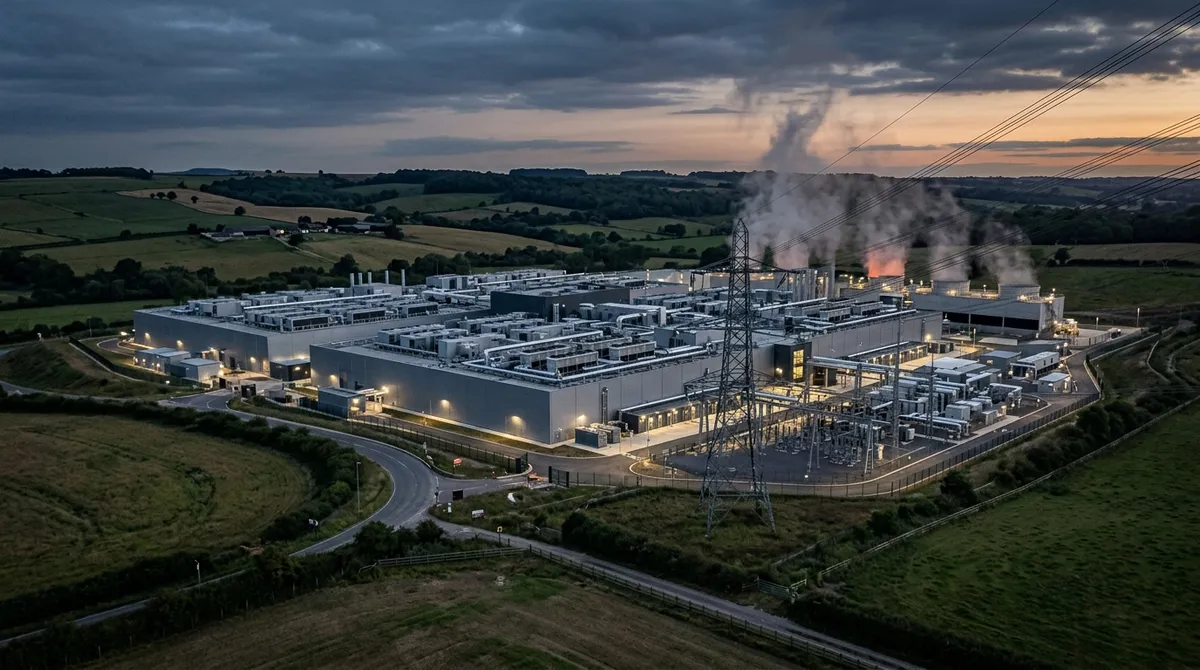
The UK has suddenly discovered that the climate footprint of artificial intelligence is not merely noticeable but potentially enormous. After revising its official calculations, the government acknowledged that emissions from AI data centers in the country may have been underestimated by more than 100 times. It is an important signal not only for British policy but for the entire race for computing capacity: the more aggressively states and corporations build AI infrastructure, the harder it is to pretend that its energy cost is secondary.
The revision was prompted by updated figures that British officials published with little fanfare. According to the new estimate, the energy consumption of AI data centers in the UK could lead to emissions of 34 million to 123 million tonnes of CO2 between 2025 and 2035. The upper bound is comparable to the emissions of roughly 2.7 million people over the same period. By comparison, the earlier estimate, which was later deleted, put the figure at a maximum of 0.142 million tonnes of CO2 in a single year. Formally, the calculation horizon is different, but even with that caveat the gap is too large to write off as a methodological nuance.
The new figures appeared in a revised version of the British compute roadmap, the government plan for building a "world-class" computing ecosystem for artificial intelligence development. The authorities are betting on this strategy as a source of future economic growth. The logic is clear: more data centers, more computing, and a better chance of attracting investment, research projects and AI businesses. The problem is that AI data centers consume noticeably more electricity than traditional facilities for storing and processing ordinary online data, and a significant share of that energy is still tied to fossil fuels.
Even the lower bound of the new estimate looks significant against the scale of the national climate agenda. According to calculations by the UK Department for Science, Innovation and Technology, AI infrastructure could account for 0.9% to 3.4% of the country's total emissions in 2025–2035. The low scenario is possible only if models and hardware become efficient faster and the power system decarbonizes more quickly. In other words, the optimistic case depends not on one factor but on several improvements that still have to be delivered in practice. That turns talk of "green AI" from a question of image into a question of concrete energy policy.
The revision followed criticism from the independent organization Foxglove and the climate publication Carbon Brief, which argued that the earlier figures looked implausibly low. Critics note that the UK has a legally binding target of reaching net zero by 2050, and that it fits increasingly poorly with the aggressive expansion of hyperscale data centers. Foxglove argues that without oversight, this course could sharply increase electricity demand and add a major new source of emissions just as the carbon budget is tightening. The government, for its part, has not publicly commented in detail on the revision.
For the industry, this is not only a story about a calculation error. It also ends the convenient illusion that the AI boom can be discussed separately from energy and climate. If even a country with a formal climate agenda and a developed state apparatus underestimated the impact of AI data centers this badly at first, a similar blind spot may exist in other jurisdictions. The next stage of the debate will not be about whether AI needs computing capacity, but about who will pay for its energy consumption, how quickly grids and generation can adapt, and what limits governments are prepared to impose to meet their own climate goals.
- Nov 2, 2026ASTC Compresses Agent Context Without Training, Cutting Attention Pairs by 50.68%
- Nov 2, 2026DLC Correction Keeps KL to On-Policy Training Within Two Noise Floors on Qwen3
- Oct 31, 2026Author puts his script before an AI jury: the verdict cost 850 thousand tokens
- Oct 31, 2026SciGame Tests Five LLM Agents: Familiar Formulas Get in the Way of Finding Altered Laws
Test Frontier LLMs & Autonomous Agents in One Workspace
Run Claude Opus 5.5, GPT-6, Gemini 3.1, and DeepSeek side-by-side in Nomad AI (nomadnet.ai) — unified model routing, deep research, and multimodal workflows under one subscription.
The AI world, distilled — once a week
Seven stories that actually mattered, hand-picked. No noise, no reposts, no press releases.
Done! Check your inbox for a confirmation.