Mathieu Kassovitz: In Two Years, Audiences Won't Care Whether an Actor Is Human or AI-Generated
Mathieu Kassovitz, director of La Haine, is making a film that uses AI. He believes audiences will soon stop caring whether the person on screen is a living actor or a synthetic version. His stance on copyright is even blunter: he sees AI as the main new tool for cinema and does not share fears about borrowing from others' work. The remarks stand out because they come from a filmmaker known for human observation rather than technology, and they point to a wider shift in how the film world talks about AI.
AI-processed from Guardian; edited by Hamidun News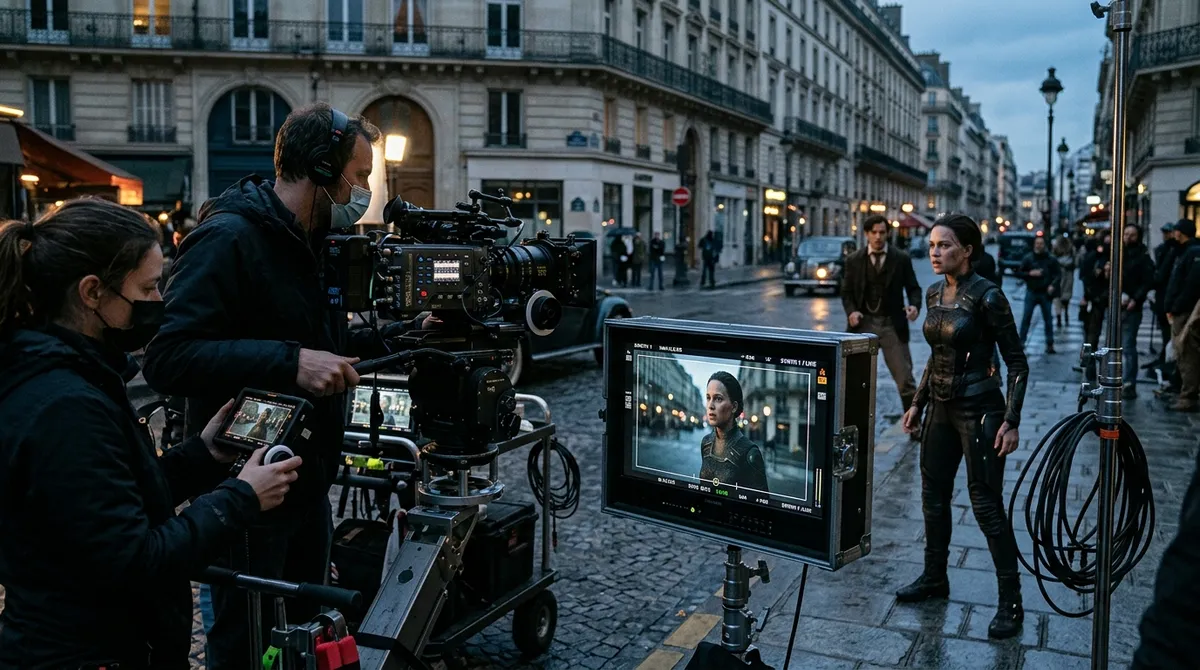
Mathieu Kassovitz, director of La Haine, is convinced that the question of whether a live actor stands behind an on-screen character will quickly stop mattering to mainstream audiences. In his forecast, within two years viewers will think far less about where the character on screen comes from, whether played by a human, a digital double or generated entirely by an artificial intelligence system. Kassovitz is already working on a film that uses AI, and he talks about the technology not as a passing experiment but as the next key tool for cinema.
In the film industry, the statement carries extra weight coming from a man many know for La Haine, a tough, vivid story of the Paris suburbs that became one of the most prominent French films of its time. So what's interesting is not just another upbeat comment about AI, but a turn by an author who made his name through precise human observation and the near-documentary energy of his frames. He now sees generative technology as a full part of the future of film production, not as a threat to the craft.
The shift itself shows that AI is ceasing to be a toy for tech enthusiasts and is increasingly discussed by people from traditional cinema, for whom the key things used to be an actor's physicality, the living texture of a face and the unpredictability of human presence in the frame.
Kassovitz calls AI the last major artistic tool that authors had yet to get. That wording carries not only enthusiasm for new possibilities but also a fairly radical view of how films get made. If the director really sees AI this way, he is talking not about automating individual tasks such as pre-production, storyboarding or post-production, but about a deeper transformation: from creating images and characters to working with voice, movement and on-screen presence. His thesis that viewers will soon not care who "plays" a role effectively erases the old line between acting and synthetic simulation.
For studios and producers, this could mean more control over the result, fewer constraints from shooting schedules and, in theory, cheaper reshoots, de-aging, extra takes and localization. For actors, it means the opposite: more anxiety about where their work ends and where exploitation of a digital likeness begins.
Just as telling is how sharply the director waves off concerns about copyright. Against the backdrop of drawn-out disputes over whether models can be trained on others' work, where the line of borrowing lies and how to protect the labor of actors, screenwriters and artists, his position looks like an almost demonstrative challenge to the entire existing rulebook. In essence, Kassovitz proposes looking at AI through a practical lens rather than a legal one: if a tool lets people make films faster, cheaper or more freely, the industry will use it anyway.
But this is exactly where the core of the debate lies: speed and convenience for studios by no means always match the interests of performers, rights holders and those whose work has already become raw material for training models.
His two-year forecast matters too. This is not an abstract talk about a distant future but almost a production deadline, after which the market may start behaving as if the authenticity of the performer no longer affects a film's commercial success. If such a shift really happens, what changes will not only be how films are shot but also contracts, rules on consent to the use of a person's likeness, payment schemes, project insurance and the very logic of casting.
Today audiences can still see digital people as a technical trick or a controversial compromise. But the faster the quality of image generation, speech synthesis and facial animation improves, the easier it will be for cinema to present an artificial performer as a familiar element of the screen rather than a sensation.
Kassovitz's statement matters not because it settles the debate, but because it shows how fast the tone of the conversation inside cinema is changing. Where AI was recently discussed mostly as an auxiliary technology, it is now increasingly described as a full replacement for some creative professions and even for the human on-screen presence. That does not mean the public will instantly accept synthetic actors as the norm. But it does mean that one of Europe's prominent directors is already publicly betting on such a scenario, and in doing so pushes the industry toward a harder choice between technological efficiency and the value of human participation.
Ship AI Faster with Founders, Engineers & Weekly Architecture Reviews
Inside Vibe Club (hamidun.com/club) — weekly live masterminds with Zhemal Khamidun, Tech Radar, full LMS access, and 370+ production Claude Code skills.
The AI world, distilled — once a week
Seven stories that actually mattered, hand-picked. No noise, no reposts, no press releases.
Done! Check your inbox for a confirmation.