DeepSeek Slashes Prices on New AI Flagship, Intensifying Price War in China
DeepSeek has launched a direct attack on the market with sharp price cuts for access to its new flagship AI. This intensifies China's price war, where developers compete not just on model quality but for the right to be the most cost-effective choice for businesses, startups, and product teams. Lower pricing makes it easier for companies to test APIs, launch pilots, and move real workloads to production.
AI-processed from Bloomberg Tech; edited by Hamidun News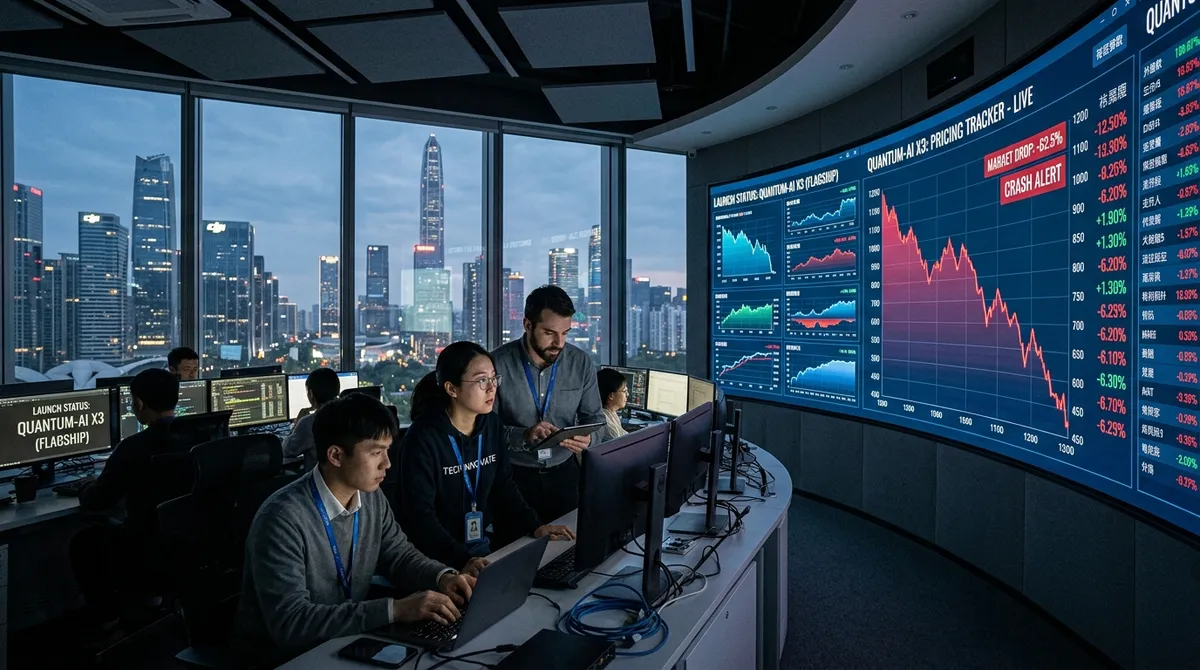
DeepSeek has decided to hit the most sensitive spot in the AI market—price. The company has begun aggressively promoting cheap rates for its newly unveiled flagship model, turning the launch not merely into a product announcement but into a direct attack on competitors. For the Chinese market, this is an important signal: the competition is now about not just answer quality and generation speed, but about who can make powerful AI a mass service accessible to businesses and developers.
The logic behind DeepSeek's move is to quickly get the flagship model onto a broad user base. In the generative AI segment, low pricing works in several directions simultaneously: it simplifies testing for new clients, lowers the barrier for integration into products, and forces competitors to reconsider their own rates. If a model proves sufficiently strong in quality, aggressive pricing can accelerate its adoption faster than any advertising campaign.
This is why reducing the cost of access to the new model looks not like a temporary promotion, but as part of a strategy to capture market share. For the Chinese AI industry, this is a continuation of a broader price war. Local players have long been trying to prove they can compete not only with each other but also with the best systems from Silicon Valley.
However, catching up to leaders in quality is not enough: companies also need to be convinced to move workloads, build new products on local APIs, and allocate budgets specifically for these models. When a new flagship appears on the market with noticeably cheaper plans, pressure arises across the entire chain—from cloud infrastructure to startups selling applied AI services and calculating unit economics literally by tokens. One must also consider the political and economic background.
For Chinese companies, the pricing question relates not just to commerce but to technological sovereignty. The cheaper local models are, the easier it is for major customers to justify the transition to domestic solutions that don't depend on external suppliers and export restrictions. For developers, this is also a practical argument: if a model costs less, it's easier to embed in chatbots, search, corporate assistants, and internal automation without the risk that inference bills will consume the entire benefit of implementation.
In this sense, DeepSeek's cheap plans represent an attempt to sell not just a model, but confidence that a local AI platform can be economically more advantageous than foreign alternatives. There is another important aspect: price attacks in AI always test not only the generosity of the provider but also the strength of its business. Lower rates help quickly build up usage but simultaneously reduce margins and increase computational load.
This means DeepSeek is betting on scale rather than a premium position. The company is essentially offering the market a simple trade: lower entry cost today in hopes of a larger ecosystem tomorrow. The exact parameters of the new rates are not fully disclosed in available descriptions, but the rhetoric around low prices alone shows that DeepSeek wants to set the pace for the entire category, not just participate in it on equal terms.
For clients and developers, such a situation is advantageous in the short term. The harder providers compete, the cheaper it becomes to experiment with large models, launch pilots, and compare the quality of different solutions in real scenarios. But for the market as a whole, this means accelerated consolidation: companies that cannot maintain price, quality, and infrastructure simultaneously will lose faster.
DeepSeek's move shows that the next phase of AI competition will be defined not only by benchmarks but also by the ability to sell strong models as an almost standard service. If this strategy works, pressure on Chinese competitors will intensify, and global interest will also grow in how far price competition can reshape the balance of power in generative AI.
Want to stop reading about AI and start using it?
AI News is a curated feed of AI/tech news. Hamidun Academy teaches you to use AI systematically in your work.
The AI world, distilled — once a week
Seven stories that actually mattered, hand-picked. No noise, no reposts, no press releases.
Done! Check your inbox for a confirmation.