Meta unveils Sapiens2, a single vision model for pose, segmentation and 3D
Meta has released Sapiens2, a new family of high-resolution vision models for human-centric tasks. A single architecture covers pose estimation, body-part segmentation, surface normals, pointmap and albedo. The lineup scales from 0.4 to 5 billion parameters, was trained on 1 billion images of people and, according to the company, is noticeably more accurate than the first-generation Sapiens. *Meta has been designated an extremist organization and is banned in Russia.
AI-processed from MarkTechPost; edited by Hamidun News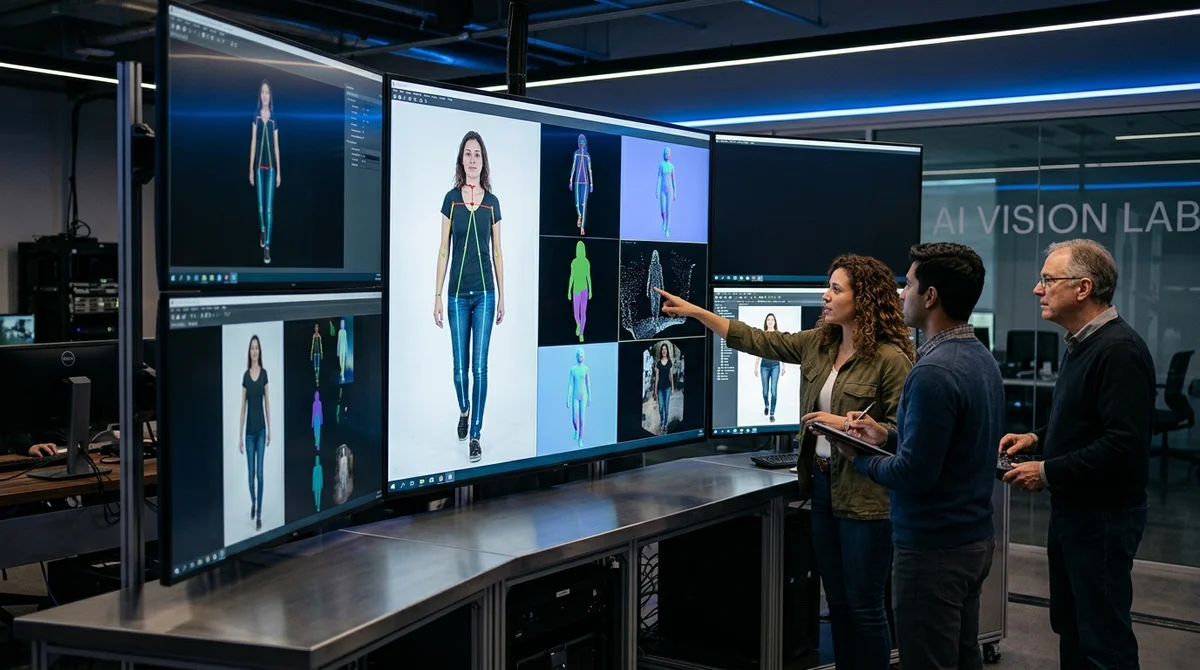
Meta Reality Labs has released Sapiens2, a new generation of human-centric vision models that aims to replace a scattered set of specialized networks with one shared foundation. In a single lineup, the company has combined tasks that usually live separately: human pose estimation, body-part segmentation, surface normal recovery, pointmap for 3D geometry and albedo estimation. For the market this is an important signal: Meta keeps betting not only on generative AI but also on applied computer vision, which is needed for AR devices, digital avatars, virtual try-on, motion capture and video analysis.
The core idea of Sapiens2 is that one base architecture can work at several levels of understanding a person in the frame at once. The system no longer needs one network for the skeleton, another for body labeling and a third for surface geometry. Meta claims that a single backbone covers all these scenarios after fine-tuning.
In practical terms this simplifies the production pipeline: fewer components, less desynchronization between models and lower maintenance costs. The published checkpoints include, among others, a model for top-down pose estimation on 308 keypoints, including detailed points on the face, hands and feet, as well as segmentation into 29 body-part classes. The key update lies not only in the set of tasks but also in how the model was trained.
Sapiens2 was pretrained on a curated dataset of 1 billion high-quality images of people. In pretraining, Meta combined masked image reconstruction with a self-distilled contrastive objective, so the model retains both low-level detail for dense prediction and high-level semantics for zero-shot and few-label scenarios. The architecture also borrows techniques from more recent frontier models to sustain longer training runs without losing stability.
The lineup scales from 0.4 to 5 billion parameters and runs at native 1K resolution, while hierarchical variants support 4K and use windowed attention for longer spatial context. Compared with the first-generation Sapiens, Meta claims a notable gain on almost all key metrics.
On pose estimation the new version adds 4 points of mAP, on body-part segmentation 24.3 points of mIoU, and on surface normals it cuts angular error by 45.6%.
It is also worth noting that Sapiens2 goes beyond the familiar tasks of the first release. The family can now build a pointmap, that is, predict 3D coordinates in the camera frame for every pixel, and work with albedo, the base color of a surface without the influence of lighting. For avatars, AR and digital try-on this is especially useful: such representations help reconstruct a person's shape more accurately, transfer lighting and build more believable 3D scenes from an ordinary photo.
The practical value of the release is that Meta did not stop at a research paper. The company has already posted the Sapiens2 family on Hugging Face and the code on GitHub, and the collection includes separate variants for pose, segmentation, normals and pointmap. This lowers the barrier to entry for teams building products around human-focused computer vision, from fitness apps and video analytics systems to XR interfaces and virtual characters.
It is important to remember, though, that Sapiens2 is not a universal model for any computer vision task but a strong stack specifically for human-centric imagery. Its main strength is in frames where a person remains the central subject, along with their pose, surface, clothing and body geometry. What this means in practice: Meta is taking another step toward a unified visual backbone for everything involving a person in the frame.
If the claimed results hold up in real production scenarios, the company will gain a strong base for its own XR products and set a new bar for open research in human-centric vision. For the market, it is a good example of foundation models starting to pay off not only in text and generation but also in precise, engineering-grade computer vision tasks.
*Meta has been designated an extremist organization and is banned in Russia.
- Nov 2, 2026Meta's Muse assistant keeps dossiers on loved ones and gets root on Ubuntu by default
- Nov 2, 2026The Verge reviewer builds a $50 Meta Muse Charm alternative with Claude Code
- Nov 1, 2026MoneyGate safety layer blocked all 42 fraudulent requests to local AI models
- Oct 31, 2026Open-source LLM gateway KTMS 1.0 plugs your own GPUs into the cloud and survives outages
Test Frontier LLMs & Autonomous Agents in One Workspace
Run Claude Opus 5.5, GPT-6, Gemini 3.1, and DeepSeek side-by-side in Nomad AI (nomadnet.ai) — unified model routing, deep research, and multimodal workflows under one subscription.
The AI world, distilled — once a week
Seven stories that actually mattered, hand-picked. No noise, no reposts, no press releases.
Done! Check your inbox for a confirmation.