China blocks Meta's $2 billion acquisition of startup Manus
China has stopped Meta's planned $2 billion acquisition of the startup Manus. Officials feared that key agentic AI technology would leave for the US along with the company. For Meta, the decision derails a fast way to strengthen its position in agentic AI. For the wider industry, it signals that large AI acquisitions will increasingly hinge on geopolitics, not just money. *Meta is designated an extremist organization and banned in Russia.
AI-processed from Bloomberg Tech; edited by Hamidun News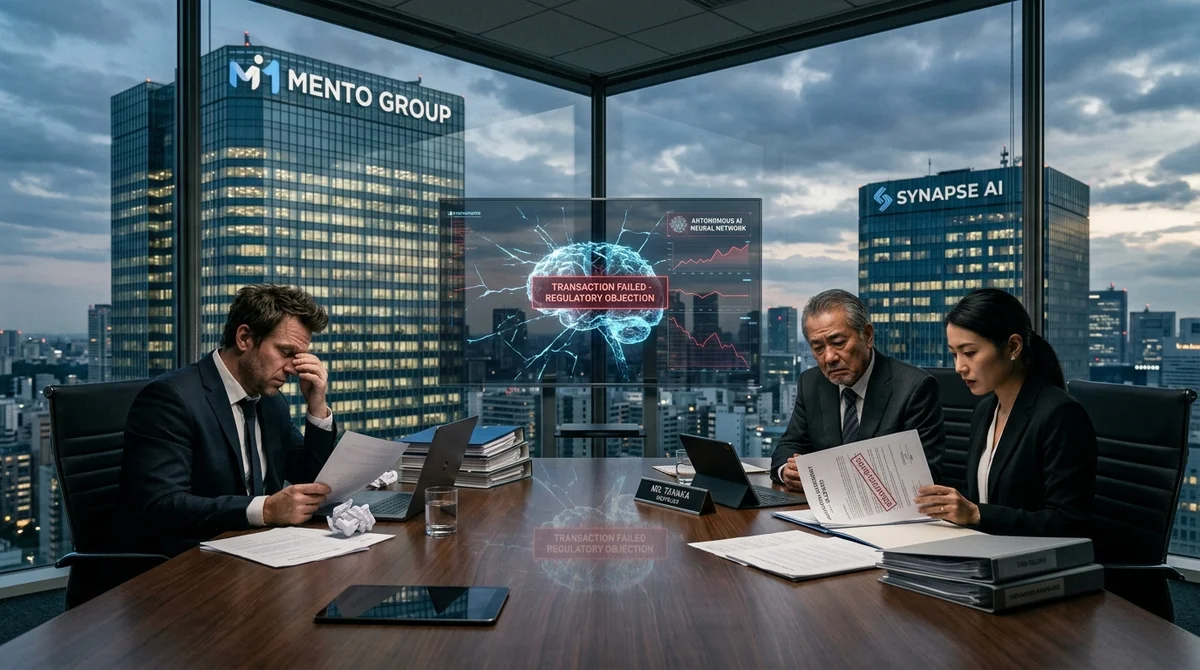
China has blocked Meta's $2 billion acquisition of Manus, halting one of the most high-profile deals in AI and making clear that handing promising Chinese technology to American corporations is now a political question rather than a routine corporate transaction. The decision stands out because Manus works in agentic AI: systems that do more than answer prompts and can plan actions, execute chains of tasks, and operate more autonomously than ordinary chatbots. In effect, Beijing chose to cancel the deal after critics argued it could lead to technology leaking to the US.
Judging by the wording, the dispute over Manus was less about price and more about control over the team, the intellectual property, and future products. Chinese authorities increasingly treat such assets as sensitive: they see agentic AI systems as an important technological foundation for the next generation of digital services, enterprise automation, and, potentially, broader strategic applications. In deals like this, the code itself is only part of the value.
Accumulated data, research expertise, and the ability to turn lab work into mass-market products quickly matter just as much. For Meta, the purchase would have been a fast way to strengthen its position in the new race for AI products. Big tech companies now compete not only on models but also on interfaces, task-execution tools, and platforms that let AI act on the user's behalf.
Startups that can build these agentic workflows are especially valuable because they cover the application layer, from workplace assistants and business process automation to more sophisticated digital operators. That is why a distinct market is forming around agentic AI: products that can take over a significant share of routine work without constant human involvement. The $2 billion price tag showed that Meta was prepared to pay not for an early experiment but for a potentially strategic asset.
China's decision also fits a broader push for technological sovereignty. Even if this is formally a single acquisition, the message to the market is unmistakable: companies building critical AI technology inside China will not be able to move freely under the control of American players if the state considers that a risk. This raises uncertainty for cross-border AI deals, especially those involving code, research teams, data, and infrastructure work.
For investors, it means valuations of such startups now depend more heavily not only on technology and revenue but also on political approval of the deal itself. For founders, it is a reminder that a strategic exit through a sale to a global tech giant may be not only a business matter but also a matter of state policy. For Manus itself, the outcome could prove both a constraint and an opportunity.
On one hand, the startup loses an immediate path under the wing of a global tech giant with its compute resources, product scale, and distribution channels. On the other, the block confirms that the company's technology is seen as important enough to fight over at the state level. That could boost interest in Manus inside China, raise expectations for its future growth, and make it part of a more localized AI ecosystem where key technologies are kept within the country.
The main takeaway is that the AI market runs less and less by the usual rules of venture capital and corporate M&A. A major deal used to mean, above all, synergy between product, team, and capital; now it increasingly has to pass through a technology-security filter. The blocked Manus acquisition shows that in agentic AI, an asset's price is measured not only in money but also by who exactly ends up controlling the technology.
For Meta, it means losing an important boost; for China, it is a show of a hard line; and for the whole industry, it is a reminder that the next big AI deals will be decided not only in boardrooms but also at the level of governments.
*Meta is designated an extremist organization and banned in Russia.
- Nov 1, 2026Local AI models agreed to pay scammers, while simple rules blocked all 42 schemes
- Oct 31, 2026Open-source LLM gateway KTMS 1.0 plugs your own GPUs into the cloud and survives outages
- Oct 31, 2026A 22B-Parameter Video Model Runs on an RTX 3080 with 10 GB of VRAM
- Oct 29, 2026T-Tech Introduces LIMe, a Method That Trains Language Models With 15% Less Compute
Delegate Deep Research, Coding & Multi-Step Workflows to Nomad Agent
Deploy autonomous task execution with Nomad Agent (agent.nomadnet.ai) — automated web research, data synthesis, code generation, and MCP tool orchestration.
The AI world, distilled — once a week
Seven stories that actually mattered, hand-picked. No noise, no reposts, no press releases.
Done! Check your inbox for a confirmation.