Apple's Mac mini shortage pushes eBay prices up as demand for local AI grows
The Mac mini has gone into short supply at Apple, and the secondary market reacted quickly: eBay now has listings with noticeable markups. The cause is growing interest in running AI models and tools locally. For developers and enthusiasts, the compact Mac is increasingly a quiet, energy-efficient box for a home AI stack. Demand is especially visible for versions with more memory.
AI-processed from TechCrunch; edited by Hamidun News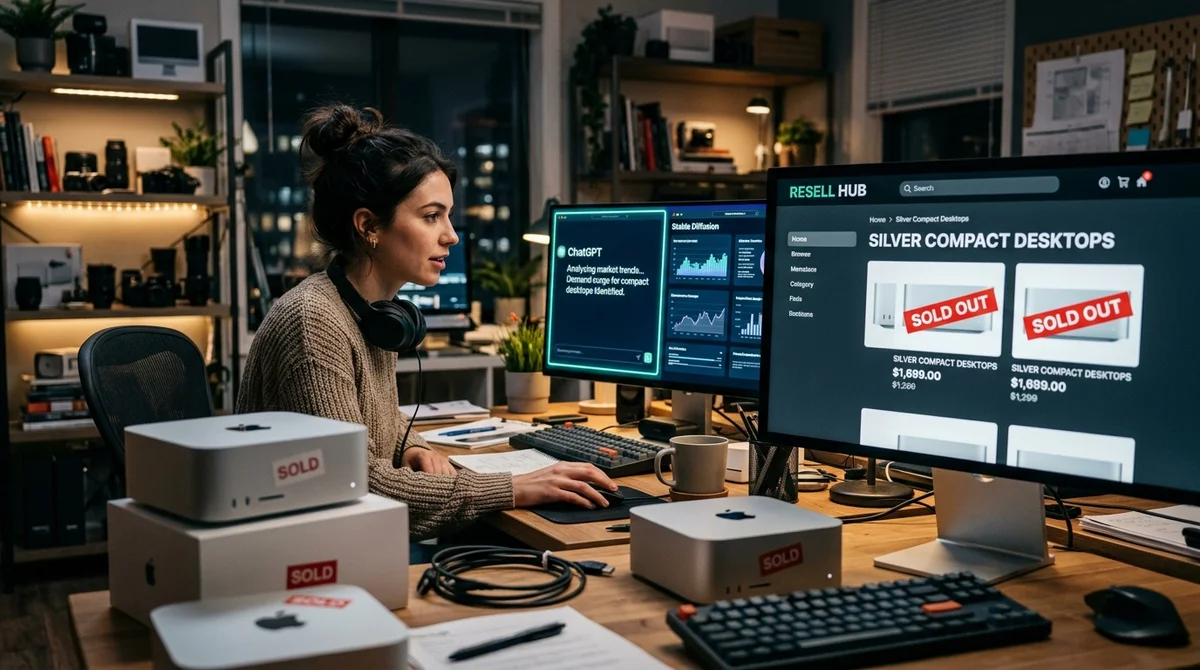
The Mac mini has abruptly gone from "just a compact Apple computer" to a scarce item for a new wave of AI users. While some configurations sell out in Apple's official store, eBay is filling up with listings at a markup. Demand comes from developers, enthusiasts and small teams who want a relatively affordable, quiet and powerful computer for running models and AI tools locally.
The situation shows how quickly the consumer hardware market is shifting under the influence of generative AI. Not long ago, the Mac mini was seen as a convenient desktop Mac for the office, development and everyday work. Now it is increasingly considered a base machine for a local AI stack: running language models, agents, automation tools, transcription, code generation and other tasks that used to be associated almost entirely with the cloud. As soon as Apple ran short of devices, the secondary market responded instantly, with sellers listing computers above the official price.
The reason for the interest is clear. Modern Apple Silicon models deliver good performance per watt, do not require a separate discrete graphics card, run relatively quietly and take up little desk space. For users who do not want to build a bulky PC or keep a server running around the clock, the Mac mini looks like a compromise between a home machine, a workstation and a small local node for AI tasks. Configurations with a large amount of unified memory are especially prized, because memory, not just compute power, is often the limiting factor when working with local models.
There is also a broader shift in buyer behavior. Some users are moving AI workloads from the cloud to local devices because of the cost of subscriptions and APIs, privacy concerns and a wish to reduce latency. If a model can sit next to the data, it gives more control over documents, code, internal notes and workflows.
For small studios, independent developers and automation teams, it is also a way to build a predictable working environment without a monthly dependence on external services. So demand for the Mac mini today comes not only from Apple fans but also from people who until recently would hardly have looked at this computer as an AI tool. As a result, even a mass-market consumer device is starting to behave like scarce professional hardware.
Markups on the secondary market usually appear where demand has run far ahead of supply. In the Mac mini's case there is also a psychological factor: buyers see that the device is sold out at the manufacturer and are ready to close a deal faster, fearing further price rises or even longer delivery delays. For resellers this is an ideal situation: a well-known brand, a clear use case and an audience that understands exactly why it needs this particular configuration.
The growing number of overpriced eBay listings is also a signal for the whole industry: local AI is ceasing to be a niche hobby and turning into a practical tool that users are already willing to overpay for suitable hardware to run. For Apple, it is also indirect confirmation of a new use case for its compact computers: not as an office desktop, but as a base station for personal AI.
The main takeaway is simple: the Mac mini shortage is not a story about a random spike of interest on a marketplace, but a reflection of a deeper change. AI is changing not only software and cloud services, but also the logic of buying ordinary computers. If the trend holds, users will increasingly choose devices not by familiar criteria such as office tasks or video editing, but by how convenient they are for running local models, agents and automation. And the Mac mini has already become one of the first mass-market computers to benefit from this shift.
- Nov 2, 2026TensorFold 1.2.0 boosts Qwen3.8-27B throughput on M3 Ultra by 44.2% at 16 streams
- Nov 1, 2026Local models lose to Opus and Codex: 0.21 on a MacBook versus 1.00 for Codex
- Oct 29, 2026Claude Code Edits Video From a Transcript: How the video-use Skill With 30 000 Stars Works
- Oct 29, 2026Stanford AI tool verifies part of Signal's code in half a day for under $500, versus five months of expert work
Ship AI Faster with Founders, Engineers & Weekly Architecture Reviews
Inside Vibe Club (hamidun.com/club) — weekly live masterminds with Zhemal Khamidun, Tech Radar, full LMS access, and 370+ production Claude Code skills.
The AI world, distilled — once a week
Seven stories that actually mattered, hand-picked. No noise, no reposts, no press releases.
Done! Check your inbox for a confirmation.