Apple raises Mac mini starting price to $799 amid demand for local AI tools
Apple quietly pulled the $599 Mac mini from sale, so the model's starting price is now $799. The reason is strong demand from developers who use the compact desktop for local AI tools, agents and cloud-free testing. According to Tim Cook, Apple may need several more months to catch up with demand, so the shortage will not disappear quickly.
AI-processed from TNW; edited by Hamidun News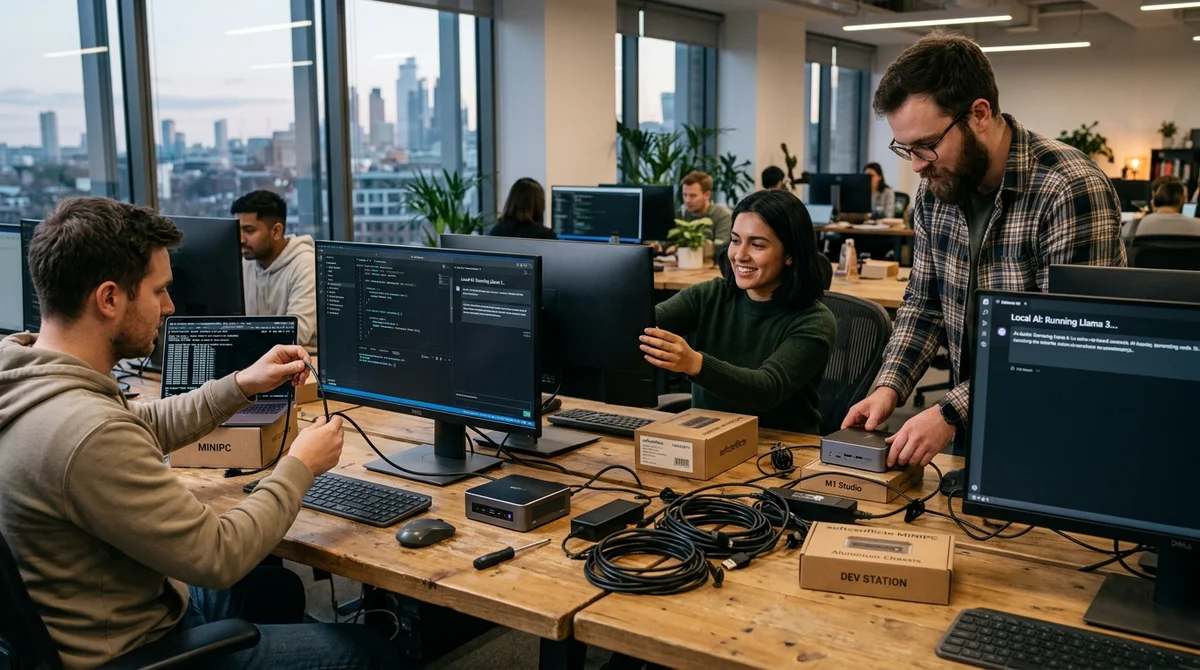
Apple has pulled the $599 Mac mini from sale and raised the entry point of its desktop lineup to $799. The cause was not a new redesign or a routine hardware refresh, but unexpectedly high demand from developers who use the compact Mac for local AI tools and agent workflows.
Why the base model disappeared
For several years, the Mac mini was the cheapest way into Apple's desktop ecosystem. After the M4 update in late 2024, it became especially attractive for people who wanted to run models locally: a compact case, quiet operation, an energy-efficient chip and solid performance without a separate graphics card.
As a result, the device became more than a home computer. It turned into a convenient work machine for developers testing AI features on their desk, in an office or in small internal infrastructure.
According to TNW, this demand quickly cleared out stock of the entry-level configuration. Apple made no separate announcement, but effectively moved the Mac mini's starting price from $599 to $799 because the most affordable version is no longer on sale. To buyers, this looks like a quiet price increase, even though the company formally just removed the bottom rung of the lineup.
The difference is not merely an accounting one: the configuration that for years was the main argument for the Mac mini among students, indie developers and small teams is gone.
Why AI picked the Mac mini
Growing interest in local AI now looks logical. Developers increasingly want to run models and agents without the cloud, so they can test scenarios faster, avoid paying for every request and keep sensitive data away from external providers. For such tasks they need a computer that can sit next to the workstation, serve as a personal inference station or become a small server for internal experiments. The Mac mini landed neatly in this niche thanks to its mix of price, size and performance.
The Mac mini proved convenient not for one reason but because of a fortunate set of practical qualities. Size, power consumption, quiet operation and a development environment familiar to many all came together. For a team that wants to stand up local AI scenarios quickly without separate server infrastructure, that combination often matters more than theoretical peak performance. This is especially true where the count is in hours, not in the perfect configuration.
In practice, it looks like this:
- a compact case that is easy to keep on a desk or in a rack
- Apple Silicon chips with a good balance of performance and power consumption
- quiet operation, important for constant local runs
- macOS as a familiar environment for developing and testing applications
- a lower entry price compared with other desktop Macs
This does not make the Mac mini a universal machine for every resource-hungry AI scenario. Training large models, heavy GPU workloads and complex pipelines still call for entirely different budgets and hardware. But for prototypes, agent orchestration, local inference and desktop applications, this configuration proved very practical.
When the market finds a use case this clear, even an affordable model quickly turns from a mass-market product into a scarce tool for a specific professional audience.
What is changing now
The shift in starting price from $599 to $799 noticeably changes the positioning of the whole lineup. Previously, the Mac mini was an almost automatic choice for anyone who needed an inexpensive desktop Mac without overpaying for an iMac, Mac Studio or Mac Pro. Now the price gap is noticeable, and some buyers will start comparing it not only with other Apple computers, but also with compact Windows machines, mini PCs or self-built Linux boxes for local AI tasks. In other words, the Mac mini is losing some of its status as the "obvious recommendation."
The shortage compounds the situation. According to Tim Cook, Apple may need several months to catch up with demand. This looks less like a random spike than a more lasting shift: developers have begun widely treating an ordinary desktop computer as a convenient platform for local AI experiments. If the trend continues, similar distortions in price and availability may appear at other manufacturers, especially in the segment of compact, quiet and energy-efficient machines.
What this means
The Mac mini story shows that AI now affects not only the market for cloud GPUs and data centers, but also demand for ordinary work computers. When developers move their agent and local-model experiments to their own hardware en masse, even a base desktop Mac stops being merely a budget entry to the ecosystem and becomes a scarce AI tool.
For the market, this is a direct signal: the next wave of AI demand will be visible not only in the cloud, but also on the shelves with ordinary computers.
- Nov 1, 2026Local models lose to Opus and Codex: 0.21 on a MacBook versus 1.00 for Codex
- Oct 29, 2026Claude Code Edits Video From a Transcript: How the video-use Skill With 30 000 Stars Works
- Oct 29, 2026Stanford AI tool verifies part of Signal's code in half a day for under $500, versus five months of expert work
- Oct 29, 2026Liquid AI releases LFM3: six multimodal 2B models with a 256K context window
Key Questions Answered
Why the base model disappeared?
For several years, the Mac mini was the cheapest way into Apple's desktop ecosystem. After the M4 update in late 2024, it became especially attractive for people who wanted to run models locally: a compact case, quiet operation, an energy-efficient chip and solid performance without a separate graphics card. As a result, the device became more than a home computer. It turned into a convenient work machine for developers testing AI features on their desk, in an office or in small internal infrastructure. According to TNW, this demand quickly cleared out stock of the entry-le
Why AI picked the Mac mini?
Growing interest in local AI now looks logical. Developers increasingly want to run models and agents without the cloud, so they can test scenarios faster, avoid paying for every request and keep sensitive data away from external providers. For such tasks they need a computer that can sit next to the workstation, serve as a personal inference station or become a small server for internal experiments. The Mac mini landed neatly in this niche thanks to its mix of price, size and performance. The Mac mini proved convenient not for one reason but because of a fortunate set of p
What is changing now?
The shift in starting price from $599 to $799 noticeably changes the positioning of the whole lineup. Previously, the Mac mini was an almost automatic choice for anyone who needed an inexpensive desktop Mac without overpaying for an iMac, Mac Studio or Mac Pro. Now the price gap is noticeable, and some buyers will start comparing it not only with other Apple computers, but also with compact Windows machines, mini PCs or self-built Linux boxes for local AI tasks. In other words, the Mac mini is losing some of its status as the "obvious recommendation." The shortage compounds
Test Frontier LLMs & Autonomous Agents in One Workspace
Run Claude Opus 5.5, GPT-6, Gemini 3.1, and DeepSeek side-by-side in Nomad AI (nomadnet.ai) — unified model routing, deep research, and multimodal workflows under one subscription.
The AI world, distilled — once a week
Seven stories that actually mattered, hand-picked. No noise, no reposts, no press releases.
Done! Check your inbox for a confirmation.