Siemens and Nvidia humanoid robot completes an eight-hour shift at a German factory
Siemens, together with Nvidia and the British startup Humanoid, deployed the wheeled humanoid robot HMND 01 Alpha at a working factory in Germany. Over eight hours of continuous work, it performed 60 cargo operations per hour with a grasp accuracy above 90%, and it was integrated directly into Siemens' corporate systems. The test took place at Siemens' electronics plant in Erlangen, in the facility's logistics zone.
AI-processed from TNW; edited by Hamidun News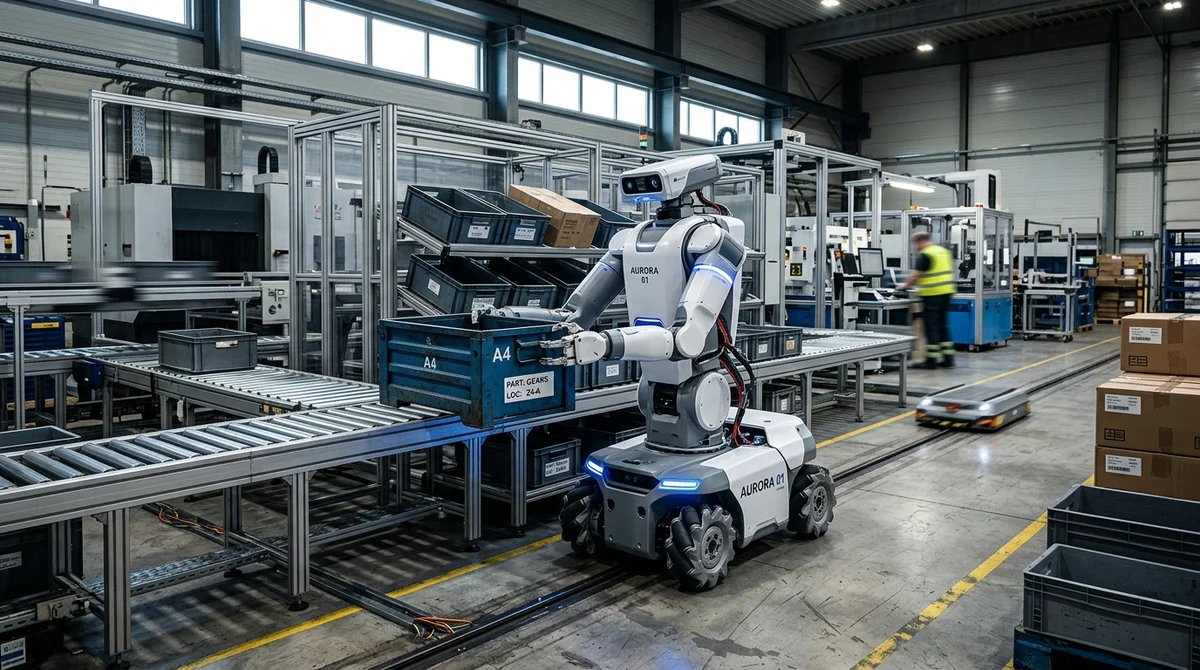
A humanoid robot has worked a full eight-hour shift at a working Siemens facility for the first time, and it performed better than the test's organizers expected. Siemens, Nvidia and the British startup Humanoid deployed the wheeled robotic platform HMND 01 Alpha at an electronics plant in Erlangen, Germany. The task was specific: autonomous sorting and moving of containers in the plant's logistics zone. The robot performed 60 operations per hour, and its grasping and stacking accuracy exceeded 90%. The system was connected directly to Siemens' corporate IT infrastructure, with no special adapters or isolated test bench.
HMND 01 Alpha runs on Nvidia's Isaac platform, a software stack for industrial robotics that includes simulation, reinforcement learning and real-time inference. Humanoid, founded in 2023, positions its robots as a solution for tasks that require both mobility and manipulation of objects of arbitrary shape. Unlike bipedal counterparts, the wheeled design offers greater stability and speed of movement in the structured environment of a warehouse or shop floor.
Context matters here: an eight-hour test in real conditions is a fundamentally harder challenge than demos on a trade-show stand. A production environment brings unpredictable situations: containers of different weights, changing lighting, people moving nearby. A success rate above 90% under such a load suggests the system is already close to commercial viability rather than merely at the prototype stage.
For Siemens, this is not a one-off experiment. The company is actively investing in automating its own production capacity while also selling industrial automation solutions to other businesses. A successful pilot in Erlangen strengthens both sides: internal efficiency and market position.
The Erlangen test marks an important shift: humanoid robotics is moving from laboratory demonstrations to real production deployments. The next question is scalability. One robot that worked a shift is a proof of concept. A hundred robots working in parallel with people without incidents would be an industrial standard.
- Nov 1, 2026Local models lose to Opus and Codex: 0.21 on a MacBook versus 1.00 for Codex
- Nov 1, 2026Habr author fine-tunes YOLOv8l on dental X-rays and pushes mAP50 to 0.642
- Nov 1, 2026Voice bots built on LLMs turn to Jev, a fast classifier, for decisions in 200–500 ms
- Nov 1, 2026MoneyGate safety layer blocked all 42 fraudulent requests to local AI models
Test Frontier LLMs & Autonomous Agents in One Workspace
Run Claude Opus 5.5, GPT-6, Gemini 3.1, and DeepSeek side-by-side in Nomad AI (nomadnet.ai) — unified model routing, deep research, and multimodal workflows under one subscription.
The AI world, distilled — once a week
Seven stories that actually mattered, hand-picked. No noise, no reposts, no press releases.
Done! Check your inbox for a confirmation.