Meta* AI solves a century-old math problem: breakthrough or hype?
A Meta* AI model has solved a difficult math problem about the stability of dynamical systems, one that stumped scientists for decades. The result raises questions about AI's role in scientific discovery and its potential to surpass human intelligence. *Meta is designated an extremist organization and banned in Russia.
AI-processed from Habr AI; edited by Hamidun News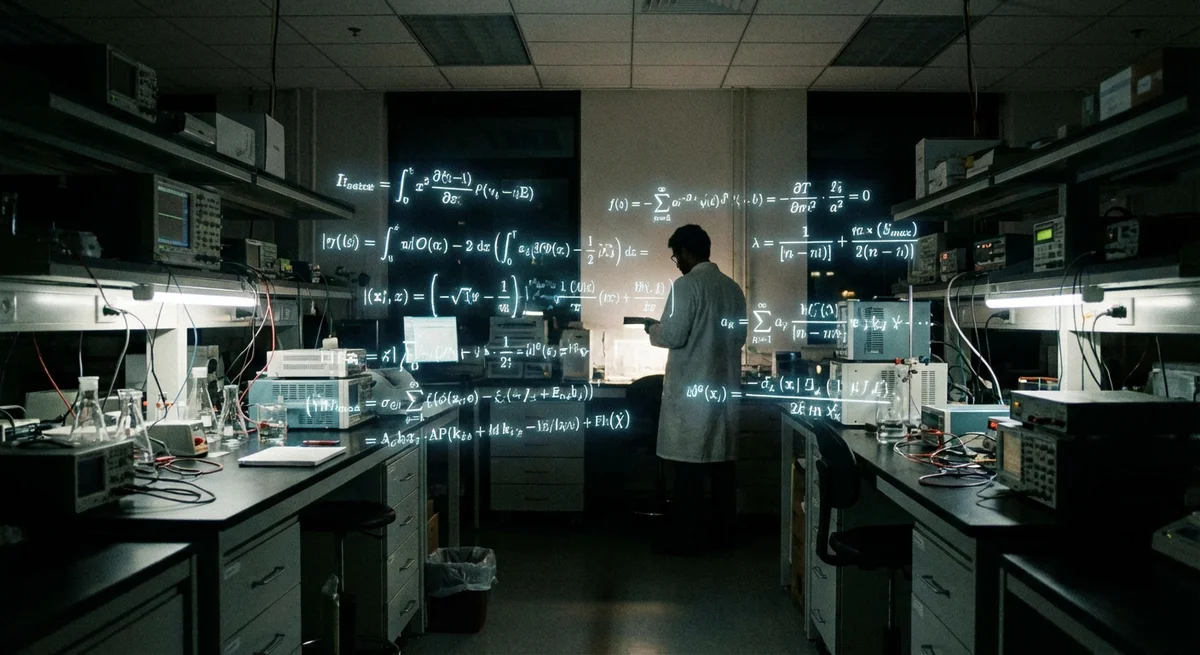
In October 2024, a sensational story spread across news feeds: an AI developed by Meta* (designated an extremist organization and banned in Russia) had solved a math problem considered unsolvable for an entire century. The problem concerns determining the stability of solutions to equations that describe dynamically changing systems, such as the swing of a pendulum or the oscillation of a spring. In other words, the AI was able to predict whether these systems will keep behaving predictably over the long term.
The news predictably caused a stir. Mathematics, with its abstract concepts and rigorous logic, has traditionally been seen as a domain where human intelligence dominates. An AI succeeding at a hard math problem raises a question: can artificial intelligence do more than automate routine calculations, and actually make breakthrough discoveries that exceed the abilities of even the most brilliant mathematicians?
To understand why this matters, it helps to look at the context. The problem comes from dynamical systems theory, which is used across a wide range of science and engineering, from physics and engineering to economics and biology. The equations that describe dynamical systems are often extremely complex, and solving them exactly is impossible. So scientists try to determine whether a solution is stable — that is, whether a small change in initial conditions leads to drastic changes in how the system behaves. Stability is key to predicting and controlling such systems.
Meta's* AI used machine learning methods to analyze large amounts of data and find patterns that scientists had missed. The model was able to establish the conditions under which the equations' solutions remain stable. The specifics of the algorithm have not been disclosed, but it is known to combine elements of symbolic computation and numerical simulation. Notably, the AI did not simply produce an answer: it provided a proof that it was correct, which is a core requirement in mathematics.
The significance of this breakthrough for science is enormous. First, it opens up new ways to study complex dynamical systems that traditional methods cannot handle. Second, it shows AI's potential as a powerful tool for scientific discovery. Third, it raises questions about the future of mathematics and the human role in it. Will AI eventually replace mathematicians, or will it remain an assistant that speeds up research? For now, that question remains open.
For users and the industry as a whole, this means faster progress across many technologies. From more accurate weather and financial market forecasts to more reliable and safer engineering systems, the results obtained with AI could have very broad applications. The achievement also encourages further investment in AI and machine learning research, which in turn will lead to new breakthroughs and innovations.
In conclusion, solving a century-old math problem with AI is a significant event that points to artificial intelligence's growing potential in science. Fully replacing human intelligence is still a long way off, but AI is already becoming a powerful tool that can solve hard problems and open new horizons across many fields of knowledge. This is the start of a new era in science, one in which humans and machines will work together to unravel the mysteries of the universe.
- Nov 2, 2026I Interrogated 6 AI Models About Myself Through a Procurement Manager's Eyes: Amazon, Esoterica, 'Telo Hudelo' and 5 Holes We Closed in a Day
- Nov 2, 2026Eight LLMs Lose 35–46% of Strategy Calibration in Free-Form Generation
- Nov 2, 2026NVIDIA releases Nemotron 3.5 Bolt E4B: 4 GB and 133 tokens per second on an RTX 5070
- Nov 2, 2026Meta's Muse assistant keeps dossiers on loved ones and gets root on Ubuntu by default
Test Frontier LLMs & Autonomous Agents in One Workspace
Run Claude Opus 5.5, GPT-6, Gemini 3.1, and DeepSeek side-by-side in Nomad AI (nomadnet.ai) — unified model routing, deep research, and multimodal workflows under one subscription.
The AI world, distilled — once a week
Seven stories that actually mattered, hand-picked. No noise, no reposts, no press releases.
Done! Check your inbox for a confirmation.