Memories.ai is building a visual memory layer for wearables and robots
Startup Memories.ai is building a large visual memory model, an infrastructure layer for physical AI. The system can index and retrieve real-world video, giving wearables and robots the ability not just to see but to remember the past. Today, physical AI works like an amnesia patient: every launch starts from scratch, with no context from earlier events.
AI-processed from TechCrunch; edited by Hamidun News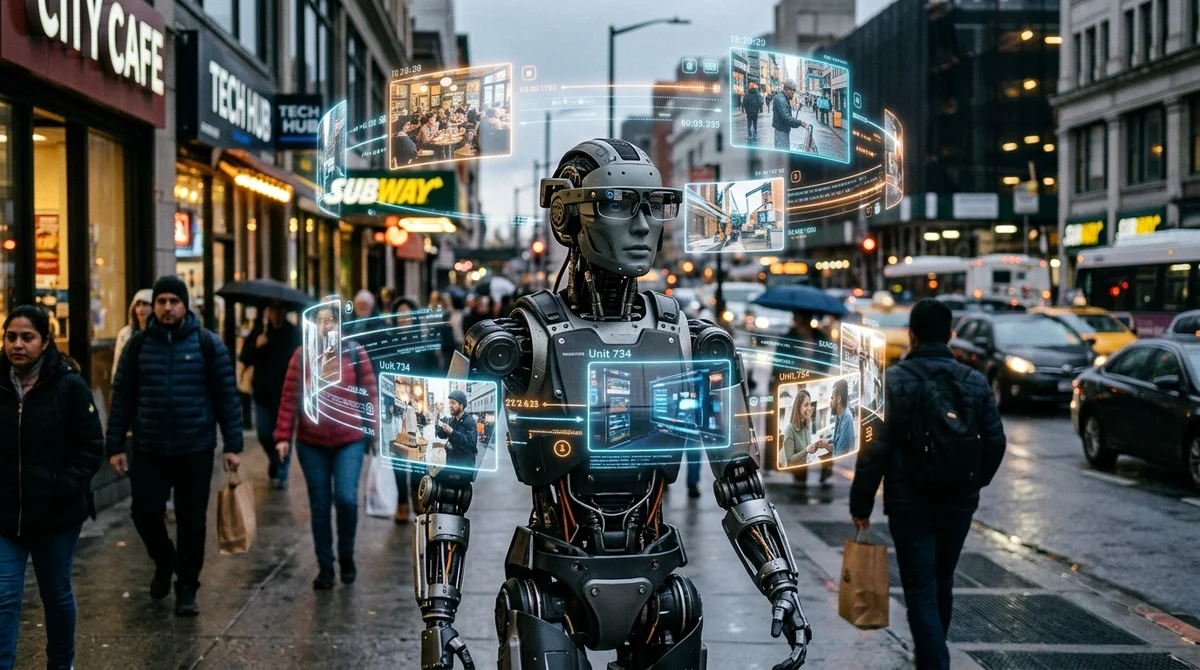
Startup Memories.ai has announced it is developing a large visual memory model, a system that would let physical AI index and retrieve video-recorded memories of the real world. In essence, the team is building what wearables and robots have lacked: the ability not just to see but to remember.
The idea sounds simple, but the technical difficulty is enormous. Ordinary language models work with text: they store and reproduce information as words and symbols. Video is fundamentally different: every second holds thousands of frames, spatial relationships, object motion and a temporal sequence of events. For a robot or smart glasses to recall where the keys are, or what happened in the kitchen three hours ago, it takes a specialized architecture optimized for visual data.
Memories.ai positions its work as an infrastructure layer for physical AI, a new class of systems that act in the real world rather than the digital one. Physical AI is what powers wearables such as Ray-Ban Meta* and Humane AI Pin, as well as the humanoid robots now actively entering the market: Boston Dynamics, Figure, Agility Robotics. All of them suffer from the same problem: no long-term contextual memory of what is happening around them.
For wearable gadgets, visual memory means being able to answer "where did I see this person?" or "when was I last in this cafe?" For robots, it means understanding changes in the environment, tracking where objects have moved, and avoiding mistakes made earlier. Without such a layer, physical AI works like an amnesia patient: every new launch starts from scratch, with no accumulated experience.
The team does not disclose technical details of the architecture or the volume of training data. It is unknown what stage development is at, or whether there are already partners among hardware makers. Still, the very appearance of specialized startups focused on visual memory for physical devices suggests the industry has reached the next scaling barrier.
Until now, most AI startups have focused on language or multimodal models that work mainly with text and static images. Video memory is a far more resource-hungry problem, requiring new approaches to compression, storage and search. Big players such as Google DeepMind and OpenAI are working on video understanding, but their products are built for cloud processing rather than embedded solutions. Judging by its positioning, Memories.ai is aiming at a different segment: edge solutions that run directly on the device. That is critical for robots and wearables, which cannot afford the latency of a cloud request every time they need to consult past experience.
If the startup manages to deliver on what it claims, its model could become one of the key components of the physical AI stack, comparable in significance to the arrival of large language models for text assistants. The race for visual memory is only beginning.
*Meta has been designated an extremist organization and is banned in Russia.
- Nov 2, 2026Meta's Muse assistant keeps dossiers on loved ones and gets root on Ubuntu by default
- Nov 1, 2026Local models lose to Opus and Codex: 0.21 on a MacBook versus 1.00 for Codex
- Nov 1, 2026Kimi scores 96.2% on a 1C database analytics test and emerges as a fallback if Claude access is blocked
- Nov 1, 2026OpenAI Rewrites GPT Behavior Rules: Five Values and a Chain of Command
Test Frontier LLMs & Autonomous Agents in One Workspace
Run Claude Opus 5.5, GPT-6, Gemini 3.1, and DeepSeek side-by-side in Nomad AI (nomadnet.ai) — unified model routing, deep research, and multimodal workflows under one subscription.
The AI world, distilled — once a week
Seven stories that actually mattered, hand-picked. No noise, no reposts, no press releases.
Done! Check your inbox for a confirmation.