A "Made by Human" Label: A New Idea to Protect Creators from AI
"This looks like AI" is a phrase more and more artists, photographers and writers hear. A journalist at The Verge proposes a fix: label human-made content rather than AI content, along the lines of the Fair Trade logo. With platforms doing nothing, creators have their own incentive to prove they made their work.
AI-processed from The Verge; edited by Hamidun News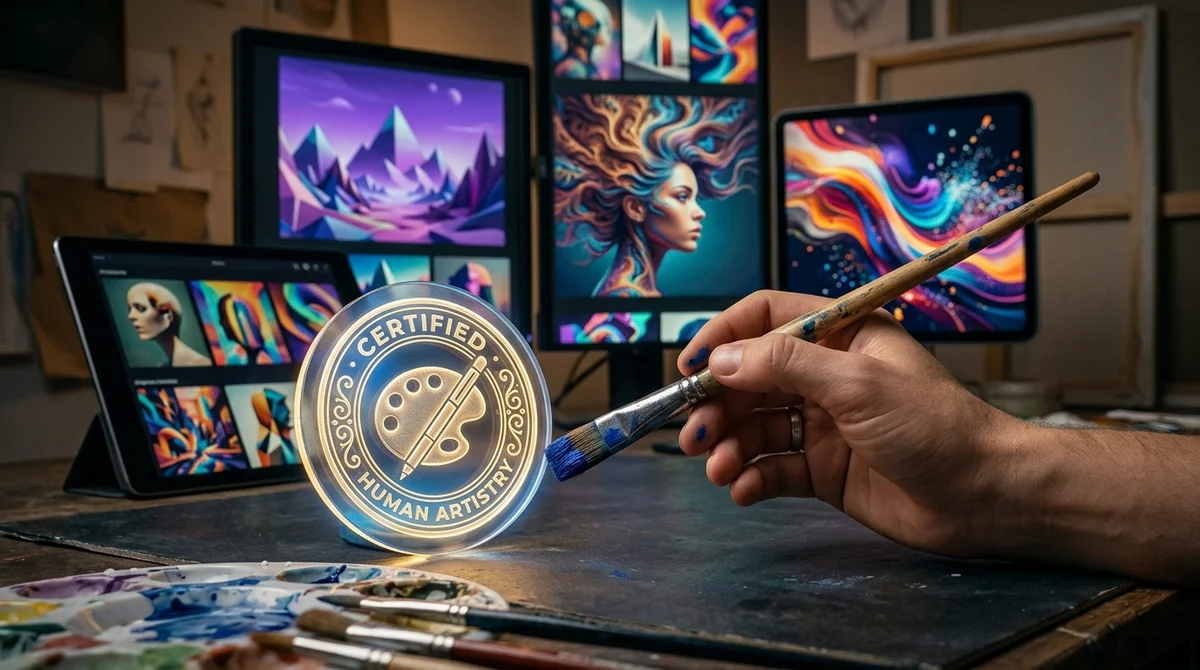
Platforms are in no rush to label even obviously generated content, while creators face the opposite problem: their own work gets mistaken for the output of a neural network. This is no longer an isolated complaint but a systemic crisis of trust in all digital creative work.
A journalist and amateur illustrator describes a situation many will recognize: you post a photograph or a drawing, and the comments say "looks like AI." Generative models have learned to imitate human style so convincingly that audiences have switched their default setting to suspicion. And that is rational: major platforms, including Instagram, YouTube and others, have still not rolled out reliable mandatory labeling of AI material, despite the existing C2PA standard.
The proposal the author discusses: instead of waiting for algorithms to start honestly labeling their own output, create a universal mark for human creativity, something like the Fair Trade logo that consumers instantly recognize on packaging. The logic is simple: machines have no motivation to disclose their origin, but living authors do. So they should take the initiative first.
The idea is not new, but it is now taking on a practical dimension. Several initiatives are already working on such standards, from watermarks to cryptographically signed metadata confirming human authorship. The problem is that none of these tools has yet won mainstream recognition or been built into the major platforms by default.
The economic context matters: the generative AI market is growing, and stock agencies, editorial desks and advertising budgets are shifting to cheap synthetic content. Illustrators, photographers and copywriters are losing commissions, not because their work is worse, but because, in the buyer's eyes, it has become indistinguishable. If a "made by human" mark gains the same cultural weight as an organic certificate or a craft-production badge, it could change consumer behavior. Part of the audience is willing to pay a premium for authenticity; the question is whether an infrastructure people can trust will emerge.
Until it does, every creator has to prove authorship by hand: publishing drafts, process timelapses and source files. It is tiresome, but for now it is the only approach that works.
*Meta is recognized as an extremist organization and banned in the Russian Federation.
- Nov 2, 2026Meta's Muse assistant keeps dossiers on loved ones and gets root on Ubuntu by default
- Nov 2, 2026The Verge reviewer builds a $50 Meta Muse Charm alternative with Claude Code
- Nov 1, 2026MoneyGate safety layer blocked all 42 fraudulent requests to local AI models
- Oct 31, 2026Open-source LLM gateway KTMS 1.0 plugs your own GPUs into the cloud and survives outages
Test Frontier LLMs & Autonomous Agents in One Workspace
Run Claude Opus 5.5, GPT-6, Gemini 3.1, and DeepSeek side-by-side in Nomad AI (nomadnet.ai) — unified model routing, deep research, and multimodal workflows under one subscription.
The AI world, distilled — once a week
Seven stories that actually mattered, hand-picked. No noise, no reposts, no press releases.
Done! Check your inbox for a confirmation.