UK government urged to protect authors from free AI training on their books
British writers have taken the dispute over AI and copyright to the London Book Fair. They are marking books with a Human Authored logo and handing out an empty anthology, Don’t Steal This Book, pressing the government to drop an opt-out scheme under which authors themselves must forbid the use of their texts for model training. According to Cambridge research, almost 60% of authors believe their work has already ended up in datasets without their consent.
AI-processed from Guardian; edited by Hamidun News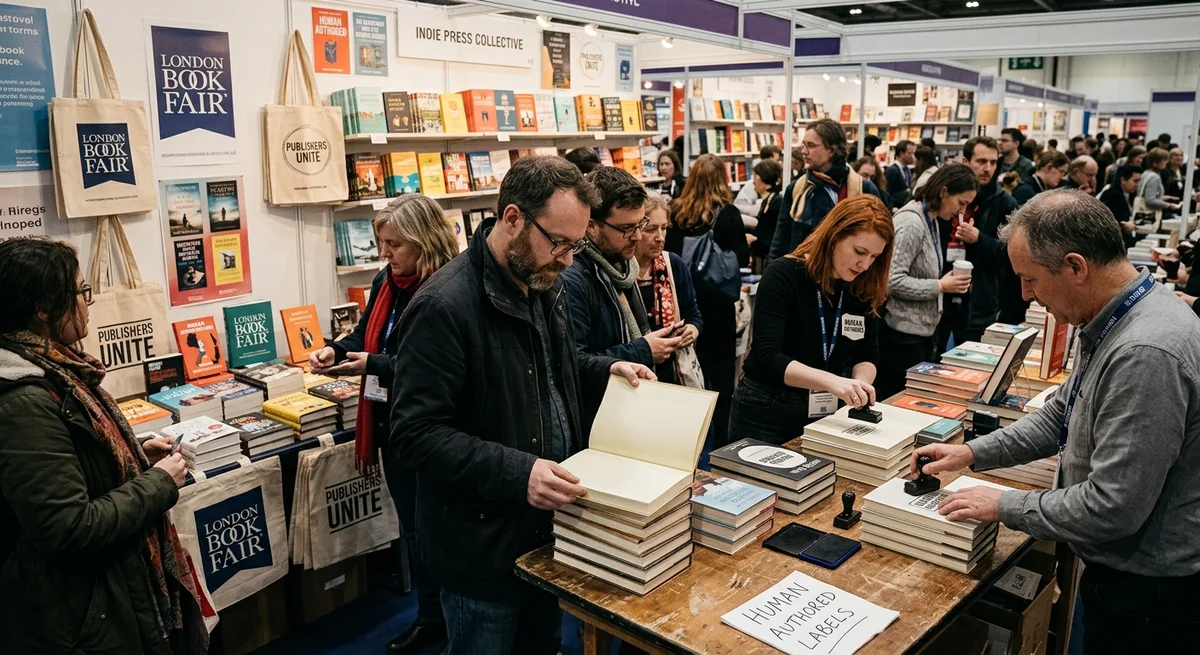
At the London Book Fair, British writers turned the dispute over AI and copyright into a public campaign. They want the government not to loosen the rules in favor of tech companies and not to turn books into free raw material for training models.
The book fair as protest
One of the most visible scenes at the fair was the labeling of books with the Human Authored logo. The UK Society of Authors launched the scheme as a stopgap protection and a way to remind the market that human creativity now has to identify itself separately next to AI content. A sticker alone does not solve the legal problem, but it shows the mood in the industry well: writers are no longer willing to watch in silence as their texts become training data for generative systems.
The second symbol of the campaign was the anthology Don’t Steal This Book, handed out to visitors. About 10,000 authors took part, including Kazuo Ishiguro, Malorie Blackman, Jeanette Winterson and Richard Osman. But the pages inside the book are empty. The gesture is blunt: if the state allows books to be used for model training without proper consent and payment, authors will see it as plain theft, only legalized under the banner of technological progress.
The dispute over the rules
The campaign comes at a particularly sensitive moment. Next week the UK government is due to publish a progress report on AI and copyright. The writers' anger was triggered by last year's proposals to relax current rules through an opt-out model: instead of a company obtaining permission in advance, the author is expected to opt out of having their work used. To many writers, this logic looks like an upside-down system of protection, in which the burden of policing infringement falls on the weaker party.
Authors see four points as critical in this fight:
- using books and articles for model training only with clear consent;
- fair payment if the work does end up in datasets;
- transparency about which texts were used and exactly how;
- dropping a scheme in which the author must hang out a "sign" themselves and ask that their content not be taken.
The outrage is backed by figures. According to a University of Cambridge study from last autumn, almost 60% of published authors believe their work has already been used to train large language models without consent and without compensation. Almost 40% said their income has already fallen because of generative AI or machine-made novels. Against this backdrop, author Philippa Gregory's remark that opt-out is like a sign on the door asking burglars to walk past sounds less like a metaphor than a description of a real imbalance of power.
Why the dispute is widening
A Guardian editorial stresses that nonfiction and factual books look especially vulnerable to ChatGPT. Sales of such books in the UK fell 6% in 2025 compared with 2024, to their lowest level since 2014. At the same time, painfully personal books, whose value rests on authentic experience and the author's voice, outperformed the market. This again shows that readers are looking for more than information in a convenient form: they want credible human testimony.
"AI can imitate words faster, but it has not bled on the page."
That thought comes from author Sarah Hall, who earlier asked for a Human Written stamp on her novel Helm.
The argument here is economic, not romantic. Britain's creative industries contributed £124 billion to the economy in 2023, of which £11 billion came from publishing. The Society of Authors is not asking for a ban on AI, but for basics: consent, fair payment and transparency. And a House of Lords report published last week describes two scenarios outright: either Britain becomes home to responsible, lawful AI, or it slides into silent acceptance of mass unlicensed use of creative content.
What it means
The story of the empty book and the Human Authored logos shows that the central conflict over generative AI is shifting from model quality to rights over the source material. If the authorities try to speed up the AI sector by weakening author protections, resistance from writers, publishers and the whole creative industry will only grow.
- Nov 1, 2026Local models lose to Opus and Codex: 0.21 on a MacBook versus 1.00 for Codex
- Nov 1, 2026Kimi scores 96.2% on a 1C database analytics test and emerges as a fallback if Claude access is blocked
- Nov 1, 2026OpenAI Rewrites GPT Behavior Rules: Five Values and a Chain of Command
- Nov 1, 2026Google admits AI Mode cuts search revenue, shares fall 15%
Key Questions Answered
What are the key details on The book fair as protest?
One of the most visible scenes at the fair was the labeling of books with the Human Authored logo. The UK Society of Authors launched the scheme as a stopgap protection and a way to remind the market that human creativity now has to identify itself separately next to AI content. A sticker alone does not solve the legal problem, but it shows the mood in the industry well: writers are no longer willing to watch in silence as their texts become training data for generative systems. The second symbol of the campaign was the anthology Don’t Steal This Book, handed out to visitor
What are the key details on The dispute over the rules?
The campaign comes at a particularly sensitive moment. Next week the UK government is due to publish a progress report on AI and copyright. The writers' anger was triggered by last year's proposals to relax current rules through an opt-out model: instead of a company obtaining permission in advance, the author is expected to opt out of having their work used. To many writers, this logic looks like an upside-down system of protection, in which the burden of policing infringement falls on the weaker party. Authors see four points as critical in this fight: using books and art
Why the dispute is widening?
A Guardian editorial stresses that nonfiction and factual books look especially vulnerable to ChatGPT. Sales of such books in the UK fell 6% in 2025 compared with 2024, to their lowest level since 2014. At the same time, painfully personal books, whose value rests on authentic experience and the author's voice, outperformed the market. This again shows that readers are looking for more than information in a convenient form: they want credible human testimony. "AI can imitate words faster, but it has not bled on the page." That thought comes from author Sarah Hall, who earli
Ship AI Faster with Founders, Engineers & Weekly Architecture Reviews
Inside Vibe Club (hamidun.com/club) — weekly live masterminds with Zhemal Khamidun, Tech Radar, full LMS access, and 370+ production Claude Code skills.
The AI world, distilled — once a week
Seven stories that actually mattered, hand-picked. No noise, no reposts, no press releases.
Done! Check your inbox for a confirmation.