Owners of detention centers and work camps strike gold in the AI boom
The companies building infrastructure for artificial intelligence have found some unexpected partners. As giant data centers move to remote regions with access to powerful power plants, local civilian infrastructure can no longer cope with thousands of workers. Tech corporations are now renting "man camps" in bulk: self-contained, enclosed settlements traditionally used by the oil industry or as US Immigration and Customs Enforcement (ICE) detention centers. The owners of these complexes see the AI revolution as a vast new market, proof that behind cloud technology stand harsh industrial realities.
AI-processed from TechCrunch; edited by Hamidun News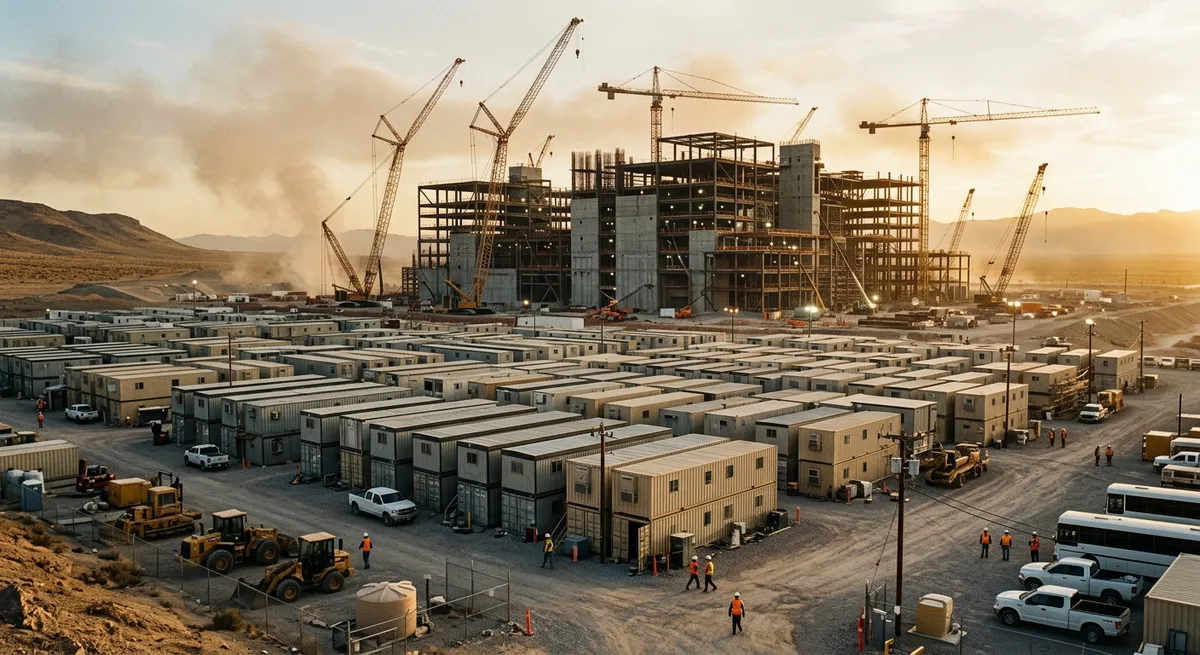
The AI industry is commonly pictured as living somewhere in an ethereal cloud, woven from complex algorithms, mathematical models and pure software code. The physical reality of this revolution is far more prosaic and harsh. Behind every breakthrough in training large language models stand millions of cubic meters of concrete, thousands of kilometers of copper cable and enormous amounts of human labor. The infrastructure boom, driven by the need to build ever more hyperscale data centers, has produced entirely unexpected business alliances and brought onto the stage players who are hard to associate with high technology.
Developers of AI infrastructure increasingly turn to companies that specialize in building temporary settlements for workers in extremely remote regions. In particular, operators that historically ran immigration detention centers for US Immigration and Customs Enforcement (ICE), and built so-called "man camps" for oil and mining workers, have found a new and enormously large gold mine in the AI boom. Their specific experience in rapidly deploying self-contained, enclosed residential complexes for thousands of people has proved critically in demand in the cutting-edge technology sector, which is now desperately short of hands on the periphery.
To understand the reasons for this paradoxical merger of industries, it helps to look at the rapidly changing geography of modern computing. Traditional data center hubs, such as the Northern Virginia region or the suburbs of Silicon Valley, now face a severe shortage of available power capacity. Local grids are overloaded, designing and building new substations takes years, and land prices have soared, making projects unprofitable.
In search of electricity that is cheap and, more importantly, available in huge volumes, tech corporations have headed into the American heartland. They are buying isolated plots in deserts and on abandoned industrial sites, close to nuclear power plants or large hydroelectric facilities. But building a technology facility worth tens of billions of dollars on an empty lot requires the continuous presence of a colossal army of construction workers.
When a division of several thousand engineers, welders, electricians and fitters arrives in a quiet rural county of a couple of thousand residents, local civilian infrastructure collapses instantly. Corporations book every roadside motel years ahead, the private rental market skyrockets and ruthlessly pushes out local residents, and modest grocery chains and narrow transport arteries simply cannot cope with the flow. It is at this point of infrastructure crisis that solutions proven over decades in the harsh realities of shale extraction and the industrial rushes of the last century come to the rescue.
Self-contained, enclosed work camps become the only logistically and economically justified option for developers determined to deliver their computing factories on time at any cost. These complexes are endless rows of fortified modular dormitories equipped with their own powerful generators, large canteens, laundries, medical stations and tough perimeter security systems. Companies that honed their skills on government contracts for holding undocumented migrants have unique and unrivaled expertise here. They know exactly how to set up a camp of five thousand beds far from civilization in the shortest possible time, ensure uninterrupted food deliveries and large-scale waste removal, and maintain strict order among a dense, exclusively male workforce.
This unexpected symbiosis exposes hidden ethical and reputational contradictions in the modern technology industry. Silicon Valley companies, which traditionally invest hundreds of millions of dollars in a spotless public image, actively promote inclusivity initiatives and take pride in high standards of corporate social responsibility, have to look the other way on the origins of their main infrastructure contractors. They quietly rely on corporations whose reputations are tied, at times scandalously and inseparably, to the prison system and the grueling conditions of oil fields. Even so, the harsh pragmatism of capitalism and the AI arms race leave them no choice: no other sector of the economy today can provide dependable infrastructure backup for such rapid deployment of technology megaprojects.
The way the situation around building autonomous server farms is unfolding shows plainly what the technology of the next decade really looks like. The current stage of generative AI is, above all, a large-scale story about heavy industry, brute physical force, logistics and classic real estate development. The most sophisticated virtual mind of the future is being forged right now by the calloused hands of ordinary fitters in the spartan conditions of remote isolation camps.
And while investors on Wall Street admire the new intellectual abilities of language models, the real and most profitable beneficiary of this progress may well turn out to be not only an elite chip maker, but also the owner of modular barracks in the middle of the desert.
Ship AI Faster with Founders, Engineers & Weekly Architecture Reviews
Inside Vibe Club (hamidun.com/club) — weekly live masterminds with Zhemal Khamidun, Tech Radar, full LMS access, and 370+ production Claude Code skills.
The AI world, distilled — once a week
Seven stories that actually mattered, hand-picked. No noise, no reposts, no press releases.
Done! Check your inbox for a confirmation.