SplatSSC: Gaussian Splats Learn to Fill in Reality From a Single Photo
At AAAI 2026, researchers presented SplatSSC, a new method for monocular semantic scene completion. It uses Gaussian splats (3DGS) instead of heavy voxels to reconstruct volume and recognize objects from a single photograph. The key idea is decoupled depth control, which separates geometry from semantics. That lets robots and autonomous vehicles understand their surroundings with ordinary, cheap cameras instead of expensive lidars. The efficiency and accuracy of reconstruction reach a new level, which could make 3D vision available to mass-market devices.
AI-processed from Jiqizhixin (机器之心); edited by Hamidun News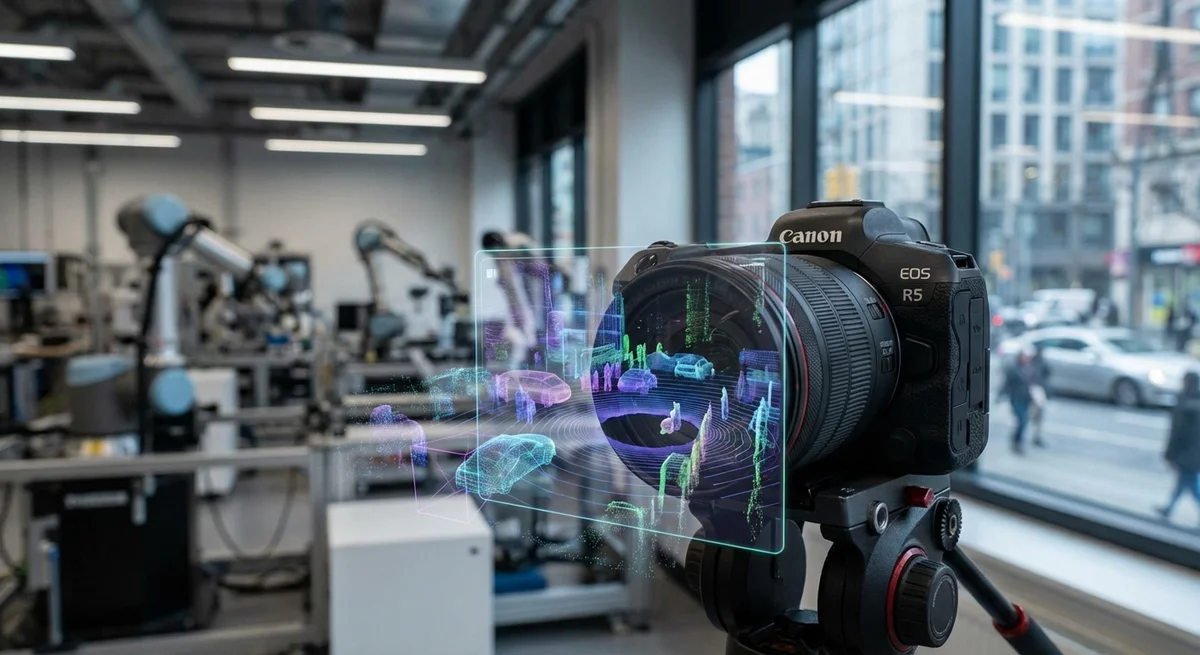
Robots and self-driving vehicles have long suffered from "flat" vision. To figure out what lies around a corner or how deep a corridor runs, they either had to be loaded with lidars or burn enormous computing resources on heavy voxel grids. At the prestigious AAAI 2026 conference, researchers presented a solution that may settle the question once and for all. SplatSSC brings the power of Gaussian splatting (3D Gaussian Splatting) to semantic scene completion (Semantic Scene Completion). Now the AI does not merely reconstruct geometry from a single photo, but also understands where the chair is, where the wall is, and where there is empty space that can be safely used for maneuvering.
Monocular vision has always been limited by a severe shortage of depth data. With only one lens, judging the exact distance to objects becomes a lottery. Researchers used to try building dense 3D grids from voxels, but the sheer volume of data turned any computer into an overheated space heater. SplatSSC changes the rules with a method of decoupled depth control. Instead of guessing, the algorithm splits the prediction of geometry and semantics into two independent but linked streams. This lets the system focus on detail where it really matters and avoid wasting precious resources on empty chunks of space.
What makes SplatSSC truly interesting is the decisive shift from heavy voxels to lightweight Gaussian points. Where the digital scene used to be a bulky pile of Lego bricks, it is now a cloud of graceful ellipsoids that smoothly describe surfaces of any complexity. This not only saves a radical amount of memory but also allows remarkable precision in object boundaries. For self-driving cars, that is the critical difference between "I see some blurry obstacle" and "I see a specific curb and clearly understand its height relative to the road surface."
The researchers did not just add another complicated acronym to academic textbooks. They tackled a fundamental problem: integrating 2D data into 3D space. Traditional methods often lost fine texture detail when lifting pixels into volume. SplatSSC preserves all the important information thanks to direct projection of Gaussians. This gives the algorithm the ability to reconstruct even parts of the scene that are currently occluded by other objects. The system literally fills in reality based on visual context and previously learned patterns, doing so many times faster than any existing competitor.
Why does this matter right now? We are on the threshold of mass adoption of personal home robots and budget autopilot systems. Nobody wants to pay an extra five thousand dollars for a lidar on a robot vacuum or a delivery drone. SplatSSC opens a direct path to advanced navigation with ordinary cameras that cost next to nothing. If the technology confirms its claimed performance in real-world field conditions, we could see a sharp jump in the quality of augmented reality and autonomous systems within the next couple of years.
Of course, questions remain about implementation on mobile hardware, but the very fact that a monocular camera can now compete with expensive multi-camera systems is impressive. The AAAI researchers have clearly struck gold in optimizing 3D vision. Now the ball is in the court of processor makers, who need to adapt chip architectures to the specific computations of Gaussian splats in order to turn this software into an industry standard.
The bottom line: SplatSSC shows that understanding the 3D world does not require expensive sensors, only smart depth-decoupling algorithms. Will lidars be able to survive in a world where an ordinary camera sees almost as sharply?
- Nov 2, 2026Karpathy builds a YouTube clone with 6454 videos from Hacker News recommendations in two hours
- Nov 2, 2026Karpathy used Claude to build HackerTube from 6,454 videos recommended on Hacker News
- Nov 2, 2026Arca gives AI agents finance tasks lasting up to 10 days, but leaves the trades to humans
- Nov 2, 2026DeepSeek open-sources Super-agent prototype: p95 task completion time of 15.7 minutes vs. 29.5
Test Frontier LLMs & Autonomous Agents in One Workspace
Run Claude Opus 5.5, GPT-6, Gemini 3.1, and DeepSeek side-by-side in Nomad AI (nomadnet.ai) — unified model routing, deep research, and multimodal workflows under one subscription.
The AI world, distilled — once a week
Seven stories that actually mattered, hand-picked. No noise, no reposts, no press releases.
Done! Check your inbox for a confirmation.