Luma launches creative AI agents built on its "Unified Intelligence" models
Luma has introduced Luma Agents, a platform of creative AI agents running on its new Unified Intelligence models. The system can coordinate several AI models at once and generate content through an end-to-end pipeline covering text, images, video, and audio. In effect, Luma isn't offering a standalone tool but an orchestrator that manages an entire ecosystem of generative models. That's a serious bid in a market that has so far been dominated by point solutions for each media type.
AI-processed from TechCrunch; edited by Hamidun News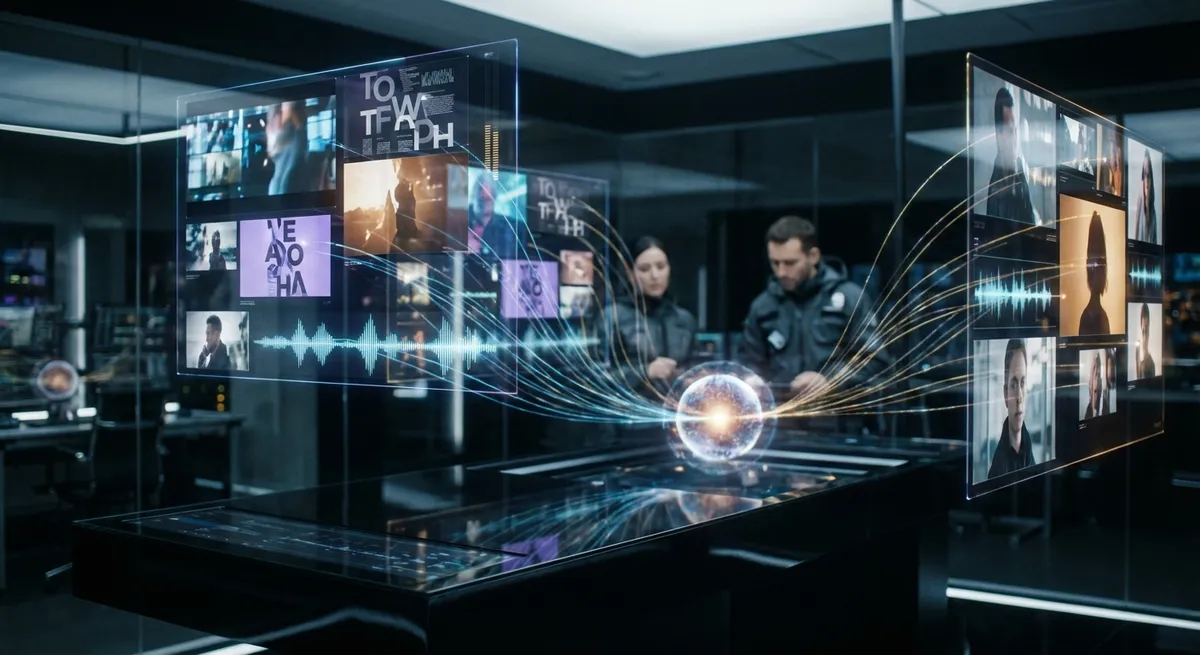
Generative AI has so far lived in a world of separate tools: one model writes text, another draws pictures, a third edits video. Luma decided it was time to bring all of that together into a single orchestra, and it has introduced Luma Agents, a platform of creative AI agents built on the company's own family of models with the ambitious name Unified Intelligence.
The announcement is simple and sweeping at the same time. Luma Agents isn't yet another image generator or a video editor with a neural network under the hood. It's a coordination system that can manage several AI models at once and assemble their work into a single end-to-end pipeline. A creative brief goes in; a finished multimedia product comes out, complete with text, images, video, and audio. The agents act as a producer: they break the task down, hand the pieces to specialized models, keep the results consistent, and assemble the final product.
To see why this matters, it helps to recall the context. Luma Labs first made its name with Dream Machine, a video generation model that quickly became one of the main rivals to OpenAI's Sora and to Runway. But generative video is commoditizing fast: dozens of companies offer similar capabilities, and competing on image quality alone keeps getting harder. The logical next step is to move up a level and offer not a single model but a full platform that can orchestrate many models. That is exactly what Luma is doing with this launch.
The Unified Intelligence models that power the platform deserve a closer look. The name itself hints at the architectural philosophy: instead of a set of disconnected neural networks, Luma is building a unified foundation in which different modalities — text, visuals, sound — are processed within a single representation. The approach isn't new in research circles: Google with Gemini and Meta with its multimodal models are moving in the same direction. But Luma is betting that a unified architecture is especially well suited to the agent paradigm, where coordination across modalities is critical.
The practical consequences of this launch could be significant for entire sectors of the creative industry. Picture an ad agency that needs to build a campaign: a script, visual assets, video spots, and an audio track. Today that means working across five or six different tools, manually keeping style and tone consistent, and going through many rounds of iteration. Luma Agents promises to collapse that process into a single request. Of course, there's always a gap between promise and reality, but the direction itself is telling.
It's also worth noting that Luma fits into a broader 2026 trend: the shift from standalone models to agent systems. OpenAI, Anthropic, Google — all the major players are actively building agent frameworks. But most of them focus on productivity and workflow automation. Luma is staking out a clearly different niche, aiming squarely at creative production. It's smart strategic differentiation: rather than taking on the giants head-on, the company is choosing territory where its expertise in visual content generation becomes a real advantage.
Skeptics will, of course, raise fair questions. How reliable is the coordination between agents? How well does the system maintain a consistent style across an entire project? What happens when one agent's output doesn't satisfy the user — can individual elements be corrected selectively? The answers will determine whether Luma Agents becomes a real working tool or remains an impressive demo.
One thing is certain: the era of "one model, one task" is coming to an end. The future of generative AI lies in systems that can think in terms of projects rather than individual prompts. Luma has placed one of the first serious bets on that future in the creative space, and the results of this experiment are worth watching closely.
*Meta is designated an extremist organization and banned in Russia.
- Nov 2, 2026Meta's Muse assistant keeps dossiers on loved ones and gets root on Ubuntu by default
- Nov 1, 2026Local models lose to Opus and Codex: 0.21 on a MacBook versus 1.00 for Codex
- Nov 1, 2026Kimi scores 96.2% on a 1C database analytics test and emerges as a fallback if Claude access is blocked
- Nov 1, 2026OpenAI Rewrites GPT Behavior Rules: Five Values and a Chain of Command
Ship AI Faster with Founders, Engineers & Weekly Architecture Reviews
Inside Vibe Club (hamidun.com/club) — weekly live masterminds with Zhemal Khamidun, Tech Radar, full LMS access, and 370+ production Claude Code skills.
The AI world, distilled — once a week
Seven stories that actually mattered, hand-picked. No noise, no reposts, no press releases.
Done! Check your inbox for a confirmation.