AI Has Learned to Unmask Anonymous Social Media Accounts
Researchers from ETH Zurich, Anthropic and the MATS program have published a paper describing an automated system of AI agents that can deanonymize internet users. The system can search the web and cross-reference data from different sources, linking anonymous accounts to real people. The work has not yet been peer-reviewed, but it already raises serious questions about the future of online privacy. Secret accounts on Reddit, X or Glassdoor may be far less protected than their owners believe.
AI-processed from The Verge; edited by Hamidun News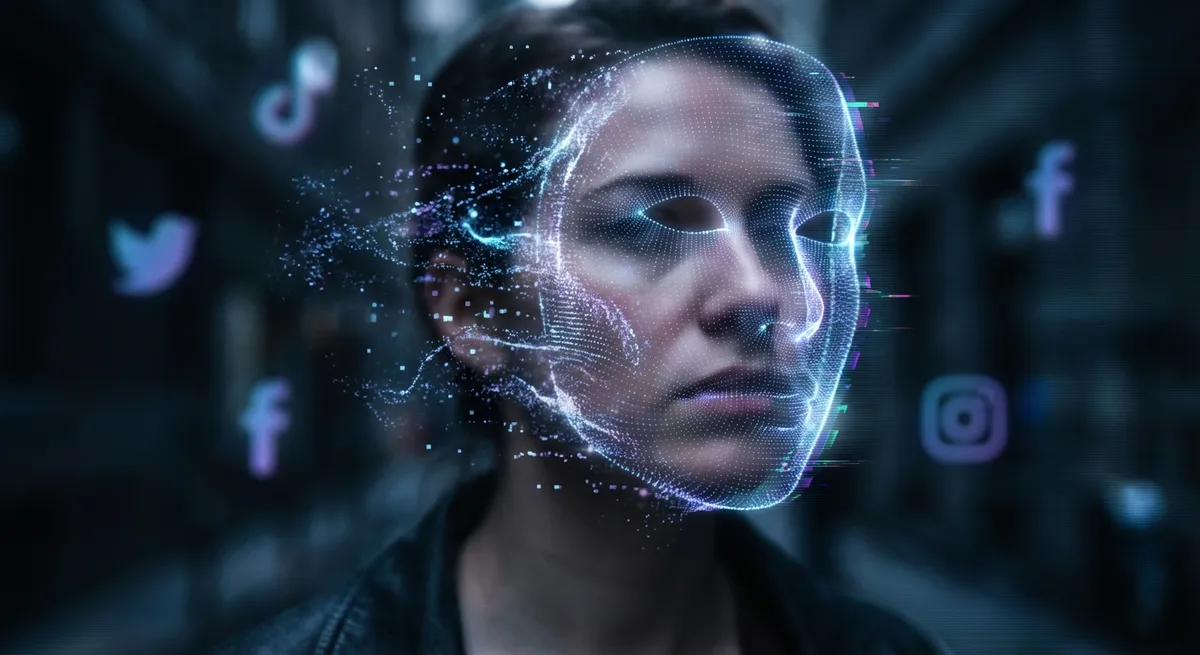
Do you have an anonymous Reddit account where you speak frankly about your boss? Or a secret social media profile where you allow yourself to be your real self? A new study shows that artificial intelligence can link those accounts to your real identity, and do it faster and more efficiently than any private detective.
A group of researchers from Switzerland's ETH Zurich, the company Anthropic and the Machine Learning Alignment and Theory Scholars (MATS) program has developed an automated system of AI agents that can deanonymize internet users. The system uses unnamed language models that can search the web on their own, analyze what they find and build chains of connections between scattered accounts. In effect, it is a digital investigator that never tires and never loses the thread of its reasoning.
To grasp the scale of the problem, it helps to recall how deanonymization used to work. Unmasking an anonymous account traditionally required either substantial resources, like those of intelligence agencies or large corporations, or a blunder by the user: a photo published by accident with geolocation data, the same nickname reused across platforms, distinctive turns of phrase. The process was labor-intensive, expensive and did not scale. One analyst could work a single investigation for weeks. Artificial intelligence changes this economics radically. What once took a team of specialists and months of work, a system of AI agents could potentially do in hours or even minutes, and for thousands of accounts at once.
Technically, the researchers' approach relies on the ability of modern language models to perform so-called multi-step reasoning. An AI agent does not simply compare two texts for stylistic similarity; it builds complex logical chains. Did you mention on your anonymous account that you live near a particular park? Did you write on your main profile about a favorite coffee shop in the same neighborhood? Do you use a specific professional term in both places? Each such detail proves nothing on its own, but together they form a unique digital fingerprint. Modern models excel at exactly this task: synthesizing scattered fragments of information into a coherent picture.
It is important to note that the study has not yet been peer-reviewed, and the authors do not disclose which models were used in the experiments. This means the specific results should be treated with caution. Still, the very fact that Anthropic, a company that positions itself as a leader in AI safety, took part in the work says a lot. The research was most likely conducted as part of a risk assessment: before releasing ever more powerful models, you need to understand what threats they pose. And deanonymization is one of the most serious.
The consequences of this finding go far beyond the awkward situation of a boss discovering your anonymous Glassdoor review. Anonymity online is not just a convenience; it is a fundamental tool of free speech. Whistleblowers exposing corruption. Residents of authoritarian states criticizing those in power. Victims of domestic violence seeking help. Activists in countries where dissent is persecuted. For all these people, anonymity is not a whim but a matter of safety, and sometimes of life. If AI deanonymization tools become widely available, the balance of power in the information space will shift toward those who already hold power: corporations, states and stalkers.
For a Russian audience, this topic is especially acute. When anonymous speech online remains for many the only safe way to express an opinion, the emergence of accessible AI-based deanonymization tools creates an entirely new landscape of risk. Defending against such systems is also much harder than against traditional methods: using a VPN and different nicknames is not enough if your writing style, set of interests and behavioral patterns become a unique identifier.
The study's authors rightly note that it is too early to bury anonymity. There is a significant distance between a lab demonstration and mass use. But the direction of travel is clear: with each generation of language models, deanonymization will become easier and cheaper. That means the industry, regulators and users themselves need to think seriously about new privacy protections, ones that account for the capabilities of AI and not only traditional threats. The time when anonymity was ensured by simply creating a new account under a made-up name is passing.
- Nov 2, 2026Karpathy builds a YouTube clone with 6454 videos from Hacker News recommendations in two hours
- Nov 2, 2026Karpathy used Claude to build HackerTube from 6,454 videos recommended on Hacker News
- Nov 2, 2026Arca gives AI agents finance tasks lasting up to 10 days, but leaves the trades to humans
- Nov 2, 2026Anthropic needs to grow revenue 32% a year to cover $850 billion in contracts
Test Frontier LLMs & Autonomous Agents in One Workspace
Run Claude Opus 5.5, GPT-6, Gemini 3.1, and DeepSeek side-by-side in Nomad AI (nomadnet.ai) — unified model routing, deep research, and multimodal workflows under one subscription.
The AI world, distilled — once a week
Seven stories that actually mattered, hand-picked. No noise, no reposts, no press releases.
Done! Check your inbox for a confirmation.