Nvidia invests $103 million in British self-driving startup Oxa
Nvidia has backed British autonomous-driving startup Oxa in a $103 million funding round. It is not the California chipmaker's first investment in British self-driving technology. Nvidia is steadily expanding its presence in autonomous transport, offering not only capital but also its Drive computing platform. For Oxa, the deal opens access to the infrastructure and ecosystem of the world's most valuable company by market capitalization.
AI-processed from Bloomberg Tech; edited by Hamidun News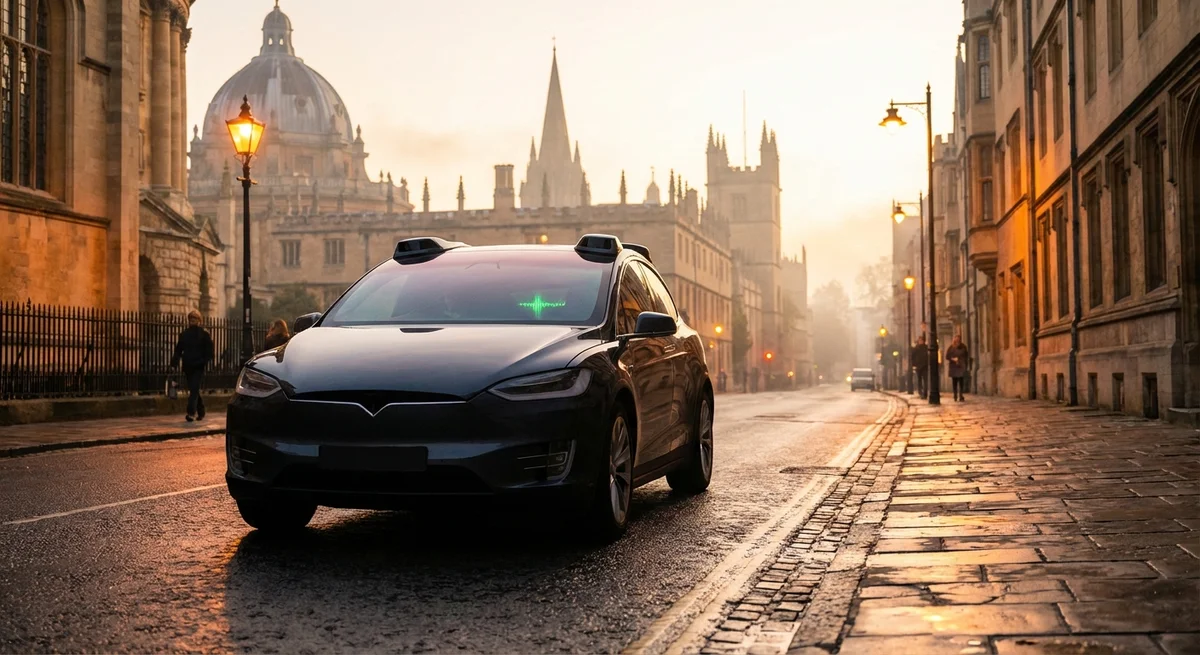
The world's most valuable company keeps methodically positioning its pieces on the autonomous-transport chessboard. Nvidia has joined the investors in British startup Oxa, which raised $103 million in a new funding round. For the UK, it is further confirmation that the country is becoming a significant hub for self-driving technology. For Nvidia, it is another strategic move in a race where the stakes are measured in trillions.
Oxa is not the best-known name on the autonomous-driving map, but the company deserves attention. The startup, which grew out of a University of Oxford research program, develops software for autonomous vehicles. Unlike giants such as Waymo or Cruise, which build their own robotaxi fleets, Oxa is betting on a universal platform: software that can be integrated into different types of vehicles, from trucks to shuttles. It is a fundamentally different approach, and it is apparently what caught Nvidia's eye.
For the California chipmaker, the investment in Oxa is part of a broad strategy that reaches far beyond making graphics processors. Nvidia stopped being merely "the company that makes graphics cards for gamers" a long time ago. Its Drive platform, designed for autonomous driving, is used by dozens of automakers and startups around the world. By putting money into companies like Oxa, Nvidia tackles two goals at once: it widens the ecosystem around its chips and gets early access to promising technologies that could shape the future of the transport industry.
The geographic context matters too. In recent years the UK has deliberately built a reputation as Europe's leader in autonomous technology. The government is actively working on a regulatory framework for self-driving vehicles, and British universities, including Oxford, Cambridge and Imperial College London, produce a steady stream of startups in the field. For Nvidia, investing in British companies is also a way to gain a foothold in the European market, which still lags behind the US and China in autonomous-driving development but has enormous growth potential.
A $103 million round is a serious sum for Oxa, but by the standards of the autonomous-driving industry it looks modest. Waymo has raised more than $5 billion over its lifetime, and Chinese competitors operate with comparable budgets. Still, for a startup betting on a software platform rather than its own vehicle fleet, that level of funding may be enough to reach the commercial stage. Oxa's key advantage is a relatively light business model: the company does not need to buy and maintain thousands of cars, it only needs to license its software to partners.
Nvidia's participation in the round gives Oxa something more than money. It brings access to computing infrastructure, engineering expertise and, especially important, Nvidia's global network of automotive partners. When the world's largest company by market capitalization bets on a startup, it sends a signal to the whole market, from potential customers to future investors. For Oxa, it is a kind of seal of quality that could sharply speed up talks with automakers and logistics companies.
More broadly, the deal reflects an important trend: the biggest tech companies are investing ever more actively in autonomous driving, even though the industry went through a period of disillusionment in 2022-2024. After a string of crashes, revoked licenses and the shutdown of projects such as Argo AI, many wrote self-driving cars off. Now the pendulum has swung back. Waymo's successes in San Francisco, the progress of Chinese companies and growth in computing power have brought optimism back to the industry. Nvidia evidently believes the window of opportunity is opening right now, and it intends to be on the right side of that window by investing in startups in key markets worldwide.
- Nov 2, 2026TensorFold 1.2.0 boosts Qwen3.8-27B throughput on M3 Ultra by 44.2% at 16 streams
- Nov 1, 2026Local models lose to Opus and Codex: 0.21 on a MacBook versus 1.00 for Codex
- Nov 1, 2026Habr author fine-tunes YOLOv8l on dental X-rays and pushes mAP50 to 0.642
- Nov 1, 2026Voice bots built on LLMs turn to Jev, a fast classifier, for decisions in 200–500 ms
Ship AI Faster with Founders, Engineers & Weekly Architecture Reviews
Inside Vibe Club (hamidun.com/club) — weekly live masterminds with Zhemal Khamidun, Tech Radar, full LMS access, and 370+ production Claude Code skills.
The AI world, distilled — once a week
Seven stories that actually mattered, hand-picked. No noise, no reposts, no press releases.
Done! Check your inbox for a confirmation.