US Supreme Court Closes the Case: AI Cannot Hold a Copyright
The US Supreme Court rejected the appeal of scientist Stephen Thaler, who tried to register a copyright for an image created by his algorithm. The case dragged on since 2019, when the Copyright Office first refused to register the work "A Recent Entrance to Paradise", citing the absence of human authorship. The Supreme Court's decision effectively locks in a legal precedent: works created entirely by AI with no human involvement cannot be protected by copyright in the US. It is a key signal for the entire generative AI industry.
AI-processed from The Verge; edited by Hamidun News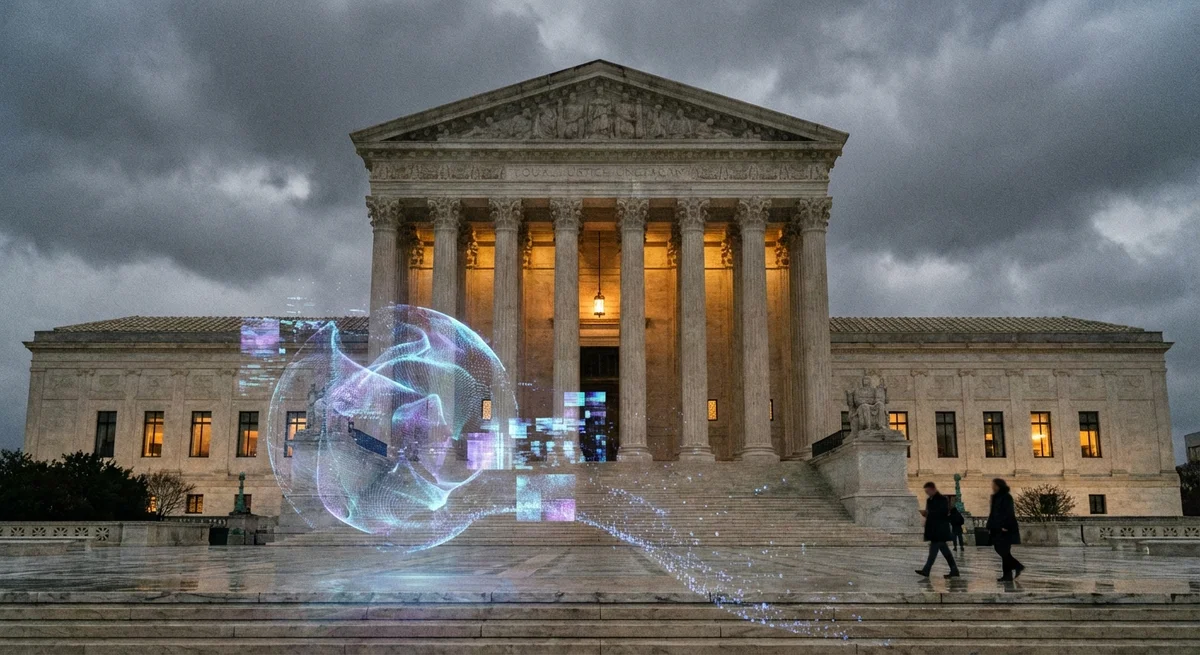
A six-year legal odyssey for a computer scientist from Missouri ended on Monday with a short, blunt decision: the Supreme Court of the United States declined to hear a case on copyright for works created by artificial intelligence. No comment, no caveats, no hope of review. Works generated entirely by a machine are not subject to copyright, and this is no longer just the position of one agency but a principle effectively established at the highest judicial level.
The story began in 2019, when Stephen Thaler filed an application with the US Copyright Office to register an image titled "A Recent Entrance to Paradise". What set the application apart was that Thaler listed as the author not himself but an algorithm he had built, an AI system called Creativity Machine. Thaler presented himself merely as the owner of the machine, insisting that authorship should belong to the algorithm and that the rights to the work should pass to him as the system's creator under the "work made for hire" principle. The Copyright Office rejected the application, pointing to a fundamental requirement: to receive copyright, a work must be the product of human creativity.
Thaler did not give up. In 2022 the Office reviewed his application again and reached the same conclusion: the image contains no "human authorship" and therefore cannot be protected by copyright. The scientist turned to the federal courts, but lost there too: the District Court for the District of Columbia upheld the Office's position, and the appeals court left that ruling in force. The Supreme Court remained the last resort, and on Monday, March 2, it rejected Thaler's petition for review without further explanation.
The context of this decision matters. Since Thaler filed his first application, the generative AI industry has seen explosive growth. Millions of people use DALL-E, Midjourney, Stable Diffusion and other tools every day to create images, text, music and video. The question of who owns the rights to these works has gone from academic to acutely practical. Companies are building business models around generative content, artists accuse developers of using their work to train models, and lawyers are trying to work out how century-old copyright laws apply to a fundamentally new technology.
Brief as it is, the Supreme Court's decision draws some important lines. It does not mean that any content made with the help of AI automatically loses legal protection. The US Copyright Office has already developed a more nuanced approach: if a person makes a sufficient creative contribution, such as writing the prompt, editing the output or arranging elements, the work may receive partial protection.
The 2023 precedent of the graphic novel "Zarya of the Dawn" confirmed this: the text and the page layout received copyright, while the individual images generated by Midjourney did not. Thaler's case was fundamentally different: he deliberately removed the human from the creative process to test whether a machine could become an author itself. The answer turned out to be unambiguous: no.
The ruling has far-reaching consequences for the industry. Startups selling fully automated content generation cannot count on copyright protection for their products. That creates a paradoxical situation: a company may spend millions of dollars training a model, yet the output ends up in the public domain, free for anyone to copy. On the other hand, it encourages an approach in which AI is a tool in human hands rather than an independent creator, and that model of interaction may well prove the most productive for both business and culture.
It is worth noting that the American precedent will inevitably influence legal debates in other jurisdictions. The European Union, China, Japan and other countries are still shaping their own approaches to regulating generative AI, and the position of the top court of the world's largest economy will carry weight in those debates. In Russia, where copyright for AI content has not yet received a clear legal framework, the American experience will also be studied closely.
The outcome of Stephen Thaler's six-year fight was predictable, but no less significant for that. The Supreme Court did not change the rules of the game; it confirmed that copyright remains a human privilege. Artificial intelligence can create masterpieces, but legally they belong to no one. And until lawmakers decide otherwise, it is the human hand on the keyboard, or at least a human idea behind the prompt, that remains the boundary between a protected work and a digital no-man's-land.
- Oct 29, 2026Modal Passes $1B ARR and Hits a $16B Valuation on Demand for Sandboxes
- Oct 26, 2026Getty Images Says It Will File for Bankruptcy to Go Private; Shares Fall 68%
- Oct 26, 2026Getty Images files for bankruptcy to restructure as shares crash 68%
- Oct 26, 2026Getty Images prepares to file for bankruptcy: shares plunge 68% as owners put in $533 million
Test Frontier LLMs & Autonomous Agents in One Workspace
Run Claude Opus 5.5, GPT-6, Gemini 3.1, and DeepSeek side-by-side in Nomad AI (nomadnet.ai) — unified model routing, deep research, and multimodal workflows under one subscription.
The AI world, distilled — once a week
Seven stories that actually mattered, hand-picked. No noise, no reposts, no press releases.
Done! Check your inbox for a confirmation.