OpenAI and a US National Lab Set Out to Speed Up Bureaucracy With AI
OpenAI and the US Department of Energy's Pacific Northwest National Laboratory (PNNL) have introduced DraftNEPABench, a benchmark that measures how AI agents can speed up NEPA, the federal environmental review process. Early tests suggest AI could cut documentation prep time by 15%. The move sends a clear signal: the biggest AI companies are now aiming beyond creative tasks at the tightest bottleneck in American infrastructure — the bureaucratic approvals that stall data centers, power grids, and transportation projects for years.
AI-processed from OpenAI Blog; edited by Hamidun News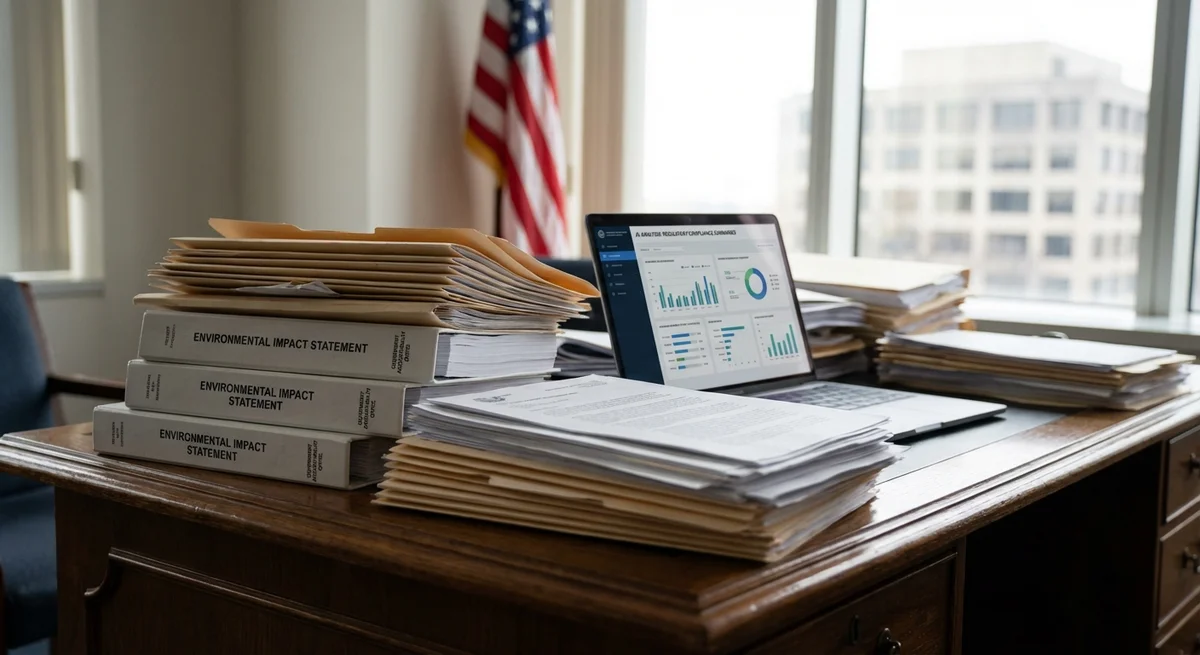
Federal environmental review in the US is a process that developers, environmentalists, and government officials all hate in equal measure. NEPA (the National Environmental Policy Act), passed back in 1970, requires an extensive environmental impact assessment before any major infrastructure project with federal involvement can begin. Preparing a single set of documents takes four to seven years on average. Now OpenAI and Pacific Northwest National Laboratory (PNNL), one of the Department of Energy's leading research institutions, want to find out whether artificial intelligence can cut this Gordian knot.
The partners have introduced DraftNEPABench, a specialized benchmark that measures how well AI agents working with code and text can draft environmental reviews to NEPA standards. This isn't an abstract academic exercise. The benchmark draws on real data from federal reviews and simulates the specific tasks analysts face: collecting and organizing environmental data, generating structured reports, and cross-checking regulatory requirements. Initial testing showed that AI agents can cut the time needed to prepare draft documentation by roughly 15%.
Fifteen percent may sound modest — until you consider the scale of the problem. In the United States, NEPA has become one of the biggest obstacles to modernizing infrastructure. New power lines, wind and solar farms, highways, and — of particular interest to the tech industry — massive data centers all get stuck in years of bureaucratic approvals. According to the White House Council on Environmental Quality, the average environmental impact statement (EIS) runs longer than 600 pages. Some projects produce thousands of pages of supporting documentation. At that volume, even a 15 percent speedup translates into months of saved time and millions of saved dollars.
OpenAI didn't pick its partner at random. PNNL has more than 60 years of history and specializes in energy, environmental science, and national security. It brings unique expertise in environmental regulation and access to troves of federal data that a private company simply couldn't obtain on its own.
For OpenAI, the project is a strategic move on several fronts. First, the company gets to show that its technology reaches far beyond chatbots and image generation. Second, it builds ties with the federal government at a moment when the administration is actively looking for ways to speed up infrastructure construction.
Third — and perhaps most interesting — OpenAI is indirectly solving its own problem: the company desperately needs new data centers and power capacity, and their construction is held up by the very bureaucracy it is now helping to streamline.
The benchmark's design deserves a closer look. DraftNEPABench doesn't just evaluate language models; it evaluates AI agents specifically — autonomous systems that can carry out multistep tasks: finding relevant data, analyzing the regulatory framework, generating structured text, and checking it for compliance. This reflects a broader industry trend in 2026: the shift from conversational models to models that execute, taking over real workflows. In effect, the benchmark sets a standard for evaluating AI in government paperwork — a field that until now has had almost no tools for objective measurement.
Critics, however, are already raising fair questions. Environmental groups worry that automating reviews could degrade their quality — after all, NEPA exists not to generate red tape but to protect the environment and the rights of local communities. Speeding up the process shouldn't mean dumbing it down. There are legal wrinkles, too: who is liable for errors in documentation prepared with AI assistance? How do you ensure transparency and public oversight if an algorithm has done a significant share of the analytical work?
Still, the direction is set, and it looks irreversible. If DraftNEPABench proves effective across a broader range of tasks, tools like it will inevitably spread beyond environmental review — to building permits, licensing, tax audits, and dozens of other bureaucratic procedures. For Russia, where approving major projects can take at least as long as in the US, this case is of particular interest. Not as a ready-made solution — the regulatory frameworks differ too much — but as proof of concept: artificial intelligence can handle not only creative tasks but also the most routine, most heavily regulated parts of the government machine. And that may be exactly where its impact is felt most.
- Nov 2, 2026NC State's AICG Framework Cuts MAE by 50.3% on Math Answer Grading
- Nov 2, 2026Я устроил допрос 6 нейросетям про себя и своё ИП глазами заказчика: как ИИ выдумал мне бизнес на Amazon в США и слил смету из закрытого КП
- Nov 2, 2026TJ Digital: 23% of AI-cited pages open with a direct answer, versus 14% of uncited ones
- Nov 2, 2026Arca gives AI agents finance tasks lasting up to 10 days, but leaves the trades to humans
Test Frontier LLMs & Autonomous Agents in One Workspace
Run Claude Opus 5.5, GPT-6, Gemini 3.1, and DeepSeek side-by-side in Nomad AI (nomadnet.ai) — unified model routing, deep research, and multimodal workflows under one subscription.
The AI world, distilled — once a week
Seven stories that actually mattered, hand-picked. No noise, no reposts, no press releases.
Done! Check your inbox for a confirmation.