Baidu loses $11 billion in market value as investors tire of AI promises
Baidu shares plunged 20% over the past month, wiping out about $11 billion in market capitalization. Investors have grown tired of waiting for a real return on the company's massive artificial intelligence spending. The sell-off is a warning for everyone in China's AI race: the market no longer accepts big promises without tangible financial results. Baidu, once the undisputed leader of China's tech sector, now has to prove that its AI strategy can generate profit, not just headlines.
AI-processed from Bloomberg Tech; edited by Hamidun News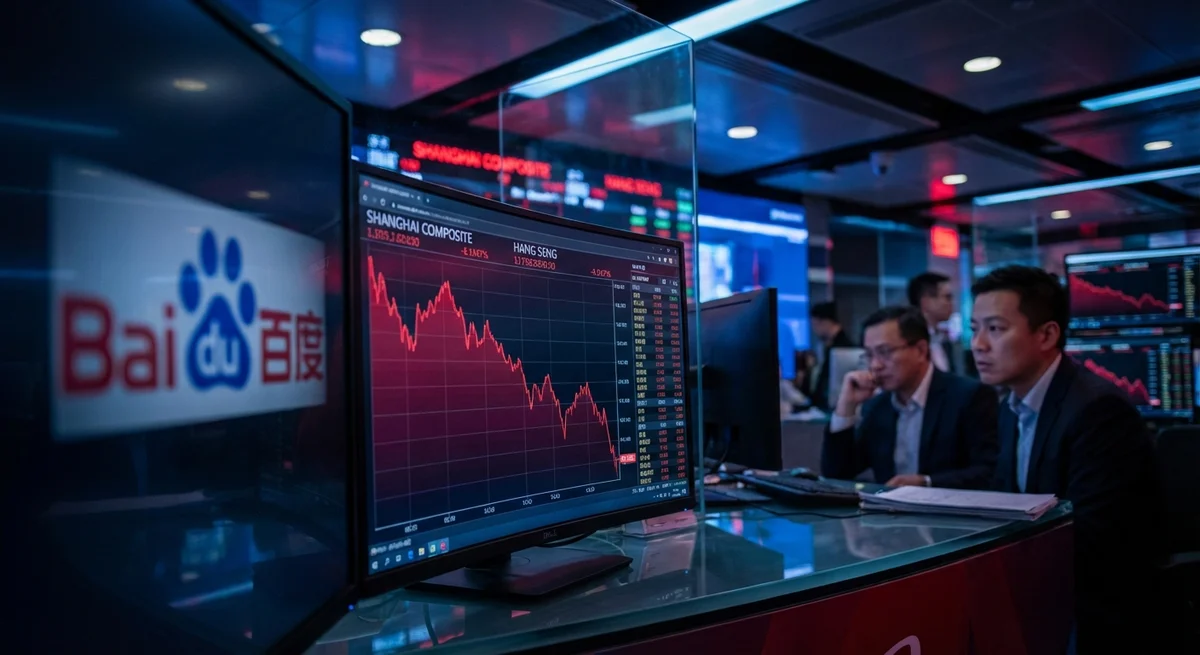
Eleven billion dollars: that is how much market value Baidu lost in a single month. Shares of the Chinese tech giant fell 20%, and the rapid sell-off may be the most eloquent message investors could send to companies betting on artificial intelligence: enough promises, show us the money.
Baidu was long considered the clear favorite in China's AI race. It was one of the first companies in the country to unveil its own large language model, Ernie Bot, positioning it as an answer to ChatGPT. Robin Li, Baidu's chief executive, regularly appeared at conferences with ambitious claims about how AI would transform every part of the business, from search to cloud services and autonomous driving. For a while, the market happily bought that story. But its patience has run out.
Baidu's problem is not unique; it is systemic across the industry. Companies worldwide have poured hundreds of billions of dollars into AI development, yet monetization remains a painful question. The difference is that American giants such as Microsoft or Google can lean on existing ecosystems with billions of paying users. Baidu has no such cushion. Its core business, search advertising, is stagnating under pressure from competitors, above all ByteDance and its aggressive expansion. The cloud division is growing, but not fast enough to offset the slowdown in advertising. And the Apollo autonomous driving project, which has swallowed enormous resources, is still far from paying for itself.
The Chinese market context makes the situation even tenser. After DeepSeek made a splash earlier this year with an efficient model built at relatively modest cost, investors began to revise their expectations. If a startup can compete with the largest labs without burning billions on infrastructure, what is the real value of Baidu's giant AI investments? The question hangs in the air, and there is no answer yet. Alibaba and Tencent are also expanding their AI efforts, but more cautiously, integrating models into products that are already profitable: e-commerce, messaging, games. Baidu, by contrast, bet practically everything on AI and made it the central narrative for investors. When the narrative stops working, the fall is especially painful.
There is a deeper problem as well. Chinese tech companies operate under strict US export restrictions on advanced chips. That means access to NVIDIA's most powerful GPUs is limited, so training and scaling models costs more and demands more ingenuity. Baidu says it is developing its own Kunlun AI accelerators, but their performance does not yet match the market leaders. When every dollar spent on compute must deliver measurable returns, a hardware gap becomes a strategic vulnerability.
The Baidu sell-off is not just the story of one company. It is an indicator of a change in market sentiment. The period when a mere mention of artificial intelligence in a quarterly report lifted share prices is coming to an end. Investors are entering what analysts call the "trough of disillusionment", the stage where inflated expectations collide with reality and the market starts separating companies with real products from those peddling hope. For Baidu, this means it must demonstrate concrete metrics in the coming quarters: growth in AI services revenue, more enterprise customers on its cloud platform, and progress in commercializing autonomous driving.
Still, it would be premature to write Baidu off. The company retains one of the strongest AI teams in China, substantial computing resources and decades of accumulated data. The question is not whether Baidu has the technology, but whether it can turn it into a sustainable business before the market's patience runs out. Eleven billion dollars that evaporated in a month amount to an unmistakable ultimatum. The clock is ticking.
- Nov 2, 2026Meta's Muse assistant keeps dossiers on loved ones and gets root on Ubuntu by default
- Nov 1, 2026Local models lose to Opus and Codex: 0.21 on a MacBook versus 1.00 for Codex
- Nov 1, 2026Kimi scores 96.2% on a 1C database analytics test and emerges as a fallback if Claude access is blocked
- Nov 1, 2026OpenAI Rewrites GPT Behavior Rules: Five Values and a Chain of Command
Test Frontier LLMs & Autonomous Agents in One Workspace
Run Claude Opus 5.5, GPT-6, Gemini 3.1, and DeepSeek side-by-side in Nomad AI (nomadnet.ai) — unified model routing, deep research, and multimodal workflows under one subscription.
The AI world, distilled — once a week
Seven stories that actually mattered, hand-picked. No noise, no reposts, no press releases.
Done! Check your inbox for a confirmation.