Ailias builds holograms of historical figures for one-on-one conversations
Ailias has unveiled holographic avatars of historical figures that users can hold a full conversation with. The platform pairs large language models trained on the works and biographies of great thinkers with three-dimensional holographic projection. Users can discuss ideas with a virtual Isaac Newton, Leonardo da Vinci or other figures from the past. The product targets education, museums and personal use, but it raises serious questions about the ethics of digital resurrection.
AI-processed from Wired; edited by Hamidun News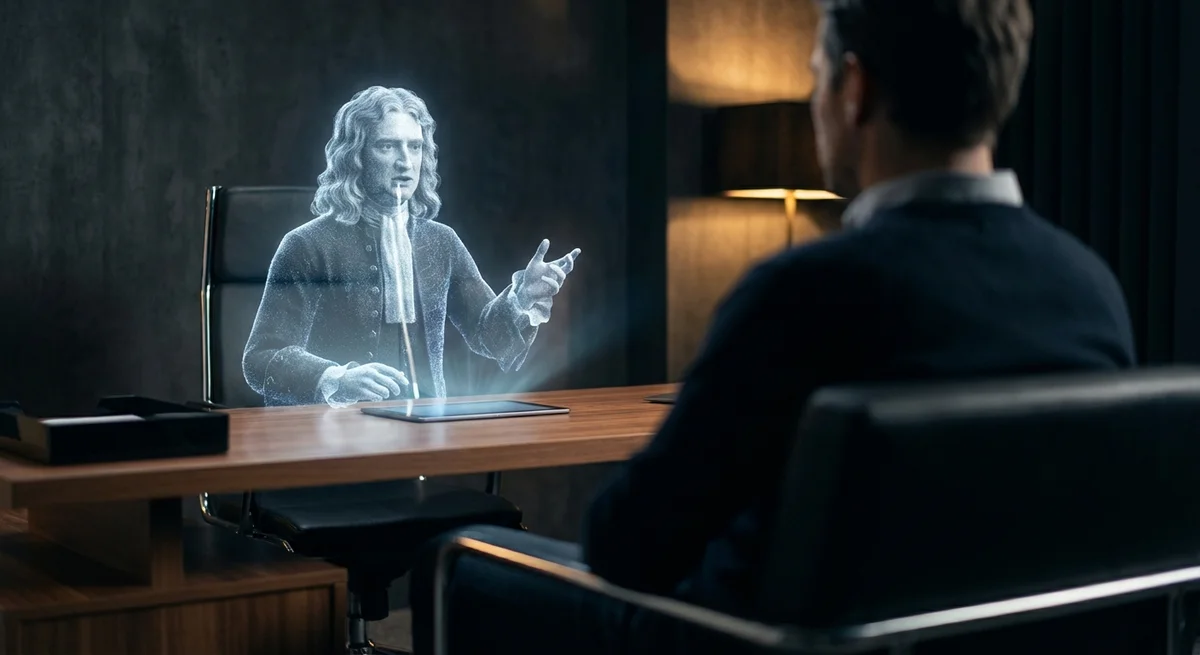
Imagine sitting across from Isaac Newton and asking what he thinks of quantum mechanics. Not metaphorically, and not in a text chat, but looking at a three-dimensional holographic figure that gestures, turns its head and answers in a voice reconstructed from historical descriptions. That is the experience promised by the startup Ailias, which has unveiled its platform of holographic avatars of historical figures.
Ailias works at the intersection of several technologies, each of which has made a qualitative leap in recent years. At the core are large language models fine-tuned on text corpora for specific historical figures: their scientific works, letters, notebooks, documented dialogues and biographical materials. On top of the language model sits a voice generation system and, most impressively, a holographic projection module that renders a volumetric image of the interlocutor in real time.
The company claims its avatars can do more than repeat well-known quotes: they can generate original answers that match the style and intellect of the person they are modeled on. Want to ask Newton about his attitude to alchemy? Or ask Leonardo da Vinci how he would design a modern drone?
Ailias promises that the avatar will answer not with a boilerplate line from Wikipedia but with a developed thought built on a deep understanding of the figure's worldview.
The context in which this product appears matters for understanding its potential. The market for so-called "AI companions" is growing fast, from Character.AI to custom GPT personas, and millions of people are already used to chatting with language models playing set roles. Until now, though, that interaction has been text-based or, at best, voice-based. Ailias takes the next logical step by adding physical presence. Holographic technology, long an expensive niche curiosity, has become noticeably more accessible over the past two years thanks to progress in lightweight projection systems and spatial displays. Ailias appears to have combined these two trends into a single consumer product.
The main use cases the company sees lie in education and culture: museums, universities, science centers, anywhere a live dialogue with a historical figure could turn passive consumption of information into an active intellectual experience. For a schoolchild nodding off over a paragraph on the laws of mechanics, talking to a holographic Newton is a fundamentally different level of engagement. Ailias also targets individual users: entrepreneurs who want to "consult" historical strategists, or writers seeking inspiration in conversation with the great authors of the past.
But this is where the serious questions begin. Digital resurrection of historical figures is an ethical minefield that the industry is crossing without a map. Who is responsible for the words AI puts in Newton's mouth?
What if a holographic Einstein voices a political position the real Einstein never held? The problem is compounded by the fact that the more convincing the technology is, and a hologram is an order of magnitude more convincing than text, the higher the risk that users will take generated answers for the genuine views of historical figures. In an educational setting this is especially dangerous: the line between "here is what Newton might have said" and "here is what Newton said" blurs with every improvement in generation quality.
There is also a legal dimension. For now, Ailias works with figures who died centuries ago, so questions of copyright and image rights remain in a gray zone. But the technology can obviously scale to more recent eras, and sooner or later someone will want to create a holographic avatar of a person whose heirs may take a very different view. Precedents involving celebrity deepfakes have already created a tense legal backdrop, and holographic avatars will only sharpen it.
Still, it is hard to deny that Ailias has found something genuinely compelling. For millennia, humanity has dreamed of talking with the great minds of the past, from the séances of the Victorian era to the holodecks of science fiction. For the first time, that dream is taking a technologically plausible form.
The question is not whether holographic AI interlocutors will become mainstream; most likely they will. The question is whether we can build a culture of honest use around this technology, one in which a virtual Newton is a tool for learning and not a source of historical myths. The answer will decide whether Ailias goes down in history as a revolution in education or as one more example of technology outrunning ethical reflection.
Test Frontier LLMs & Autonomous Agents in One Workspace
Run Claude Opus 5.5, GPT-6, Gemini 3.1, and DeepSeek side-by-side in Nomad AI (nomadnet.ai) — unified model routing, deep research, and multimodal workflows under one subscription.
The AI world, distilled — once a week
Seven stories that actually mattered, hand-picked. No noise, no reposts, no press releases.
Done! Check your inbox for a confirmation.