Hitachi bets on industrial experience in the race for physical AI
An unexpected hierarchy is taking shape in the race for physical AI, the technology that controls robots and industrial equipment. OpenAI and Google are working on foundation models, Nvidia is building development tools, but Hitachi offers a third path: deep expertise in real-world manufacturing. The Japanese conglomerate argues that decades of working with physical systems, from energy to transport, give it an advantage that algorithms alone cannot replicate. It is a bold bet, but a logical one: AI that controls the real world has to understand that world.
AI-processed from AI News; edited by Hamidun News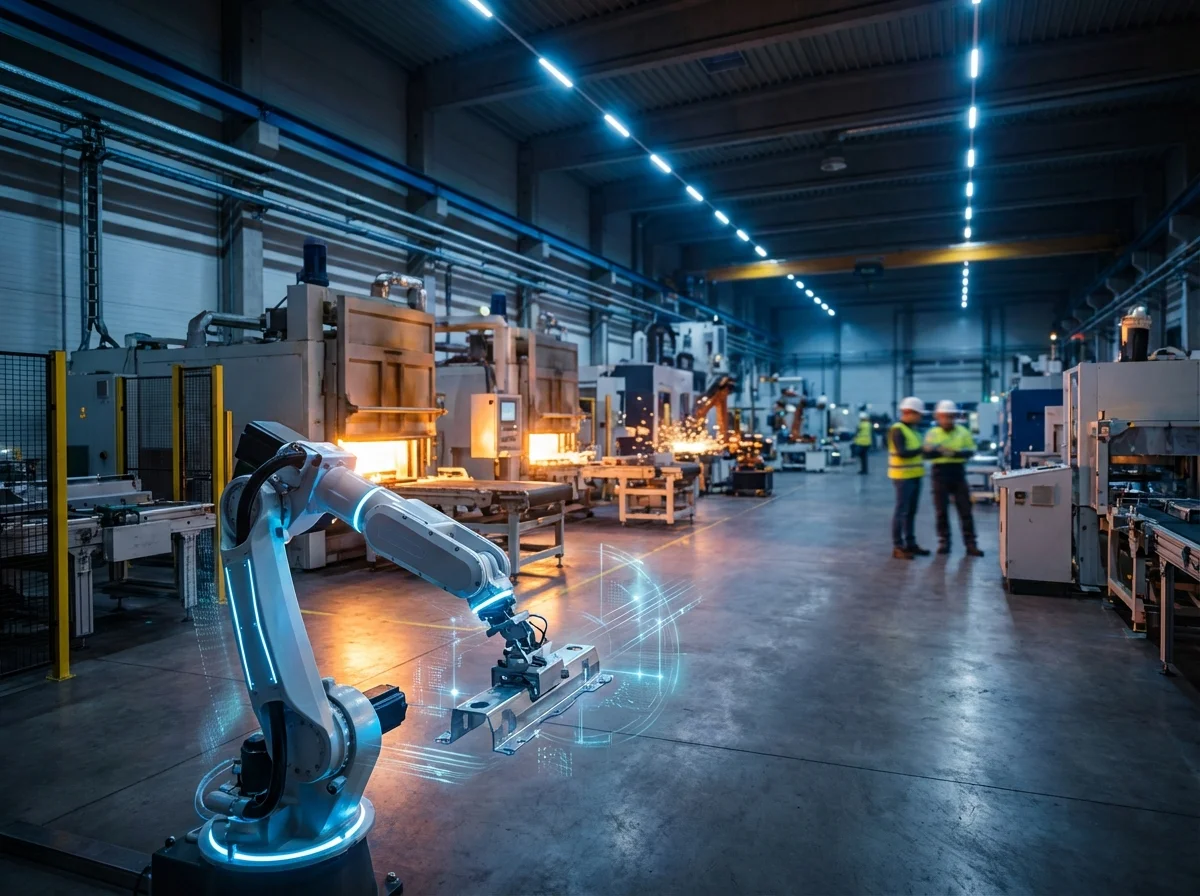
In the AI world, the conventional wisdom is that the future belongs to whoever builds the biggest language models and has the most powerful compute clusters. But when it comes to physical AI, meaning technology that controls robots, conveyor lines and industrial systems in the real world, the rules of the game may be entirely different. That is exactly what Hitachi, one of Japan's largest industrial conglomerates, is betting on.
Physical AI is not a chatbot that generates text, and it is not a neural network that draws pictures from a description. It is intelligence that must understand physics, inertia, friction, temperature and pressure: everything that determines how objects behave in the real world. A language model's mistake produces an inaccurate answer. A physical AI's mistake can cause an industrial accident, a power plant shutdown or the collision of an autonomous system. The stakes here are fundamentally different, and that changes the balance of power.
A kind of three-tier hierarchy has formed in this field. At the top are companies like OpenAI and Google, which are scaling multimodal foundation models that can process text, images, video and sensor data at the same time. Their approach is to build a general-purpose intelligence that can later be adapted to any task, including controlling physical systems. In the middle is Nvidia, which builds platforms and tools for developing physical AI, from simulators such as Omniverse to specialized robotics chips. Nvidia does not create end solutions, but it provides the infrastructure without which they are impossible.
And there is a third camp: industrial manufacturers such as Hitachi, which have worked with physical systems for decades and accumulated enormous knowledge of how the real world works. Hitachi makes everything from trains and energy equipment to medical devices and construction machinery. The company has run highly complex industrial processes for more than a hundred years. According to Hitachi's leadership, that experience is the competitive advantage that cannot be replicated simply by training a neural network on large volumes of data.
The logic is simple and deep at the same time. Foundation models from OpenAI or Google may be arbitrarily powerful, but they are trained mainly on text and images from the internet. They know what a turbine looks like in a photo, but not how it vibrates under a given load, which wear patterns are typical for a particular type of bearing, or how a cooling system behaves at abnormal temperatures.
That knowledge lives in engineering logs, in proprietary databases and in the heads of thousands of specialists, and Hitachi has access to it. Turning this experience into training data for AI is a nontrivial task, but whoever pulls it off will get models that truly understand the physical world rather than merely imitating that understanding.
It is important to understand the context of this strategic move. The industrial AI market is growing fast: by various estimates, it will exceed 200 billion dollars by 2030. Meanwhile, most industrial enterprises worldwide still use AI only piecemeal, for predictive maintenance or for optimizing individual processes. Full-scale deployment of physical AI that autonomously controls production systems remains more of a horizon than a reality. Hitachi expects to claim this niche before the Silicon Valley tech giants get there.
Hitachi's strategy is also interesting because it challenges the dominant paradigm in the AI industry, which holds that whoever has more compute and general-purpose data wins. In physical AI, that formula may not work. Domain expertise, access to real industrial data and, no less important, customer trust are critical here. No nuclear power plant operator will hand control of a system to a model built by a startup with no energy experience, however impressive its architecture. Hitachi has worked with such customers for decades.
Of course, Hitachi's bet is not without risk. Companies with a rich industrial heritage often lose to tech upstarts precisely because their inertia and bureaucracy slow innovation. In addition, OpenAI and Google are actively moving toward multimodality and robotics, and Nvidia offers ever more mature tools for physical AI every year. Hitachi's window of opportunity is not infinite.
Still, the very fact that an industrial giant from Japan openly states its intention to compete with Silicon Valley on AI signals an important shift. The era when artificial intelligence existed exclusively in the digital space is coming to an end. The next chapter is AI in the physical world, and the advantage here may belong to those who understand that world best.
- Nov 2, 2026Meta's Muse assistant keeps dossiers on loved ones and gets root on Ubuntu by default
- Nov 1, 2026Local models lose to Opus and Codex: 0.21 on a MacBook versus 1.00 for Codex
- Nov 1, 2026Kimi scores 96.2% on a 1C database analytics test and emerges as a fallback if Claude access is blocked
- Nov 1, 2026OpenAI Rewrites GPT Behavior Rules: Five Values and a Chain of Command
Test Frontier LLMs & Autonomous Agents in One Workspace
Run Claude Opus 5.5, GPT-6, Gemini 3.1, and DeepSeek side-by-side in Nomad AI (nomadnet.ai) — unified model routing, deep research, and multimodal workflows under one subscription.
The AI world, distilled — once a week
Seven stories that actually mattered, hand-picked. No noise, no reposts, no press releases.
Done! Check your inbox for a confirmation.