Hyundai doubles down on robotics and physical AI for industry
Hyundai is moving well beyond the car business and building its strategy around robotics and physical AI. The main bet is the factory floor, where Boston Dynamics humanoid robots are meant to work alongside people and take over routine tasks. The group plans major investment in the US through 2028, and by 2030 it expects to scale production of such machines to 30,000 a year.
AI-processed from AI News; edited by Hamidun News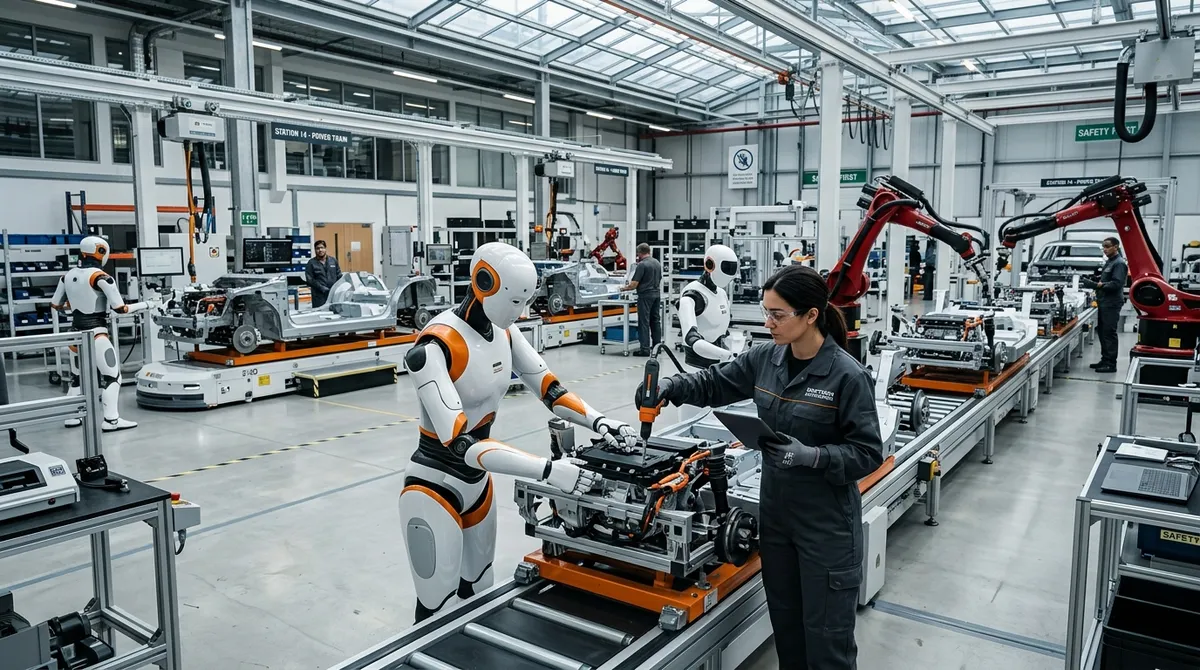
Hyundai is making it clear that it wants to be more than a carmaker: it also wants to build machines that act in the physical world. The company is betting on so-called physical AI: systems in which algorithms are built into robots, production lines and infrastructure that can move, react to their surroundings and work alongside people. For now, factories and industry remain the main testing ground for this strategy, but the effort looks broader than yet another wave of automation.
In an interview with Semafor, Hyundai Motor Group Chairman Chung Eui-sun named robotics and AI as one of the key drivers of the group's next stage of growth. According to the data the report cites, Hyundai plans to invest $26 billion in the US by 2028, on top of roughly $20.5 billion invested over the previous 40 years.
This is not only about expanding the car business. The company is trying to combine manufacturing, robots, software-defined factories and services in one strategy, where physical devices make decisions based on real-time data.
Hyundai places important emphasis on people and machines working together, not on fully replacing staff. For that, the group needs more than a standard industrial manipulator: it needs more flexible robotics that can share space with a person and take over repetitive or physically heavy tasks. Boston Dynamics, in which Hyundai acquired a controlling stake in 2021, plays the key role here. The company is preparing its humanoid robots primarily for manufacturing use: deployment is expected closer to 2028, and by 2030 Hyundai expects to reach output of up to 30,000 such machines a year. The logic is clear: humans handle oversight, coordination and exceptions, while the robot handles routine, precision and consistency of operations.
Factories remain the first and most obvious venue for physical AI. In production, the effect is easier to measure in numbers: assembly speed, defect counts, downtime, safety and employee workload. Hyundai is already moving toward software-defined manufacturing in its US operations, combining data, software control and robotization. The next step is a move to systems that do not simply execute preset commands but change behavior to fit the situation: they adapt to the flow of parts, spot deviations, redistribute tasks and help standardize processes across regions. For a global manufacturer, this matters all the more amid changing regulation, the localization of supply chains and growing customer demands on quality and delivery times.
The strategy also has an infrastructure dimension. Hyundai continues to invest in hydrogen through its HTWO brand, which covers hydrogen production, storage and use. Group leadership links the growing interest in the topic not only to transport but also to rising demand from AI infrastructure and data centers, where energy consumption is becoming an increasingly sensitive constraint.
In this context, electric vehicles and hydrogen look to Hyundai not like mutually exclusive bets but like a set of different energy scenarios for different tasks. That matters: the more AI moves out of the data center and into the real world, the more success depends not only on models and sensors but also on energy, logistics and the reliability of the physical environment.
For end users, the effect of this shift will most likely show up first not as a humanoid helper at home but in more down-to-earth things: faster-built cars, consistent quality, more flexible logistics services and new forms of mobility. Hyundai already sells over 7 million vehicles a year in more than 200 countries, so any change in its production model scales quickly.
The main takeaway is simple: Hyundai is gradually turning AI from a digital add-on into part of real machines and processes. If the company manages to bring this strategy to industrial scale, it will compete not only in the car market but also in the market for robotic systems for the physical world.
- Oct 31, 2026Author puts his script before an AI jury: the verdict cost 850 thousand tokens
- Oct 29, 2026OvisOCR3: an 0.8B-parameter model that reads documents better than specialized systems
- Oct 29, 2026Tencent releases Youtu-Parsing-Omni: one model parses documents, audio and video
- Oct 28, 2026Liquid AI releases LFM2.5-24B-A2B: an agent model with 2B active parameters
Test Frontier LLMs & Autonomous Agents in One Workspace
Run Claude Opus 5.5, GPT-6, Gemini 3.1, and DeepSeek side-by-side in Nomad AI (nomadnet.ai) — unified model routing, deep research, and multimodal workflows under one subscription.
The AI world, distilled — once a week
Seven stories that actually mattered, hand-picked. No noise, no reposts, no press releases.
Done! Check your inbox for a confirmation.