Alibaba Cloud updates Coding Plan with new Qianwen and GLM models
Alibaba Cloud has expanded its Coding Plan platform with support for two new language models: Qianwen 3.5 and GLM-4.7. Both target developer assistance, including code generation, autocompletion and error analysis. Qianwen 3.5 is Alibaba's flagship model, while GLM-4.7 was developed by Zhipu AI. The update sharpens competition with comparable tools from Baidu and Huawei in China's market for AI programming assistants.
AI-processed from Jiqizhixin (机器之心); edited by Hamidun News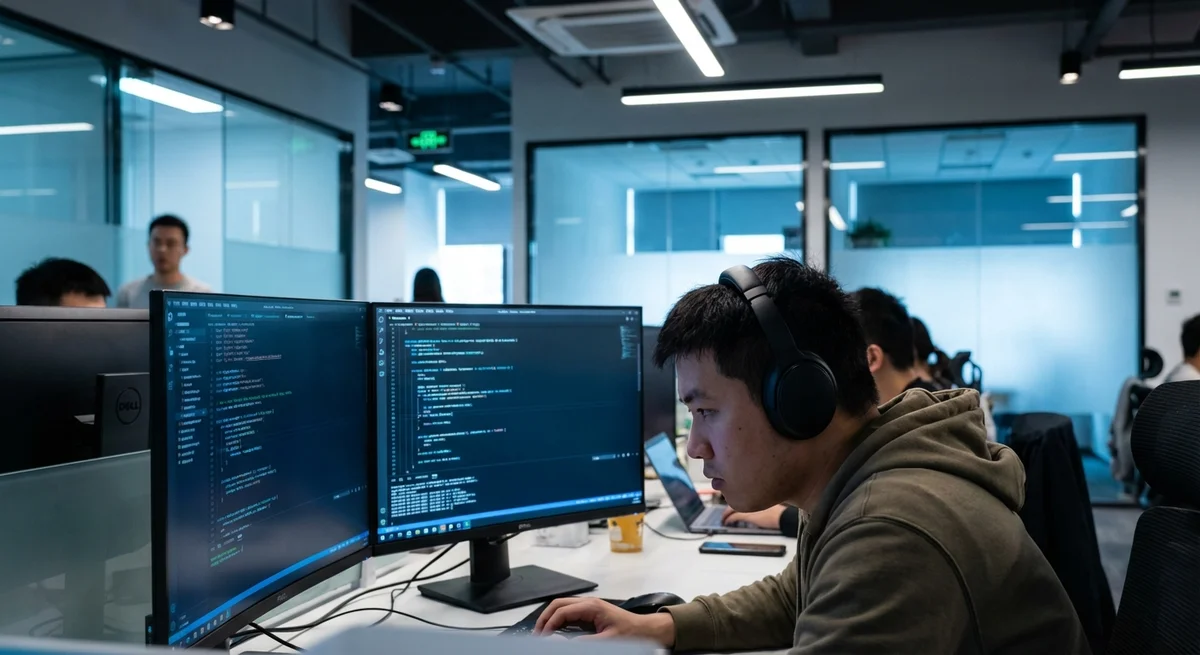
Alibaba Cloud has expanded its Coding Plan platform with support for several next-generation language models at once: the flagship Qianwen 3.5 and GLM-4.7 from Zhipu AI. The update looks technical, but it reflects a much bigger bet: Chinese tech giants are seriously intent on pushing GitHub Copilot and similar Western tools out of their domestic and regional markets.
Coding Plan is Alibaba's cloud environment for developers, combining tools for collaborative work on code, CI/CD pipelines and built-in AI assistance. Until recently, the choice of language models within the platform was limited. The new update changes that radically: users can now switch between several models depending on the task, whether that is generating code from scratch, autocompletion or finding bugs in existing code.
Qianwen 3.5 is Alibaba's own flagship model. It was built to work with code in dozens of programming languages and can do more than complete lines: it understands the context of an entire project. According to the company, it shows improved understanding of long contexts, a critical property for large codebases where the architecture of several modules must be kept in mind at once. GLM-4.7, developed by the startup Zhipu AI with the support of Tsinghua University, takes a somewhat different path: the model emphasizes accurate reasoning and the ability to explain code logic in natural language, which is especially useful in team projects and code review.
The inclusion of GLM-4.7 in Alibaba's ecosystem is notable in itself. It is not just a technical extension but a sign that large platforms in China are starting to build partnership models instead of relying exclusively on in-house developments. Zhipu AI has long been considered one of the country's most serious AI startups, and integrating its model into Coding Plan gives the young company access to a multimillion-strong audience of developers already working in Alibaba's cloud. The platform benefits too: a variety of models means each user can find a tool that fits naturally into their workflow.
The competitive context matters just as much. Baidu, with its Comate platform, and Huawei, with CodeArts, have long claimed the role of leading AI assistants for Chinese developers. The market is growing rapidly: according to analysts, adoption of AI tools in development workflows in the Asia-Pacific region accelerated after large companies recorded a real reduction in the time spent writing routine code, from 20 to 40 percent depending on the task. Alibaba clearly does not want to cede this market to competitors and is betting on model variety as a competitive advantage: instead of a single solution, an ecosystem where the user chooses.
What this means for developers outside China remains an open question. Alibaba Cloud is actively expanding its presence in Southeast Asia, the Middle East and Europe, and updates like this sooner or later become available to international audiences. Qianwen, in its various versions, has already shown competitive results in open code-generation benchmarks, which makes it potentially interesting beyond the Chinese market. GLM, by contrast, remains less familiar to the international community, although the model's academic roots are a strong argument for its technical viability.
The Coding Plan update is not an isolated event but another step in a large-scale overhaul of how software is written in the era of large language models. Tools like GitHub Copilot have changed developers' expectations: an AI assistant is now seen not as an add-on but as part of the standard working environment. Alibaba understands this and is responding with more than an update to a single model: it is building a multi-model environment that can adapt to different requirements. How quickly the platform can reach critical mass, and how closely the models' real-world performance matches the marketing promises, will become clear in the coming months.
- Nov 2, 2026Microsoft releases 4B model Mage-VL-Cowork, which solves 66.0% of OSWorld-Verified tasks
- Nov 1, 2026Google's StreamVibe video agent beats other models by 10.7% on response timing and quality
- Oct 30, 2026Mistral opens Large 4 weights: strong at code, but Chinese models score 32 to its 26
- Oct 30, 2026128 AI Agents With No Boss Passed 49% More Tests Than One
Test Frontier LLMs & Autonomous Agents in One Workspace
Run Claude Opus 5.5, GPT-6, Gemini 3.1, and DeepSeek side-by-side in Nomad AI (nomadnet.ai) — unified model routing, deep research, and multimodal workflows under one subscription.
The AI world, distilled — once a week
Seven stories that actually mattered, hand-picked. No noise, no reposts, no press releases.
Done! Check your inbox for a confirmation.