Low-Altitude Economy Gains Ground in Chinese Agriculture
China is actively bringing the low-altitude economy into agriculture. The number of agricultural drones has passed 300,000, and the area they treat has reached 460 million mu. By 2025, the country plans to reach 76.7% mechanization of farm work. The statement came from Deputy Minister Zhang Xingwang at a press conference at the State Council of China.
AI-processed from 36Kr (36氪); edited by Hamidun News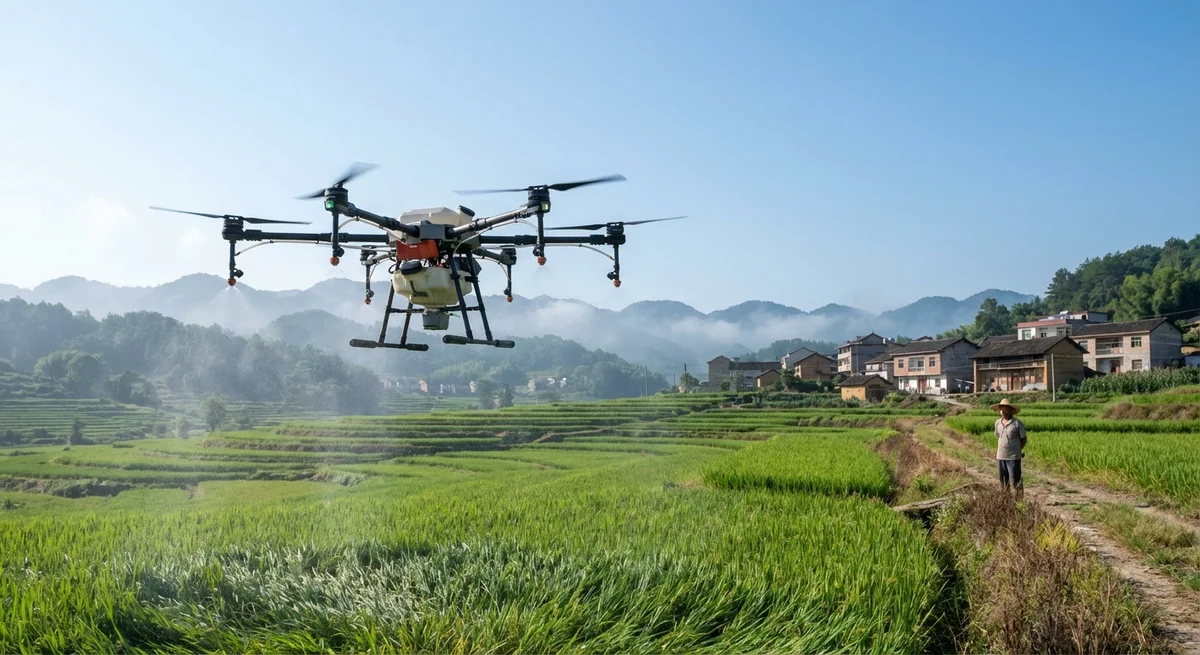
China's Ministry of Agriculture and Rural Affairs has reported significant progress in developing the low-altitude economy in the agricultural sector. Deputy Minister Zhang Xingwang made the statement at a press conference at the State Council of China. The subject is the use of unmanned aerial vehicles (UAVs) and other technologies operating at low altitudes to improve the efficiency and productivity of farming.
The context matters: China is investing heavily in agricultural modernization, aiming to secure its food supply and make the sector more competitive. Drones for spraying fields, monitoring crops and other tasks are becoming increasingly common. This helps cut costs, raise yields and reduce environmental impact.
According to the ministry, China already has more than 300,000 agricultural drones. The land area treated with drones each year exceeds 460 million mu, a Chinese unit of area equal to roughly 667 square meters. By 2025, the country plans to reach a 76.7% level of mechanization in farm work. That covers not only drones but also other types of agricultural machinery and automated systems.
The growth of the low-altitude economy in agriculture has far-reaching consequences. First, it raises labor productivity and lowers production costs. Second, it allows more efficient use of resources such as water and fertilizer. Third, it opens up new opportunities for developing rural areas and creating jobs. It also fits the "smart agriculture" strategy, which aims to integrate information technology into the agricultural sector.
There are, however, certain challenges. A regulatory framework must be developed to govern the use of drones in agriculture, along with flight safety and personal data protection. It is also important to train farmers to work with the new technologies and give them access to financing. Solving these problems would allow the low-altitude economy to realize its full potential in agriculture.
In conclusion, the active development of the low-altitude economy in Chinese agriculture is an important step toward modernizing the agricultural sector and ensuring food security. Drones and other advanced technologies can improve production efficiency, cut costs and make farming more environmentally sustainable. This experience may also be useful for other countries pursuing "smart agriculture".
Test Frontier LLMs & Autonomous Agents in One Workspace
Run Claude Opus 5.5, GPT-6, Gemini 3.1, and DeepSeek side-by-side in Nomad AI (nomadnet.ai) — unified model routing, deep research, and multimodal workflows under one subscription.
The AI world, distilled — once a week
Seven stories that actually mattered, hand-picked. No noise, no reposts, no press releases.
Done! Check your inbox for a confirmation.