Deli's evolution: how a stationery maker is moving into high tech
Deli Group is transforming from a traditional office supplies maker into a technology holding company. It has overcome the technical barrier in writing-tip manufacturing with a three-ball system that improves writing smoothness by 25%. Since 2015, Deli has been building its own printers, working around thousands of foreign patents. The brand's strategy rests on import substitution using Loongson processors, data security and lower printing costs. Its near-term plans include rolling out AI and cloud solutions to automate home and office tasks.
AI-processed from 36Kr (36氪); edited by Hamidun News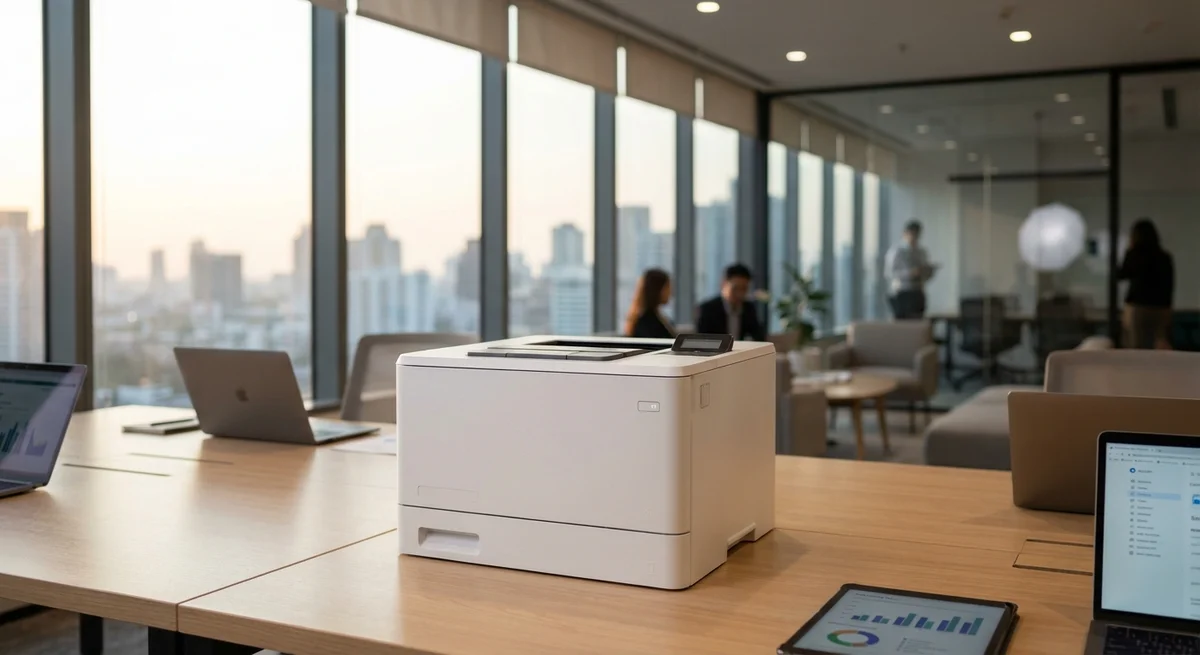
# Deli's evolution: how a stationery maker is moving into high tech
When people talk about technology companies, names like Apple, Tesla or Huawei come to mind. But while the world watches the race for artificial intelligence and electric vehicles, China's Deli Group is carrying out a digital revolution of its own, and it starts not with processors but with ballpoint pens. Over four decades, the company has grown from a modest office supplies maker into a full-fledged technology holding company, overturning the stereotype that there is supposedly nothing to innovate in stationery.
For a long time, the field Deli dominates was considered technologically primitive. Small product size, low unit cost and high output created the impression that there were no technical barriers at all. That was a deep misconception. Behind the simplicity of a ballpoint pen lies a whole world of engineering challenges: ink chemistry, transfer mechanics, materials science and micrometer-level manufacturing precision. For years, people in China said the country could not make a quality writing tip, a paradox for the world's largest factory. Deli set out to prove otherwise, investing decades of research and building its own laboratory staffed by around a hundred specialists in inks and tip design.
The breakthrough came as a three-ball system. The traditional single-ball design suffered from uneven ink flow and excessive friction when writing. Deli first developed a two-ball system, but the team did not stop there. It took three years to solve the problem of synchronizing three millimeter-scale spheres on a single axis so that they rotate stably and evenly under the pressure of the pen. The result exceeded expectations: writing smoothness rose by 25 percent, ink now lays down uniformly, and schoolchildren and office workers feel less fatigue during long writing sessions. This is not a marketing trick; it addresses a real pain point for millions of people who spend hours with a pen in hand.
But Deli did not rest on its achievements. In 2015, the company made a strategic leap from writing instruments to printers, a sector protected by hundreds of thousands of patents and decades of dominance by foreign giants. The logic seemed simple but ambitious: avoid dependence on expensive consumables, provide information security for government and corporate clients, and ultimately build an ecosystem for fully digitizing the workplace. Instead of buying licenses and embedding other companies' technology, Deli chose to develop its own, forgoing a convenient quick fix in favor of long-term control over the value chain.
This decision reflects a broader strategy of import substitution and technological independence. Deli integrates its own Loongson-series processors and develops its own software and cloud platforms. The company understands that amid growing geopolitical tension and sanctions, control over key components is becoming not just a competitive advantage but a matter of survival for large public-sector clients.
Looking ahead, Deli plans to introduce artificial intelligence and cloud solutions to automate home and office processes. That means that in the near future, users could manage printing, scanning and other operations through an intelligent interface synchronized with cloud storage, with costs managed based on usage analytics. This transformation shows that Deli sees itself not merely as a supplier of hardware and ink, but as the creator of a complete ecosystem for the smart office.
Deli's story is that of a company that began by fighting for the right to make its own pen and gradually built a vertically integrated holding company that competes with international corporations. It is a reminder that innovation can hide in the most unexpected places: it needs neither big names nor huge advertising budgets. Sometimes it simply means wanting to make people's lives a little more comfortable, listening to what they say, and not stopping when the first result arrives.
- Nov 2, 2026TensorFold 1.2.0 boosts Qwen3.8-27B throughput on M3 Ultra by 44.2% at 16 streams
- Nov 1, 2026Local models lose to Opus and Codex: 0.21 on a MacBook versus 1.00 for Codex
- Oct 29, 2026Claude Code Edits Video From a Transcript: How the video-use Skill With 30 000 Stars Works
- Oct 29, 2026Stanford AI tool verifies part of Signal's code in half a day for under $500, versus five months of expert work
Test Frontier LLMs & Autonomous Agents in One Workspace
Run Claude Opus 5.5, GPT-6, Gemini 3.1, and DeepSeek side-by-side in Nomad AI (nomadnet.ai) — unified model routing, deep research, and multimodal workflows under one subscription.
The AI world, distilled — once a week
Seven stories that actually mattered, hand-picked. No noise, no reposts, no press releases.
Done! Check your inbox for a confirmation.