A Brain for Robots: Startup Noematrix Raises Hundreds of Millions of Yuan for Embodied AI
Chinese startup Noematrix, founded by leading scientists from Shanghai Jiao Tong University and Stanford, has raised hundreds of millions of yuan in a Series A round. The investment was led by C Capital, with participation from Sea Limited and Alibaba. The company's flagship product is Noematrix Brain, a general-purpose system that gives robots the ability to understand complex commands and adapt to changing environments. The technology is already used in automated pharmacies and laundries. What sets Noematrix apart is its "accompanying data collection" approach, which relies on proprietary exoskeletons. It lets the company train models on huge volumes of real-world physical experience.
AI-processed from 36Kr (36氪); edited by Hamidun News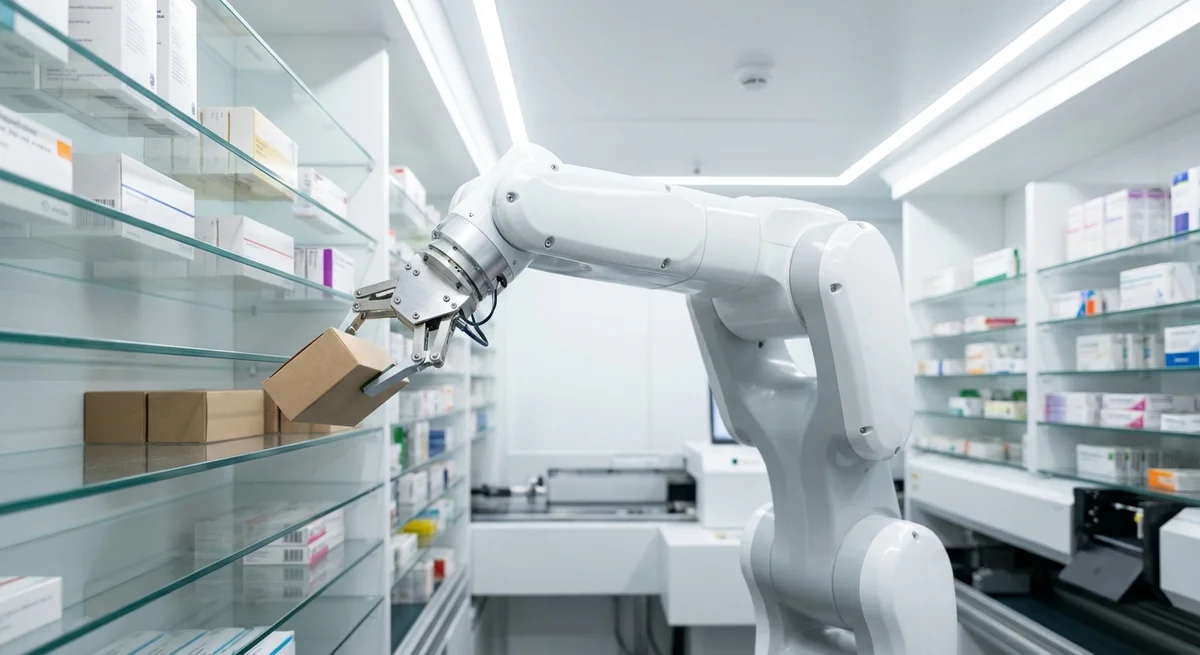
# A Brain for Robots: How Chinese Startup Noematrix Is Changing the Future of Automation
When a machine picks up a box of medicine and puts it in a bag, it looks simple. In fact, it is one of the hardest problems in robotics. Chinese startup Noematrix, founded by scientists from Shanghai Jiao Tong University and Stanford, has just raised hundreds of millions of yuan in a Series A round. The investors are venture fund C Capital and the big names Sea Limited and Alibaba. They are betting that this young company can build a universal brain for robots that will, quite literally, change automation.
Noematrix's story began in November 2023, when it was founded as one of the first companies in China to focus on embodied artificial intelligence: AI that runs not just inside a computer but in the physical body of a machine interacting with the real world. The team brings serious scientific firepower. Co-founder Lu Ce heads an AI lab at Shanghai Jiao Tong University, has authored more than two hundred scientific papers and has won awards at prestigious robotics conferences. His partner Wang Shiquan is a Stanford doctoral student who has experience building a full-fledged robotics company. Together they assembled a team of experts in systems engineering and large language models.
The company's flagship product, Noematrix Brain, is a system that gives robots something they have lacked for years: the ability to understand vague, natural-language commands and to act under uncertainty. Take a pharmacy. A robot receives an order and has to do what seems simple: find the right medicine, pick it up, pack it.
In reality it is a multi-step task in which every step requires decisions. The robot must plan the best route to the shelves if there are several. It must pinpoint the right product among hundreds of boxes.
Its grip must be gentle enough not to crush the pills, yet strong enough to hold them. And all of this must work every day, on different types of packaging, in different premises.
Noematrix has already deployed its system in real pharmacies and laundries, and these are not just lab prototypes. The system adapts to different robot platforms, from dual-arm mobile manipulators to humanoid machines. The key difference in the company's approach is how it collects data to train its models.
Instead of the costly practice of gathering information only on finished robots, Noematrix uses a "accompanying data collection" method with its own exoskeletons and portable devices. A person wearing an exoskeleton performs a task, and the system records all their movements, interactions with objects and visual cues. This lets the company gather huge volumes of data from homes, offices and industrial sites.
Noematrix currently has tens of thousands of hours of high-quality real-world data.
This distinction matters for the whole industry. Training deep learning models requires an exponential number of examples, and in robotics, quality data has historically been expensive and scarce. The company has built something like a "gene bank" for embodied AI: a repository of real physical interactions. This strategy lets it move faster than competitors and train models on a wide range of scenarios.
Long-term competition in this field will be won by whoever can build a closed loop: data from real scenarios improves the models, improved models let robots work in new environments, and new environments generate new data. Noematrix is clearly counting on exactly that. The company is already discussing deployment of its system in hospitality, logistics and other sectors. At the same time, it is expanding into international markets through partnerships with leading humanoid robot makers and data collection centers.
Funds from this round will go toward developing foundation models with better generalization and integrating cloud technologies to keep improving robots in the field. By the end of the year, the company plans to present a finished solution for smart pharmacies. This may be the start of an era in which robots finally stop being simple, rigidly programmed tools and become intelligent agents able to adapt to the real world.
Test Frontier LLMs & Autonomous Agents in One Workspace
Run Claude Opus 5.5, GPT-6, Gemini 3.1, and DeepSeek side-by-side in Nomad AI (nomadnet.ai) — unified model routing, deep research, and multimodal workflows under one subscription.
The AI world, distilled — once a week
Seven stories that actually mattered, hand-picked. No noise, no reposts, no press releases.
Done! Check your inbox for a confirmation.