Simier: How a Chinese Startup Is Putting "Sensing" Chips into Apple and BYD Supply Chains
Chinese startup Simier has raised hundreds of millions of yuan to develop next-generation chips. While everyone debates cloud LLMs, the Shanghai-based team is deploying its "unified sensing and computing" technology in Apple and BYD factories. The idea is to merge the sensor and the processor into one unit, removing the delay of moving data between them. That addresses the von Neumann bottleneck and gives robots and autopilots near-instant response. With overseas revenue growing 400%, Simier is clearly aiming to become a global leader in industrial AI. It looks like "smart hardware" is becoming more important than "smart chatbots."
AI-processed from 36Kr (36氪); edited by Hamidun News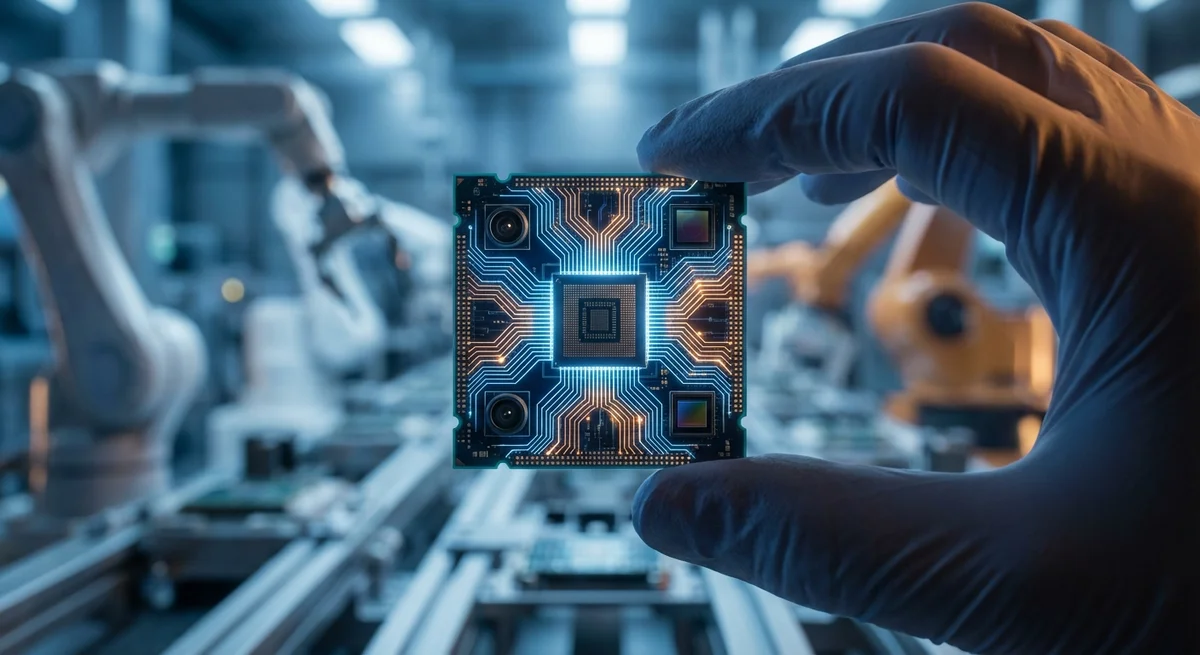
While the world watches chatbots practice their prose, a quiet but far more fundamental revolution is under way in the shadow of giant server farms. Shanghai startup Simier recently closed Series A and A+ rounds worth hundreds of millions of yuan, and behind the dry investment figures lies a real challenge to the dominance of Western architectures. The team has taken aim at something sacred: the von Neumann architecture, which for decades has forced data to shuttle between processor and memory, wasting time and energy.
The context matters more than the news itself. We are used to thinking of AI as something cloud-based and heavy. But in the real world, on Apple's assembly lines or inside BYD's electric cars, a system has no seconds to spare for deliberation. It needs to react instantly.
Simier's team, drawn from Shanghai Jiao Tong University and Tsinghua University, proposed the concept of "unified sensing and computing." The logic is simple: why ship data from a camera to a processor when you can teach the sensor itself to "think"? This is not just optimization but a change of paradigm, in which the chip becomes a hardware-native intelligence.
What does this deliver in practice?
Imagine an industrial robot that must detect a defect or avoid a collision within milliseconds. Traditional systems burn precious time moving the video stream around. Simier's solution eliminates that bottleneck at the root. Company founder Dr. Yang Minglun, who previously worked at FANUC, understands well that on a factory floor, an extra watt of power draw or an extra millisecond of latency turns into losses of millions. That is why the startup's client list already includes more than 300 industry giants, among them lithium battery maker CATL and aircraft manufacturers.
The commercial side is interesting too. While many AI startups spend years searching for a monetization model, Simier is showing aggressive growth. Its overseas revenue is growing 400% a year, and the share of export revenue is expected to exceed 40% this year. It is a direct signal that Chinese "smart hardware" is in far higher demand in South Korea, Japan and Southeast Asia than theoretical musings about artificial general intelligence. Investors from Guotai Junan and other funds are betting that the era of "giant models" is giving way to an era of "highly efficient, specialized intelligence."
Chief Technology Officer Cheng Yuan speaks directly of a shift toward "agentization." In his vision of the future, AI devices stop being mere sensors. They become autonomous systems capable of "instinctive" reactions, like living creatures whose spinal cord handles reflexes without waiting for a command from the brain. This is the "second half of the game" in AI development, where the winner is not whoever has more parameters in a model but whoever embeds intelligence into the physical world more efficiently. While Western corporations build data centers the size of cities, Simier packs that intelligence into a tiny module on a production line.
The bottom line: an era is arriving in which hardware once again dictates the rules. Can the concept of the "sensing chip" become a global standard before Western chipmakers offer their own answer?
- Nov 2, 2026TensorFold 1.2.0 boosts Qwen3.8-27B throughput on M3 Ultra by 44.2% at 16 streams
- Nov 1, 2026Local models lose to Opus and Codex: 0.21 on a MacBook versus 1.00 for Codex
- Oct 29, 2026Claude Code Edits Video From a Transcript: How the video-use Skill With 30 000 Stars Works
- Oct 29, 2026Stanford AI tool verifies part of Signal's code in half a day for under $500, versus five months of expert work
Test Frontier LLMs & Autonomous Agents in One Workspace
Run Claude Opus 5.5, GPT-6, Gemini 3.1, and DeepSeek side-by-side in Nomad AI (nomadnet.ai) — unified model routing, deep research, and multimodal workflows under one subscription.
The AI world, distilled — once a week
Seven stories that actually mattered, hand-picked. No noise, no reposts, no press releases.
Done! Check your inbox for a confirmation.