World Models: Why Video Generators Are Not About Film but the Physics of Reality
While everyone discusses polished video clips, the industry is switching to the concept of "world models". It is an attempt to build an AI that understands cause and effect and the physics of space. Video generation is only a by-product here, the tip of the iceberg. The main goal is a universal simulator capable of predicting the future state of any system. If it works, we will get not just a digital video editor but a full environment for training robots and running scientific experiments, where a mistake costs nothing except spent tokens.
AI-processed from Jiqizhixin (机器之心); edited by Hamidun News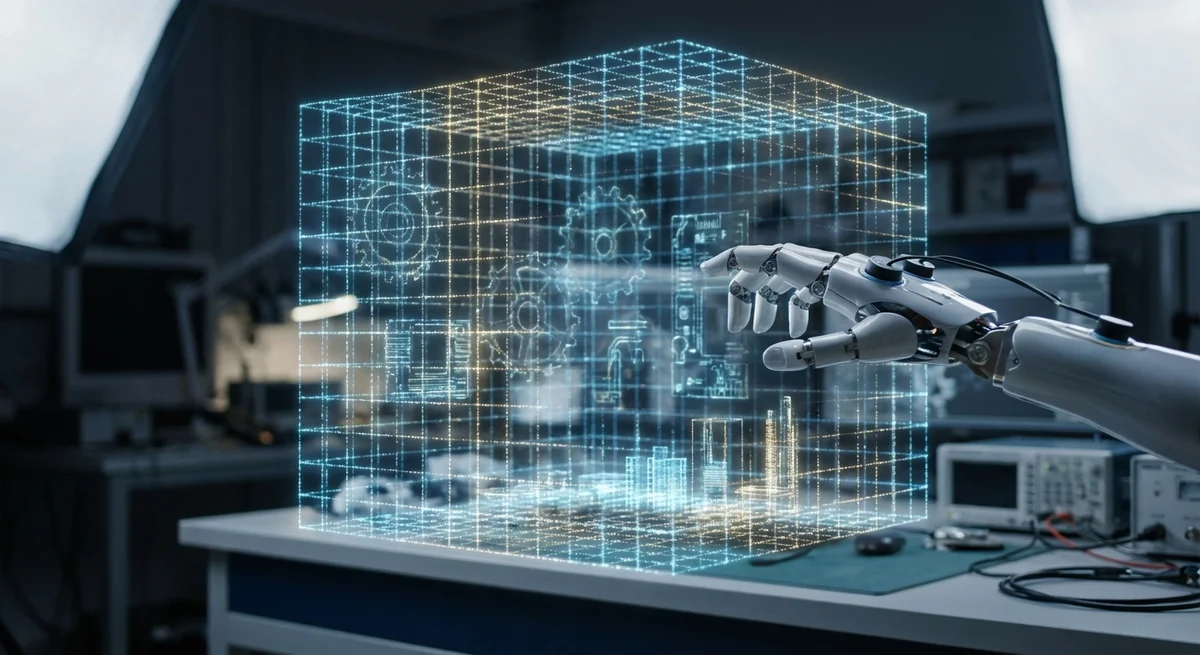
When OpenAI released Sora, everyone rushed to debate how soon Hollywood would be headed for the dustbin of history. But strip away the excitement over woolly mammoths and neon signs in Tokyo, and something more fundamental remains. We are watching a shift from simply predicting the next pixel to building full-fledged world models. This is not just a change in terminology but a tectonic shift in how machines perceive our reality. For a long time, AI lived in a world of text and static images, but now it is trying to grasp the concept of time and cause and effect.
Why model the world at all? Imagine you want to teach a robot to make coffee. Before, you had to either write thousands of lines of code or make the machine fail in reality millions of times, breaking cups and flooding the floor with water. A world model lets the AI "play out" these scenarios in its head using a universal world simulator. It is a kind of digital imagination that relies not on fantasies but on learned laws of physics. The irony is that the AI infers these laws itself, simply by watching terabytes of video, without a single formula from Newton's textbook.
The problem is that current models are still prone to "physical hallucinations". You have probably seen videos where people walk through walls or objects vanish without a trace. This happens because neural networks do not yet understand the essence of objects; they are merely masters of probability. However, new research approaches aim to build an understanding of space and time into the models' architecture through latent representations. That would let the AI not just draw frames but understand that if a ball rolls toward the edge of a table, it will inevitably fall down rather than turn into a butterfly.
For the industry, this means the end of the era of "black boxes" that simply output a result. We are moving toward systems that can justify their actions by simulating the consequences. Companies like Wayve or Tesla already use world-model-like approaches for autopilots, but researchers' ambitions go further. They want to create a single environment where AI can test scientific hypotheses or design new materials, checking their strength in a virtual world identical to ours.
What does this mean for us? Most likely, we will see explosive growth in robotics over the next couple of years. Robots will stop being clumsy hunks of metal, because they will arrive in our world already "experienced", having lived thousands of virtual lives in simulators. Video generation will remain a pleasant bonus for content creators, but the real breakthrough will happen where AI begins to predict the behavior of complex systems, from climate change to protein folding. We are finally teaching machines not just to imitate us but to understand how the stage we all perform on is built.
The bottom line: Will AI become a full-fledged "digital god", or will it remain an advanced video player with hallucinations? The answer lies in whether we can teach it not just to watch, but to grasp inertia, friction and gravity.
- Nov 2, 2026Arca gives AI agents finance tasks lasting up to 10 days, but leaves the trades to humans
- Nov 2, 2026Meta's Muse assistant keeps dossiers on loved ones and gets root on Ubuntu by default
- Nov 1, 2026Local models lose to Opus and Codex: 0.21 on a MacBook versus 1.00 for Codex
- Nov 1, 2026Kimi scores 96.2% on a 1C database analytics test and emerges as a fallback if Claude access is blocked
Test Frontier LLMs & Autonomous Agents in One Workspace
Run Claude Opus 5.5, GPT-6, Gemini 3.1, and DeepSeek side-by-side in Nomad AI (nomadnet.ai) — unified model routing, deep research, and multimodal workflows under one subscription.
The AI world, distilled — once a week
Seven stories that actually mattered, hand-picked. No noise, no reposts, no press releases.
Done! Check your inbox for a confirmation.