Found Alive: Why Neural Networks Succeed Where Thousands of Volunteers Fall Short
Around 180,000 people go missing in Russia every year, roughly the population of a mid-sized regional capital. Traditional search methods, with flashlights and volunteers combing forests on foot, are gradually giving way to technology. The LizaAlert search squad and major tech companies have adopted neural networks to analyze drone imagery. Where a person spends hours scrolling through thousands of frames, trying to spot a patch of jacket among branches, an algorithm finishes in minutes. This is not just automation. It offers a real chance to save people who would once have been given up for dead. Technology is turning hopeless searches into the longed-for words: "Found. Alive."
AI-processed from Habr AI; edited by Hamidun News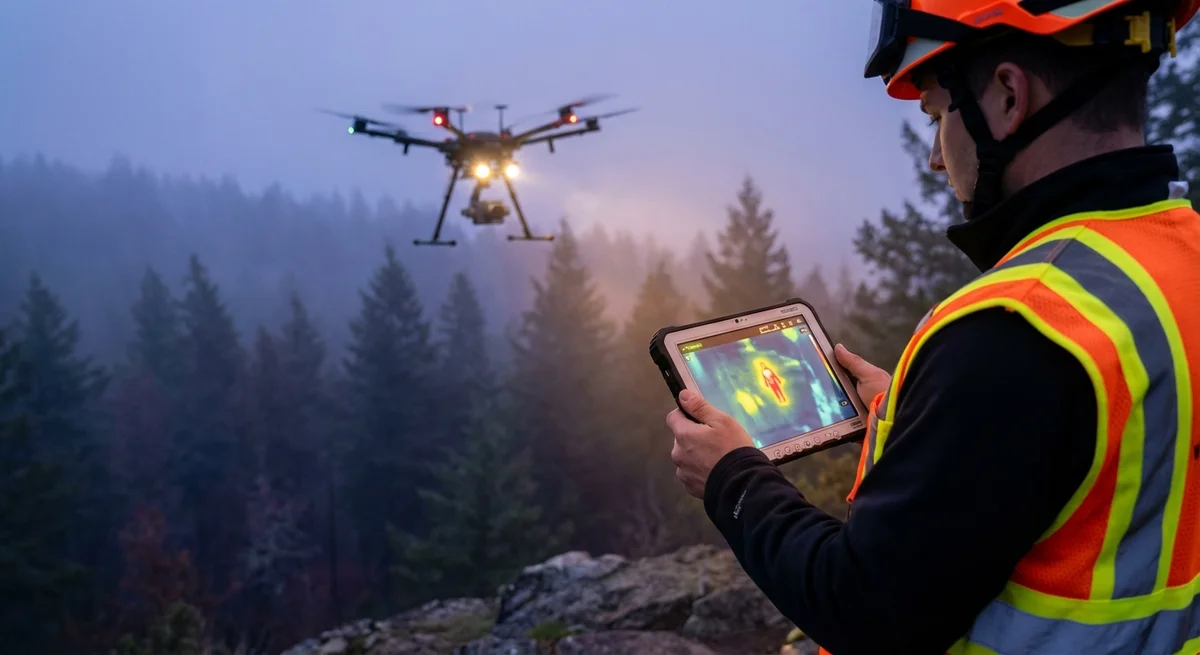
Let's be honest: Russia's missing-persons statistics read like a report from a combat zone. 180,000 reports to the Interior Ministry every year is not just a number. It is the population of an entire city like Yuzhno-Sakhalinsk, dissolving into forests and urban jungles. When the clock is counted in hours, especially in winter, classic search methods start to stall. You can gather a thousand volunteers, but human capacity is limited by physics: eyes glaze over, legs tire, and attention drifts after a couple of hours of monotonous work. This is where algorithms step in, because they know nothing of coffee breaks or attention deficits.
For a long time, the main problem for search squads like LizaAlert was data processing. Picture this: a single drone flight produces several thousand high-resolution photos. A group of volunteers needed five to eight hours to review that many images carefully.
In a forest search, that is an unaffordable luxury. If someone went missing in freezing weather, there will most likely be no one left to find after eight hours. That changed when computer vision joined the effort.
Neural networks were taught what they do best: finding patterns. The algorithm does not look for a "person". It looks for anomalies: a bright spot that does not resemble foliage, a shape not found in nature, or a heat trace standing out against cooling ground.
The turning point came when developers trained models on specialized datasets made up of thousands of real forest images taken in different seasons. Now a neural network "swallows" 2-3 thousand photos in a matter of minutes. It filters out 95% of empty content, leaving searchers only the frames that offer something to go on. This cut the time for initial analysis by dozens of times. Instead of agonizing over every pixel, search coordinators receive a ready selection of suspicious areas and immediately send ground teams or helicopters there.
Why does this matter right now? We have reached a point where "smart city" technology and military developments have finally begun to serve humanitarian goals without excess pathos. Using AI in search-and-rescue (SAR) operations is a prime example of computing power converting directly into saved lives. It is important to understand that the machine does not replace the rescuer. It frees them from routine, letting them focus on decisions. An algorithm can spot a bright red jacket in thick undergrowth, but a human will decide how to evacuate the victim from a hard-to-reach bog.
The infrastructure of these searches is changing too. Where powerful servers were once required, models are now optimized to run at the "edge": directly on board the drone or on a laptop at the field headquarters. This is critical, because deep in the forest there is often no connectivity at all, let alone access to cloud computing. Running neural networks locally makes search teams fully autonomous. We are seeing the birth of a new safety standard, in which an AI-equipped drone becomes as essential to a rescuer as a radio or a compass.
But there is a flip side. Building such systems demands huge investment and access to quality data, which often makes volunteer organizations dependent on large corporations. Even so, current results show that cooperation between the IT sector and volunteers is arguably the most effective form of social partnership today. When technology helps us hear a faint "I'm here" through the noise of a vast forest, debates about AI ethics fade into the background.
Bottom line: The speed of data analysis in search operations has grown many times over, and the only question now is scaling. Will autonomous swarms of search drones become the standard in every region within the next two years?
- Nov 2, 2026DeepSeek Open-Sources Super-agent Prototype: p95 Task Time Drops from 29.5 to 15.7 Minutes
- Nov 2, 2026LLM Agent Built a Gearbox in KOMPAS-3D, but Scored Only 50 out of 100 on the Specification
- Nov 2, 2026Agents ignored the prompt to read memory in 7 of 7 sessions: an analysis of 13 thousand logs
- Nov 2, 2026Karpathy Built HackerTube, a Catalog of 6,454 Videos, in Two Hours with Claude Code
Test Frontier LLMs & Autonomous Agents in One Workspace
Run Claude Opus 5.5, GPT-6, Gemini 3.1, and DeepSeek side-by-side in Nomad AI (nomadnet.ai) — unified model routing, deep research, and multimodal workflows under one subscription.
The AI world, distilled — once a week
Seven stories that actually mattered, hand-picked. No noise, no reposts, no press releases.
Done! Check your inbox for a confirmation.