Ibiden Bets 500 Billion Yen on the Foundation Beneath AI Chips
Japan's Ibiden, whose substrates sit inside virtually every high-end NVIDIA or AMD accelerator, has earmarked 5000 billion yen (about $3.4 billion) to expand IC substrate production. This is more than a machinery refresh: it is preparation for the next stage of the AI race. While software companies argue over the usefulness of chatbots, hardware makers are building factories, betting that demand for server capacity will keep growing. Ibiden controls a critical node in the supply chain. Without its high-performance substrates (IC), even the most powerful chip remains a useless piece of silicon.
AI-processed from 36Kr (36氪); edited by Hamidun News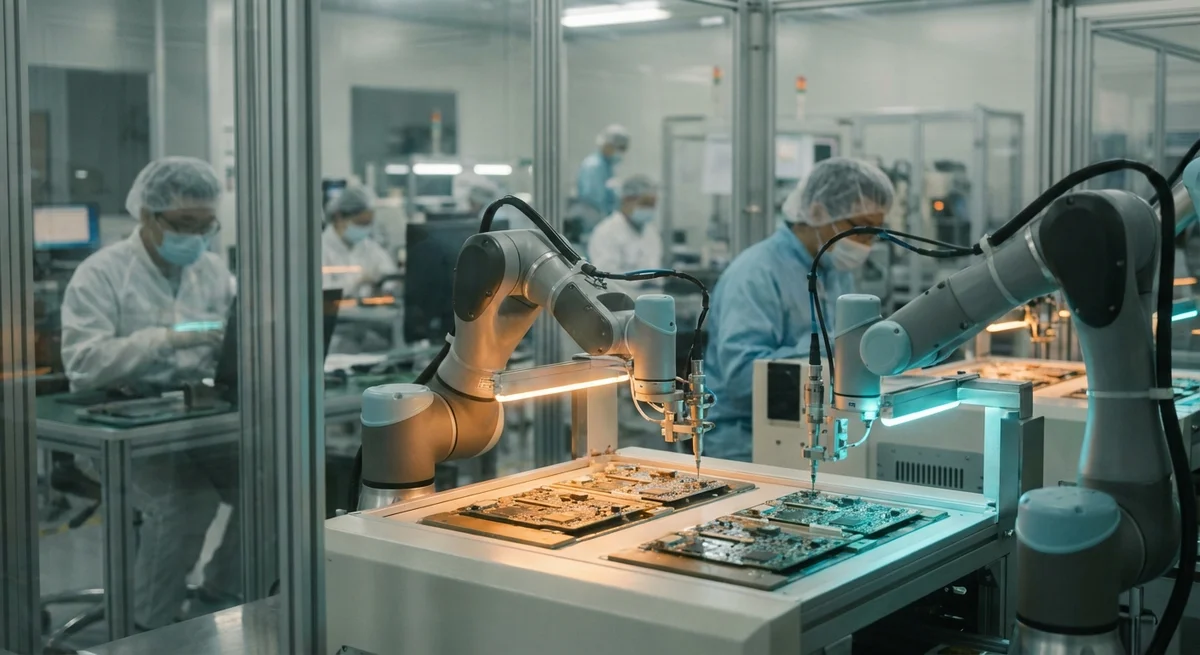
When we discuss NVIDIA's triumph or AMD's latest records, we usually look at teraflops and transistor counts. But behind the shine of silicon wafers lies an industry that looks boring at first glance yet is critically important: substrate manufacturing. Without substrates, even the most advanced GPU is a useless piece of rock.
Japanese giant Ibiden, which has held a firm grip on this market for decades, has decided the world clearly lacks sufficient capacity. The company has officially approved an investment plan of a hefty 5000 billion yen (roughly 22.2 billion yuan, or $3.4 billion). The investment cycle covers fiscal years 2026-2028. This is not a spontaneous purchase of a few new machines but a large-scale restructuring of the business around the needs of AI servers and high-performance computing. If you thought the chip shortage was behind us, Ibiden has a reminder: the infrastructure for the AI of the future is still being built.
The Japanese company plans to multiply its output of high-performance IC substrates (IC), which act as a bridge between a chip's microscopic contacts and the server's printed circuit board. The complexity of these components grows exponentially with the power of the processors themselves.
Why now? The answer lies in the architecture of modern accelerators. Chips are getting larger and more complex, and they need far more efficient heat dissipation. They require multilayer substrates built with extraordinary precision, able to withstand enormous loads and deliver flawless signal transmission at high frequencies.
Ibiden has long worked closely with the "big three": NVIDIA, Intel and AMD. In effect, the success of the next-generation Blackwell or of Lisa Su's upcoming products depends directly on whether Ibiden can start its new lines on time.
The market situation is this: producing the dies is only half the job. The bottleneck often appears at the packaging and substrate stage. We have already seen how TSMC's CoWoS capacity shortage slowed H100 shipments. As a leader in its segment, Ibiden understands that if it does not invest in expansion now, it simply will not be able to satisfy the appetite of hyperscalers such as Google or Microsoft in a couple of years. It is a play to stay ahead, with leadership in the foundation of all global computing hardware at stake.
The market for high-performance servers has finally moved from experimental hype to harsh industrial scaling. Ibiden sees this earlier than others because orders for such components are placed years before the finished server reaches a data center. The fact that a conservative Japanese corporation is ready to put billions of dollars into expanding production signals rock-solid confidence that demand for AI computing will not burst like a bubble in the next three to four years. This is not speculative capital but real concrete, steel and clean rooms.
It is interesting to watch Japanese technology leaders, often accused of sluggishness and excessive conservatism, aggressively seize key nodes in the AI supply chain. While Silicon Valley's software giants burn billions training models that may never find a way to make money, Ibiden is building real factories. They will generate profit either way, regardless of whose neural network proves smarter or whose chatbot learns to joke first. Every player will need substrates, and Ibiden is ready to be their main supplier.
Bottom line: Ibiden is effectively confirming that the AI infrastructure shortage is serious and here for the long haul. Are other players ready for such a capital-spending race, or will the Japanese remain monopolists in the foundation of the AI revolution?
- Nov 2, 2026Karpathy builds a YouTube clone with 6454 videos from Hacker News recommendations in two hours
- Nov 2, 2026Karpathy used Claude to build HackerTube from 6,454 videos recommended on Hacker News
- Nov 2, 2026Anthropic needs to grow revenue 32% a year to cover $850 billion in contracts
- Nov 2, 2026Bun creator uses Claude Code to port 750K lines from Zig to Rust in 11 days
Test Frontier LLMs & Autonomous Agents in One Workspace
Run Claude Opus 5.5, GPT-6, Gemini 3.1, and DeepSeek side-by-side in Nomad AI (nomadnet.ai) — unified model routing, deep research, and multimodal workflows under one subscription.
The AI world, distilled — once a week
Seven stories that actually mattered, hand-picked. No noise, no reposts, no press releases.
Done! Check your inbox for a confirmation.