Oracle goes all in: $50 billion to keep OpenAI from running short of compute
Oracle plans to raise up to $50 billion through debt and equity. Why so much? To finish building infrastructure for OpenAI and Nvidia in time. Demand for cloud capacity is growing faster than Larry Ellison can sign checks. This is not just an expansion but an attempt to lock in Oracle's position as the main landlord for AI giants. While Microsoft and Google focus on their own models, Oracle is becoming the foundation on which modern generative AI runs. Is it risky? Yes. But in the race for compute, only those willing to spend billions on concrete and cable survive.
AI-processed from Bloomberg Tech; edited by Hamidun News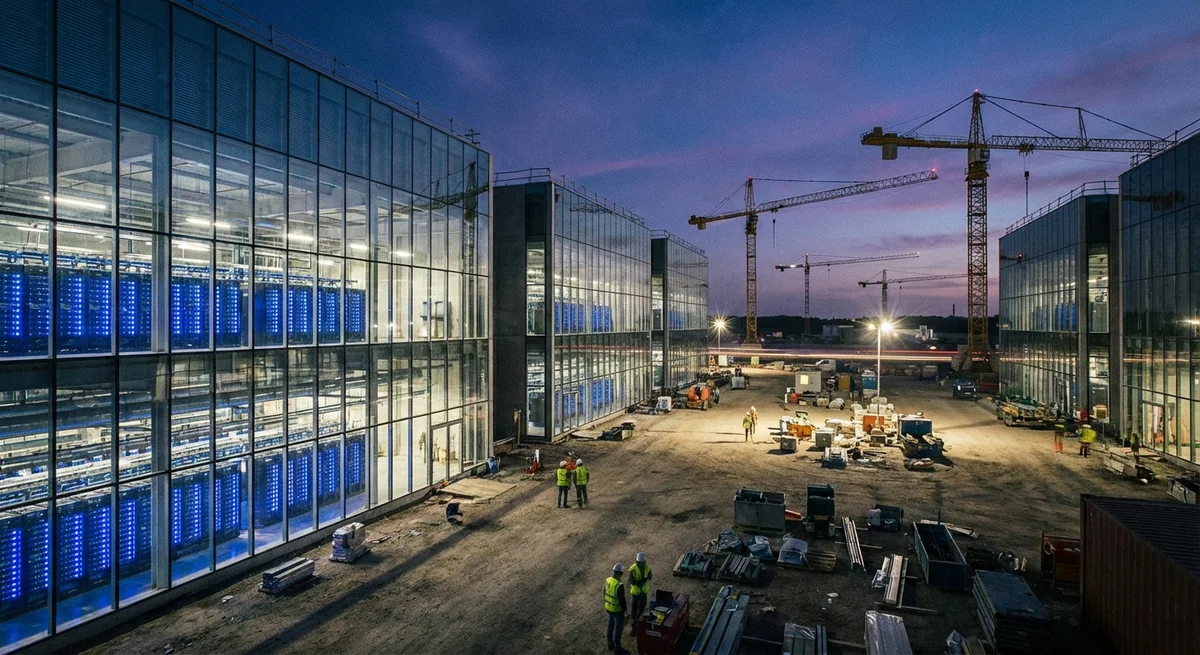
If you thought the AI arms race came down to writing code and buying GPUs, Larry Ellison is ready to prove otherwise. Oracle plans to raise an staggering $50 billion this year. This is not "a bit of money for growth" but the budget of a mid-sized European country, and it is going toward one simple but monumental goal: build, build and build more data centers. While skeptics on Twitter debate when the AI bubble will burst, Oracle is betting the bubble is so big that the planet simply does not have enough physical space for it.
The situation is almost ironic. Only five to seven years ago, Oracle was seen as a technological dinosaur hopelessly behind Amazon Web Services and Microsoft Azure. But the cloud market proved unusually fickle. When the era of large language models arrived, it turned out the old giants were too sluggish, and their infrastructure was not always well suited to the specific needs of training neural networks. Oracle adapted in time and offered exactly what Nvidia and OpenAI need here and now: scalable architecture with no unnecessary questions. The contracts are already signed, demand is guaranteed, and now Ellison simply has to turn money into working hardware in time.
$50 billion is a colossal risk. Oracle plans to use a complex mix of debt and share sales. That means the company is literally putting its financial future on the line to dominate the AI infrastructure layer. It is important to understand that OpenAI and Nvidia are not just customers for Oracle. They are the locomotives pulling the entire industry. If Oracle lacks sufficient capacity at the right moment, these giants will simply walk to competitors. So Ellison is acting in his classic style: aggressive, expensive and with maximum flourish. At 80, the founder of Oracle seems to have found the biggest challenge of his career.
Why now? Because the era of "virtual" capacity is over. Training next-generation models such as GPT-5 requires computing resources that cannot be deployed in an ordinary server rack. It takes clusters that consume energy like entire metropolises. Oracle realized its path out of obscurity is to become the main landlord for those building the future. While Microsoft tries to sit on two chairs, developing both clouds and its own models, Oracle remains a "pure" provider for the chosen few. That makes its partnership with Nvidia especially strong: Jensen Huang knows Oracle will not compete with him in software and will simply buy as many chips as he can produce.
We are watching the birth of a new architecture of the internet. We used to talk about software "eating the world"; now we are talking about real estate and energy again. If Oracle's plan works, the company will regain the status of technology leader that it nearly lost during a decade of cloud stagnation.
It would be the greatest comeback in Silicon Valley history. If demand for AI suddenly drops or growth slows, Oracle will be left with a mountain of debt and the world's most expensive empty buildings stuffed with useless silicon. But judging by Larry's determination, he does not believe in that scenario.
For him this is not just business; it is a question of who will own the foundation of the digital world.
Bottom line: The era of cheap AI is over, and the era of gigantic capital investment has begun. Oracle is betting everything that OpenAI and Nvidia will keep growing forever. Can competitors answer such a financial all-in?
- Nov 2, 2026Meta's Muse assistant keeps dossiers on loved ones and gets root on Ubuntu by default
- Nov 1, 2026Local models lose to Opus and Codex: 0.21 on a MacBook versus 1.00 for Codex
- Nov 1, 2026Kimi scores 96.2% on a 1C database analytics test and emerges as a fallback if Claude access is blocked
- Nov 1, 2026OpenAI Rewrites GPT Behavior Rules: Five Values and a Chain of Command
Test Frontier LLMs & Autonomous Agents in One Workspace
Run Claude Opus 5.5, GPT-6, Gemini 3.1, and DeepSeek side-by-side in Nomad AI (nomadnet.ai) — unified model routing, deep research, and multimodal workflows under one subscription.
The AI world, distilled — once a week
Seven stories that actually mattered, hand-picked. No noise, no reposts, no press releases.
Done! Check your inbox for a confirmation.