SpaceX and xAI: Musk Builds a Trillion-Dollar Empire (or Is He Just Rescuing His Own Money?)
Elon Musk is shaking up the market again: SpaceX is absorbing xAI, creating a structure valued at $1.25 trillion. Musk calls it an "engine of innovation" that ties together rockets, satellite internet and AI. Behind the polished language, though, lies a pragmatic and highly controversial calculation. xAI so far brings in only losses, while SpaceX is the most valuable private company in the world. Many investors see the deal as Musk's attempt to prop up his AI project with the resources of a successful space giant. For the industry, it means the birth of a major new player that plans to go public as soon as June. What comes next is either the greatest synergy in history or the biggest corporate scandal.
AI-processed from Guardian; edited by Hamidun News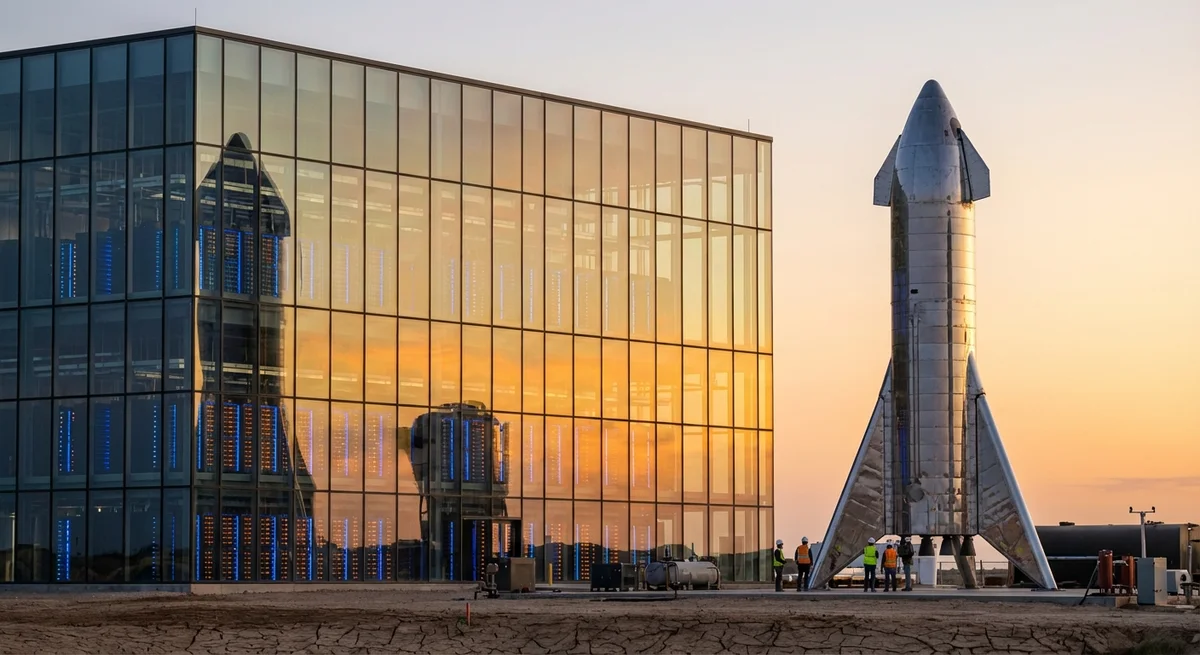
While the world watched yet another spectacular Starship stage landing, Elon Musk pulled off a far more complex and financially risky maneuver. He decided to merge SpaceX and his AI startup xAI into a single structure. The estimated value of this new "monster" came to a staggering $1.25 trillion. Musk presents it as the creation of the greatest "engine of innovation" in human history, one that will link space, the internet and artificial intelligence. But look closely at the numbers and the picture stops resembling a scene from a science-fiction film and starts to look like a classic scheme of moving money from one pocket to another.
Let's sort out what is actually happening. SpaceX today is the undisputed leader of private spaceflight and the owner of Starlink, which already turns a real profit. xAI is an ambitious but extremely voracious project that burns billions of dollars on GPUs and model training. The merger looks like an attempt by Musk to give xAI a bottomless financial resource in SpaceX. To Elon's fans it is a brilliant move in vertical integration, but to SpaceX's minority shareholders it looks like forced participation in bailing out a loss-making startup. We have seen something similar before, when Tesla acquired SolarCity, and it triggered a flood of lawsuits.
Musk describes the future company as a single organism in which AI controls rockets and Starlink satellites provide instant connectivity for neural networks. That sounds logical, if you forget that xAI has so far shown nothing that dramatically outperforms its rivals at OpenAI or Anthropic. A valuation of more than a trillion dollars is an advance paid personally to Musk and his ability to work miracles. Yet investors who put money into a "space company" have suddenly found themselves owning a stake in an AI developer that competes with Google and Microsoft. As usual, nobody particularly asked for their consent.
The rush to merge has a simple explanation: a stock market listing is planned for June. Musk wants to bring to the IPO not just a rocket company but a universal technology platform. That lets him push valuation multiples sky-high. If SpaceX is valued as an industrial giant, the combined company will be valued as an AI leader, where earnings multiples can be tens of times higher. That is great news for those who want to make a quick profit on the hype, but a huge risk to SpaceX's long-term stability. If xAI fails to take off, it can drag even the most successful space programs down with it.
The AI industry is now in an "arms race" phase, where the winner is whoever has more money and computing power. Musk has found a way to get both without approaching venture funds on standard terms. He simply took the resources of his most successful company. It is bold, it is very Musk, and it sets a dangerous precedent for corporate governance across Silicon Valley. We are watching the birth of a new form of corporation, in which the boundaries between one man's different businesses disappear completely.
The bottom line: SpaceX is effectively becoming the sponsor of Musk's AI ambitions. Can this mix be turned into a working business before the June IPO, or will shareholders stage a mutiny?
- Nov 1, 202616 models tested on 7 search tools: Exa averaged 10.5 out of 14, SearXNG about 3
- Nov 1, 2026OpenAI Rewrites GPT Behavior Rules: Five Values and a Chain of Command
- Oct 29, 2026Gemini 4 Carbon tops independent rankings, but only cyber defenders can use it
- Oct 29, 2026Study: A Single Random Failure Makes AI Agents Abandon a Working Tool 11.6% of the Time
Test Frontier LLMs & Autonomous Agents in One Workspace
Run Claude Opus 5.5, GPT-6, Gemini 3.1, and DeepSeek side-by-side in Nomad AI (nomadnet.ai) — unified model routing, deep research, and multimodal workflows under one subscription.
The AI world, distilled — once a week
Seven stories that actually mattered, hand-picked. No noise, no reposts, no press releases.
Done! Check your inbox for a confirmation.