The Butterfly Effect Under Threat: How Google and Nvidia Are Trying to Tame Weather Chaos
Google, Microsoft and Nvidia have entered the race for the "perfect forecast," challenging classical physics. Traditional meteorology relies on extremely complex equations that take weeks of computation on supercomputers. New AI models such as GraphCast do it in seconds, training on historical data from the past 40 years. It is not only a question of speed: AI is trying to beat the butterfly effect, the uncertainty in which the flap of an insect's wing changes the climate on the other side of the planet. If the algorithms learn to predict extreme events weeks ahead rather than days, it would save billions of dollars in agriculture and energy. For now, this is a battle of pure data against the laws of thermodynamics.
AI-processed from Bloomberg Tech; edited by Hamidun News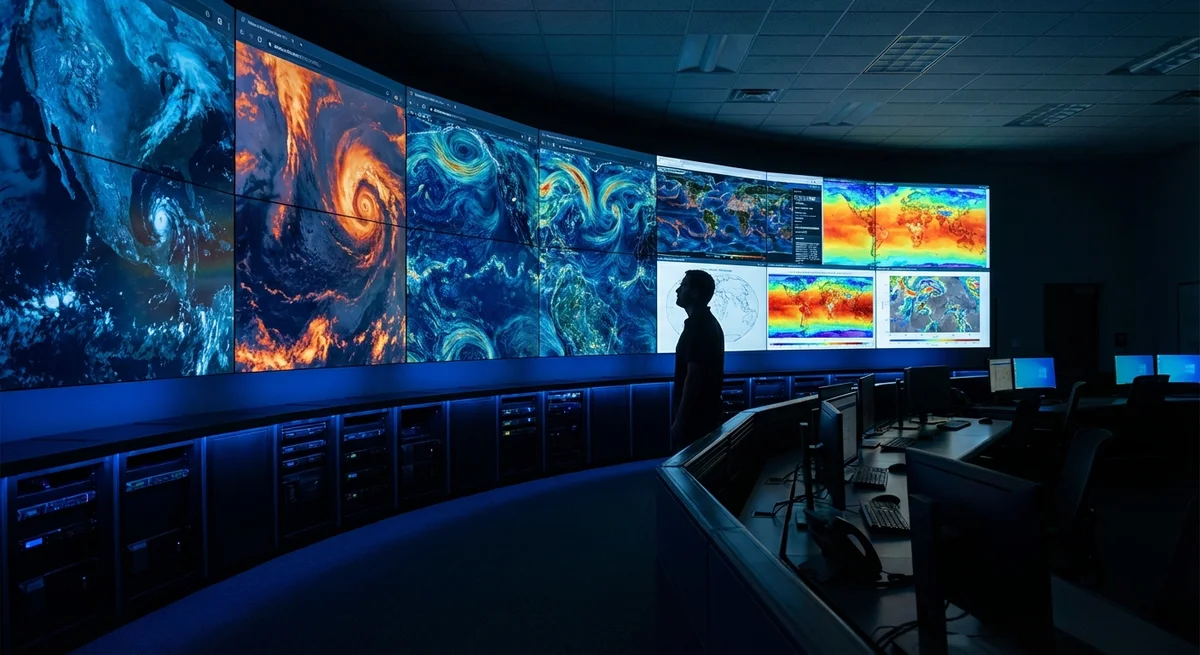
Meteorology has always been a science of deep humility. We are used to treating a forecast for tomorrow as useful information, and a two-week forecast as closer to reading coffee grounds, with a touch of science fiction. The culprit is Edward Lorenz and his famous butterfly effect. The smallest error in the starting data turns any computer model into a chaotic mess within a few days of simulation. But Google, Microsoft and Nvidia have now decided that chaos is just a poorly trained neural network, and have launched a large-scale expansion into the forecasters' territory.
For decades, global meteorology has relied on numerical weather prediction (NWP). These are monstrous systems of thermodynamic and fluid dynamics equations, "ground through" by supercomputers the size of a small warehouse. The problem is that these models are incredibly slow and expensive to run. By the time a classical model finishes crunching a complex cyclone, the storm may already be flooding coastal cities. This is where a new generation of AI models comes in, such as GraphCast from Google DeepMind or FourCastNet from Nvidia. Instead of solving the equations of physics head-on, they look at historical data archives spanning recent decades and search them for hidden patterns. This is a fundamental shift: from understanding causes to simply recognizing scenarios.
Why has this battle intensified right now? The answer is simple: we have accumulated enough high-quality data and, more importantly, enough computing power. Nvidia plays a double role here. It not only sells the "shovels" in the form of graphics chips for this gold rush, but also digs actively itself, with its Earth-2 project. It is an attempt to build a digital twin of the entire planet, in which AI could simulate climate change with unprecedented accuracy. Microsoft is keeping pace, integrating similar solutions into its cloud services for agribusinesses and logistics giants, for whom it is vitally important to know exactly when the next port will close because of a storm.
However, skepticism is growing in the meteorological community, and it is well founded. Traditional models "understand" the physics of the process: they know why the wind blows and how moisture condenses. AI models, in this context, remain "black boxes." They can produce a frighteningly accurate result but cannot explain how they arrived at it. There is a risk that, when facing an anomaly absent from the training set, for example because of rapid climate change, a neural network may hallucinate instead of producing a forecast. In meteorology, the cost of such an error is measured not in lost clicks but in human lives and destroyed infrastructure.
For the global economy, the stakes are even higher. An accurate hurricane trajectory forecast ten days out instead of five allows equipment and people to be evacuated in time, saving billions of dollars. Energy companies shifting to renewable sources depend critically on knowing how much sun and wind will be on the grid at a given hour. In essence, we are watching meteorology turn from a fundamental physical discipline into applied work with Big Data. This may permanently change how we perceive uncertainty.
Can AI defeat the butterfly effect once and for all? Unlikely, because chaos is built into the physical nature of the atmosphere. But it can certainly make that chaos predictable enough that we stop being surprised by "sudden" disasters. The battle for the sky is only beginning, and its main heroes are not people in raincoats in front of a map, but machine learning engineers trying to pack all the complexity of Earth's atmosphere into neat rows of neural network weights.
Bottom line: AI is turning meteorology from theoretical physics into a competition of algorithms and data. The speed of producing forecasts has grown thousands of times over, but are we ready to entrust the safety of cities to models that do not know the laws of physics and merely remember how things went last time?
- Nov 2, 2026Bun creator uses Claude Code to port 750K lines from Zig to Rust in 11 days
- Nov 2, 2026The Verge reviewer builds a $50 Meta Muse Charm alternative with Claude Code
- Nov 1, 202616 models tested on 7 search tools: Exa averaged 10.5 out of 14, SearXNG about 3
- Nov 1, 2026Google's StreamVibe video agent beats other models by 10.7% on response timing and quality
Test Frontier LLMs & Autonomous Agents in One Workspace
Run Claude Opus 5.5, GPT-6, Gemini 3.1, and DeepSeek side-by-side in Nomad AI (nomadnet.ai) — unified model routing, deep research, and multimodal workflows under one subscription.
The AI world, distilled — once a week
Seven stories that actually mattered, hand-picked. No noise, no reposts, no press releases.
Done! Check your inbox for a confirmation.