Brazil's Nemotron: Why Silicon Valley No Longer Sets the Rules
While the industry chases parameter counts, Brazil and NVIDIA are betting on "digital sovereignty." The release of the Nemotron-Personas-Brazil dataset marks a significant shift from global, English-centric models to locally oriented systems. Instead of simply translating Western data, the developers built a synthetic environment steeped in Brazilian cultural codes, legal nuances and social context. It is a response to the "cultural colonialism" problem in AI, where a neural network thinks in Californian terms while talking to a resident of São Paulo. Local businesses and the public sector now get a tool that actually understands local specifics instead of merely imitating them through Google Translate.
AI-processed from Hugging Face Blog; edited by Hamidun News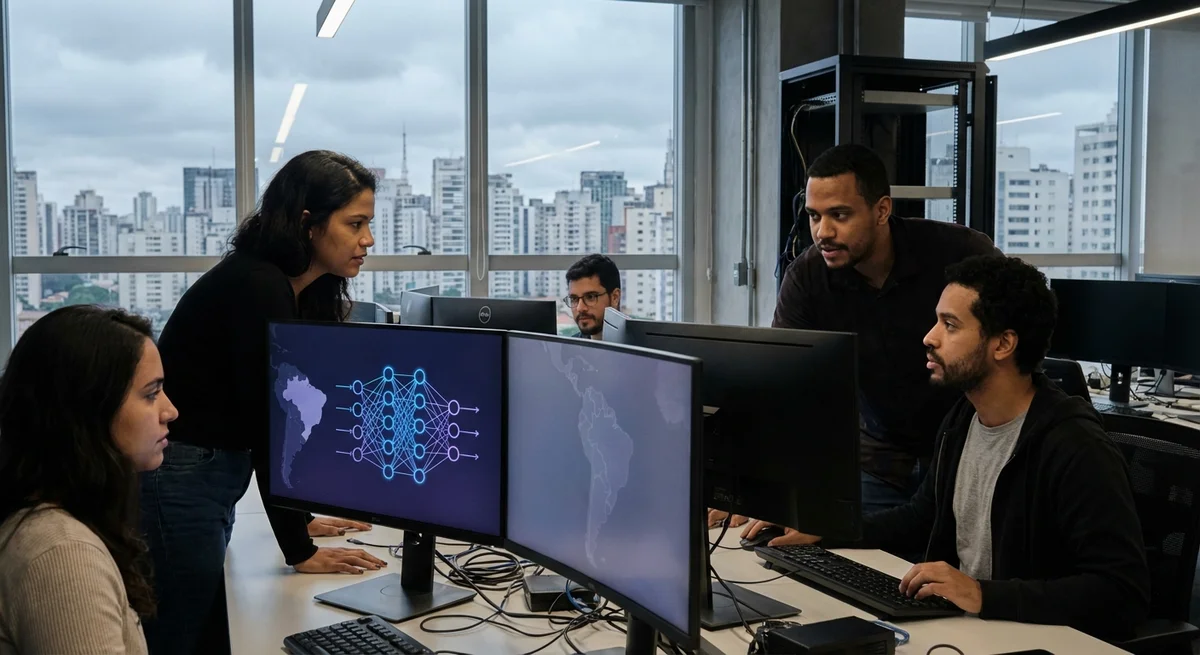
Imagine talking to an incredibly smart interlocutor who knows everything, yet sees the world solely through the lens of life in Silicon Valley. It confuses your legal norms with American ones, misses local jokes and imposes ethical standards that look odd, to say the least, in your society. That is how most of the world feels today when using GPT-4 or Claude. For a long time we put up with this "cultural colonialism" of AI, but the situation is starting to change fast. Brazil decided it did not need just a "smart translator" and introduced Nemotron-Personas-Brazil, a project that could become a playbook for any country that wants to preserve its digital identity.
The problem is that today's large language models are trained mostly on the English-language part of the internet. Even when they answer in Portuguese, their "inner logic" stays Western. NVIDIA, together with Brazilian partners Petrobras and NIC.br, took a different route. They built a synthetic data generation system that models thousands of specific "personas," from lawyers in Rio to farmers in the countryside. This is not just a set of texts but a deep simulation of social and cultural context. Instead of feeding a neural network the whole chaos of the internet, the developers created a clean, structured environment where the AI learns to be Brazilian, not a Californian who learned Portuguese.
Why does this matter now? NVIDIA is actively pushing the concept of "Sovereign AI." Jensen Huang understands perfectly well that it won't be possible to sell H100s forever only to American giants. The future of the market lies in national clusters. Every government wants an AI trained on national data, compliant with local laws and not sending confidential information to servers in Oregon. Nemotron-Personas-Brazil is the first large-scale example of NVIDIA's infrastructure turning from mere "hardware" into a foundation for building national digital states. It is a direct challenge to the dominance of OpenAI and Google, which try to build one model for everyone.
The technical side is no less interesting than the geopolitical one. Synthetic data makes it possible to work around the shortage of quality content in non-English languages. If the web has few good Portuguese texts on a narrow topic, they can be generated using Nemotron as a "teacher." This creates a closed training loop in which the model keeps sharpening its grasp of local specifics. For Brazilian startups, that means access to tools that understand the subtleties of local taxation or dialect nuances, which was practically impossible before without huge spending on manual data labeling.
Ultimately, the Brazilian experiment will show how viable the idea of a fragmented AI market is. If Nemotron-Personas-Brazil proves effective, we will see a parade of similar projects from France to Indonesia. The era of universal models that are "equally good for everyone" may end sooner than we thought. They will be replaced by specialized systems that know where you live, not because they watch you, but because they are themselves part of your culture. The irony is that the path to this cultural diversity is being paved by a company from that very California, supplying everyone with shovels to dig their own digital wells.
The key point: sovereign AI is ceasing to be a slogan and becoming a technology stack. Will global players be able to adapt to a world where every country wants its own "smart black box"?
- Nov 2, 2026Arca gives AI agents finance tasks lasting up to 10 days, but leaves the trades to humans
- Nov 2, 2026Meta's Muse assistant keeps dossiers on loved ones and gets root on Ubuntu by default
- Nov 1, 2026Local models lose to Opus and Codex: 0.21 on a MacBook versus 1.00 for Codex
- Nov 1, 2026Kimi scores 96.2% on a 1C database analytics test and emerges as a fallback if Claude access is blocked
Test Frontier LLMs & Autonomous Agents in One Workspace
Run Claude Opus 5.5, GPT-6, Gemini 3.1, and DeepSeek side-by-side in Nomad AI (nomadnet.ai) — unified model routing, deep research, and multimodal workflows under one subscription.
The AI world, distilled — once a week
Seven stories that actually mattered, hand-picked. No noise, no reposts, no press releases.
Done! Check your inbox for a confirmation.