Intel Core Ultra: Why Your Laptop Will No Longer Roar Like a Vacuum Cleaner
All last year we lived with an illusion: computers seemed to get smarter, but in practice they just started tiring out faster. Trying to run neural networks on an old architecture meant screaming fans and drained batteries. Intel Core Ultra, with its dedicated neural processing unit (NPU), changes the rules. AI workloads no longer eat into the system's resources; they move to a separate chip. This is not just a processor refresh. It is a shift toward the AI PC concept, where privacy and autonomy matter more than marketing gigahertz. The era of cloud dictate is ending right inside your system unit.
AI-processed from HuXiu (虎嗅); edited by Hamidun News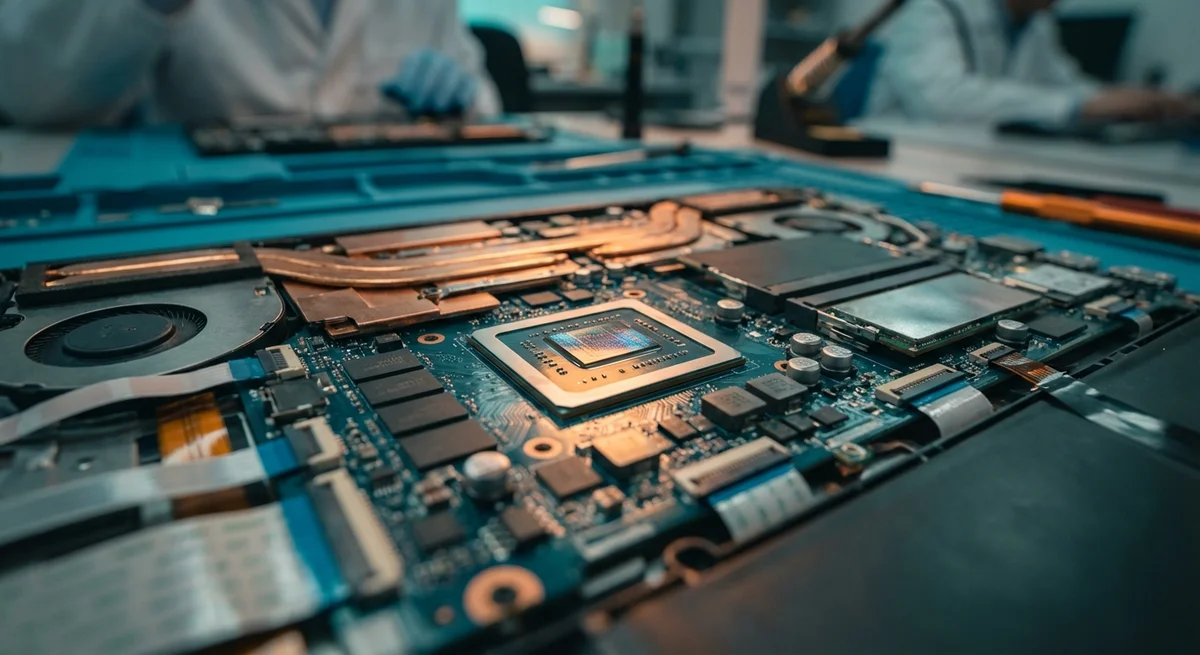
All last year, we lived in a rather strange illusion. We sincerely believed our computers had suddenly gotten smarter, learned to grasp context and generate meaning. In reality, they just started running out of steam faster. Every time you launched a trendy retouching plugin or asked the system to summarize a long text, your laptop's fans spun up to takeoff mode and the battery percentage melted away before your eyes. The problem was not the neural networks themselves. We were stubbornly trying to cram intelligence into a PC architecture that was never designed for it. We tried to make old hardware dance to the music of the future, and it predictably started to stumble.
We are used to two giants running everything inside a computer: the central processor (CPU) and the graphics chip (GPU). This pairing worked well for decades, but modern AI is a beast of a completely different order. It does not need the short bursts of computing power that classic processors are known for. It needs steady, quiet, highly energy-efficient background support. When you make a powerful graphics card compute background blur in Zoom or suppress microphone noise during a three-hour call, it does the job well as far as the picture goes, but monstrously inefficiently as far as resource consumption goes. The result: your expensive laptop turns into a portable heater chained to a wall outlet.
The Intel Core Ultra line is not just another marketing badge invented to justify buying a new device. It is the industry's first serious attempt to admit that the old division of roles inside the system unit is dead. The key change is the introduction of a dedicated neural processing unit (NPU). It is a separate region of silicon whose sole job is to crunch the mathematical weights of neural networks.
The NPU changes the very logic of how the operating system works. AI tasks stop competing for resources with your browser or text editor. They move to a "quiet zone" that consumes several times less energy, letting the laptop stay cool even under load.
Why does this shift matter right now?
Because we have finally hit the ceiling of cloud computing. Sending your every request, every cursor movement or every word to a remote server in Ohio or Singapore is slow, expensive and, to be honest, not entirely safe. Local AI gives back what we had started to lose: privacy and independence. When computation happens "on board," your data does not leave the device, and latency disappears as a category. But for this utopia to become reality, a computer must learn to "think" locally without turning into a red-hot brick after fifteen minutes of work.
Moving computation "home," inside your PC's case, is arguably the most significant shift in the industry in the past ten years. We are rapidly moving from the idea of a "computer with access to AI" to a true AI PC. In this new reality, the operating system will start anticipating your actions, and familiar apps will turn into autonomous assistants able to work without a network connection. And all of it will happen without the irritating whine of fans in your ear.
Skeptics may of course note that software is not yet keeping up with what the new hardware can do. They would be partly right. We are at the same historical point as the first smartphones with GPS modules: the hardware is already inside the case, but good maps and convenient navigation barely exist yet.
Still, critical mass has been reached. Software developers now clearly understand which chip to send neural network tasks to so they do not kill the user's battery in half an hour. That lays the foundation for a new type of application that we simply could not afford before because of power and heat limits.
Within the next couple of years, "smart" features will become as natural and unnoticed as spell checking.
Bottom line: The era of total cloud dictate in AI is coming to an end. Intel is betting that your next computer will be valued not for raw gigahertz but for its ability to run neural nets efficiently and quietly in the background. Are you ready to trust your data to local silicon instead of a distant cloud?
- Nov 2, 2026DeepSeek open-sources Super-agent prototype: p95 task completion time of 15.7 minutes vs. 29.5
- Nov 2, 2026Bun creator uses Claude Code to port 750K lines from Zig to Rust in 11 days
- Nov 2, 2026Microsoft releases 4B model Mage-VL-Cowork, which solves 66.0% of OSWorld-Verified tasks
- Nov 2, 2026Meta's Muse assistant keeps dossiers on loved ones and gets root on Ubuntu by default
Test Frontier LLMs & Autonomous Agents in One Workspace
Run Claude Opus 5.5, GPT-6, Gemini 3.1, and DeepSeek side-by-side in Nomad AI (nomadnet.ai) — unified model routing, deep research, and multimodal workflows under one subscription.
The AI world, distilled — once a week
Seven stories that actually mattered, hand-picked. No noise, no reposts, no press releases.
Done! Check your inbox for a confirmation.