Ningbo Port Bets on Millions: How AI Digests Global Exports
Ningbo Port has published its forecasts for early 2026: container throughput is expected to grow 9.5% to a hefty 5.03 million TEU. For the industry, it is an important marker. Ningbo is one of the flagships of the "smart port" concept, where traffic and loading management were handed over long ago to neural networks and driverless tractors. A load increase of nearly 10% at this scale means China fully trusts its export arteries to algorithms. If the systems cope with this flow without congestion, the question of whether to fully automate maritime hubs worldwide will be closed for good.
AI-processed from 36Kr (36氪); edited by Hamidun News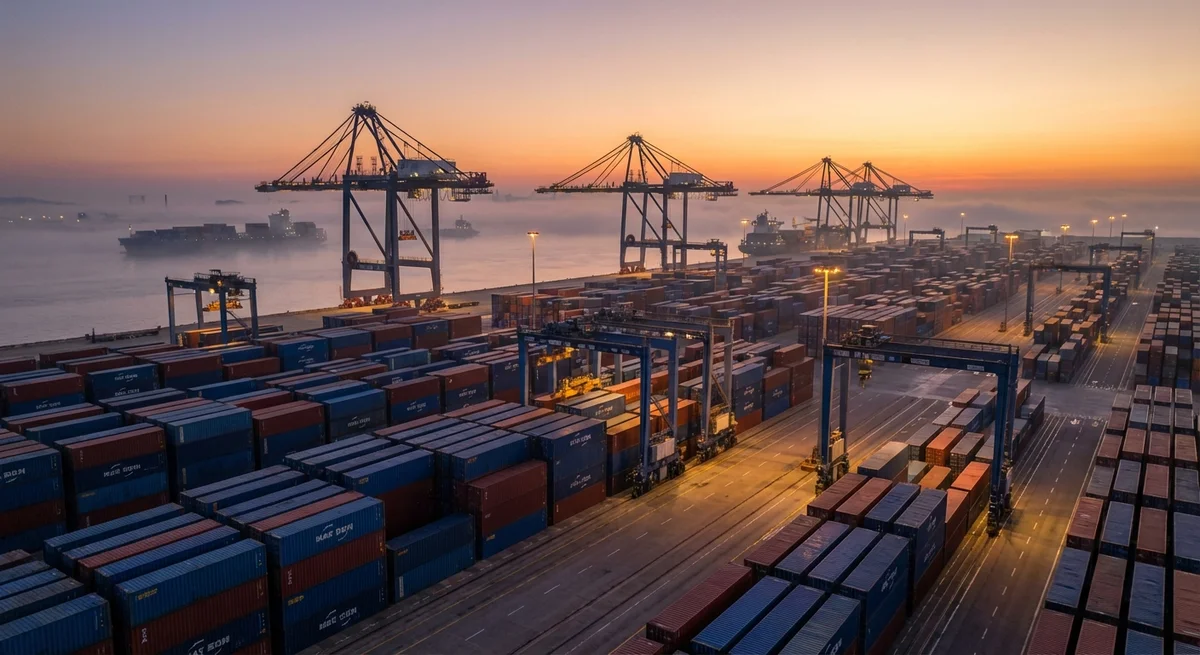
When we talk about five million containers in a single month, the human imagination usually gives up. Try picturing endless rows of steel boxes that must not merely be moved but fitted with precision into the schedules of hundreds of ships, railways and trucks. Ningbo Port, one of the largest logistics hubs on the planet, says it is ready for the challenge. The January 2026 forecast of 5.03 million twenty-foot equivalent units (TEU) is not just dry statistics but a declaration of technological superiority. Growth of 9.5% amid global instability looks almost defiant.
Why does this matter right now? We have reached a point where traditional port management methods have hit their physical limit. A dispatcher surrounded by radios and monitors can no longer effectively untangle chaos on this scale. Ningbo-Zhoushan has spent several years actively rolling out the "smart port" concept. Here, every crane movement and every route of a driverless truck (AGV) is calculated by an AI-based system. A throughput increase of almost ten percent means the optimization algorithms have become even more efficient, cutting vessel idle time at anchorage to a minimum.
The context is deeper than it looks. After the crises of recent years, global supply chains became jerky and unpredictable. China is responding with hyper-automation. Ningbo is actively deploying "digital twins" of the entire port that simulate loading scenarios in real time. This lets the system know in advance where a bottleneck will appear, before the first container ship shows up on the horizon. If the forecast of 112 million tonnes of total cargo turnover is confirmed, it will be the best proof that AI logistics is not a marketing term but the only way to survive in the modern economy.
What does this mean for us? First, it is a signal to the hardware market. Serving such capacity requires thousands of sensors, computer-vision cameras and powerful server nodes right at the edge (edge computing). Second, it is a blow to automation skeptics. If Ningbo digests 5 million boxes without an army of human coordinators, ports in Europe and the US will find themselves playing catch-up, stuck in the last century with their strikes and the human factor.
The irony is that while the world argues about AI safety, Ningbo simply hands it the keys to its gates. Looking at these numbers, you realize the race for AI leadership is being fought not only in chatbots but also on the quays. A port's efficiency converts directly into the price of goods on store shelves around the world. Chinese engineers are betting that code can be more reliable than unions and more experienced than old captains. And judging by the growth trend, they have not been wrong.
The key question: can Western logistics infrastructure answer this digital challenge, or will Ningbo remain an unreachable benchmark of autonomy?
Test Frontier LLMs & Autonomous Agents in One Workspace
Run Claude Opus 5.5, GPT-6, Gemini 3.1, and DeepSeek side-by-side in Nomad AI (nomadnet.ai) — unified model routing, deep research, and multimodal workflows under one subscription.
The AI world, distilled — once a week
Seven stories that actually mattered, hand-picked. No noise, no reposts, no press releases.
Done! Check your inbox for a confirmation.