China's Tech Sector: AI Glasses and Robots Rescue Sinking Companies
China's electronics market is splitting sharply. Of the 63 publicly listed companies (A-shares) that reported 2025 results, more than half posted losses or falling profits. Stagnation in smartphones and PCs is dragging the industry down, yet some firms are growing 20-30%. The secret is simple: they switched direction in time, to AI glasses (AI), robotics and components for electric vehicles. It is a clear signal for the whole world: the era of plain hardware is over. Either you build neural networks into wearable devices, or you prepare for oblivion. Traditional business is under pressure, while "smart" gadgets have become the only driver of survival.
AI-processed from 36Kr (36氪); edited by Hamidun News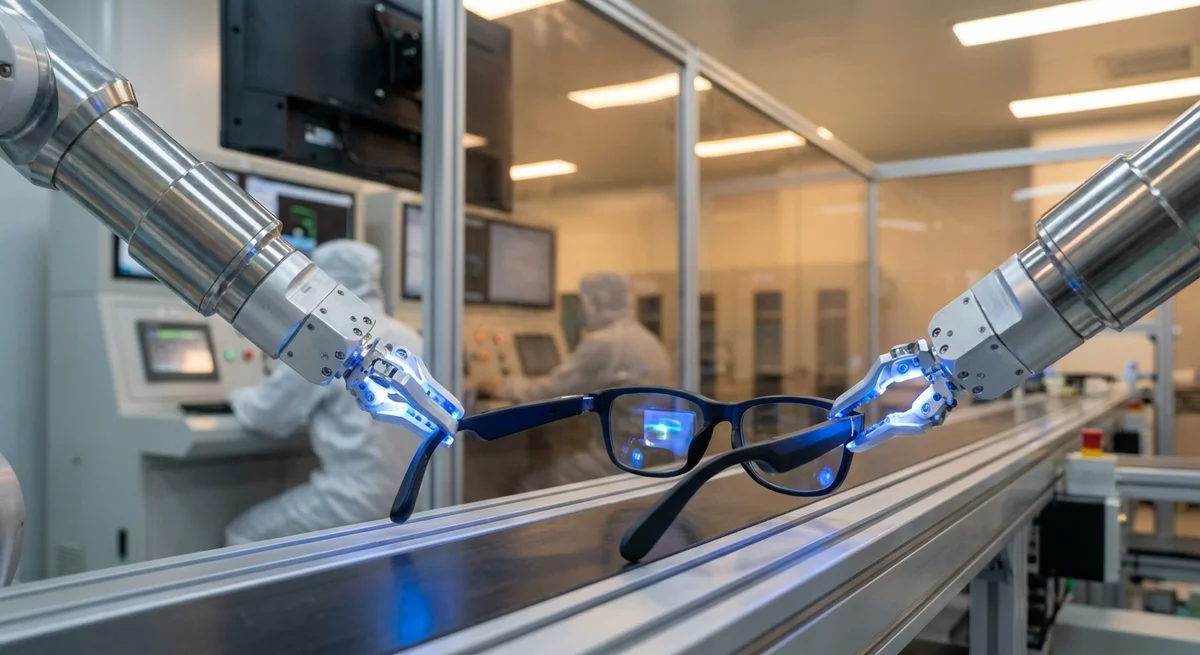
While you weigh a new smartphone against a slightly more powerful laptop, China's electronics market has already delivered its verdict: the old consumer world is dead. The latest financial reports from the 63 largest companies in the sector listed on mainland China's exchanges (A-shares) read like dispatches from a battlefield. The picture is starkly contrasting, or, as the Chinese themselves put it, sharply polarized. Of the whole sample, only 22 companies managed to grow or return from losses, while 40 players keep slowly sinking. These are not temporary difficulties but a fundamental shift that we are watching live.
Let's look at why the industry has turned into a cocktail of "cold and heat". On one side, traditional business, meaning the production of components for smartphones, tablets and home appliances, is under enormous pressure. Competition there has become so toxic that margins are heading toward zero. Consumers no longer want to buy "just a phone"; they want something fundamentally new. And this is where it gets interesting. Companies that sensed which way the wind was blowing and invested in new niches are now literally swimming in money, while their former peers count their losses.
AI glasses (AI) became the main lifeline for Chinese tech giants. After Meta* showed off its Ray-Ban glasses, the Chinese market picked up the trend instantly. It is an ideal form factor for integrating large language models: the glasses see what you see and hear what you hear. For electronics makers, it is a chance to sell us one more device that we will wear without taking it off. Besides glasses, the growth leaders include those that managed to retool for components for robotics and new energy. In essence, we are watching factories that yesterday assembled cheap music players turn into suppliers of complex systems for autonomous machines and humanoid robots.
Why does this matter to us? China is the planet's main factory, and its financial reports work as a leading indicator. If forty companies out of sixty cannot make money on ordinary gadgets, the market is oversaturated for good. That means that over the next couple of years we can expect an avalanche of strange, innovative and sometimes absurd devices with the "AI" label. Companies will take risks, because the path of cautious development leads straight to delisting. We are entering an era in which artificial intelligence stops being just an icon in the browser and finally moves into our accessories.
It is amusing to watch corporations that spent years building their strategy on mass production of identical circuit boards now frantically trying to hire neural network specialists. Those who failed to jump on this train try to justify their losses with a "difficult macroeconomic situation", but the numbers do not lie: there is money in the market, it just flows now into the pockets of those betting on smart hardware. This is natural selection in a digital environment, where the survivor is not the biggest but the most adaptive. And judging by everything, adaptability today is measured by the number of teraflops in your wearable device.
Bottom line: The stagnation of traditional electronics is pushing manufacturers toward AI and robots with redoubled force. Will wearable AI become as mainstream as smartphones, or are we just watching another attempt to inflate a bubble amid falling sales?
*Meta is recognized as an extremist organization and banned in the Russian Federation.
- Nov 2, 2026Meta's Muse assistant keeps dossiers on loved ones and gets root on Ubuntu by default
- Nov 2, 2026The Verge reviewer builds a $50 Meta Muse Charm alternative with Claude Code
- Nov 1, 2026MoneyGate safety layer blocked all 42 fraudulent requests to local AI models
- Oct 31, 2026Open-source LLM gateway KTMS 1.0 plugs your own GPUs into the cloud and survives outages
Test Frontier LLMs & Autonomous Agents in One Workspace
Run Claude Opus 5.5, GPT-6, Gemini 3.1, and DeepSeek side-by-side in Nomad AI (nomadnet.ai) — unified model routing, deep research, and multimodal workflows under one subscription.
The AI world, distilled — once a week
Seven stories that actually mattered, hand-picked. No noise, no reposts, no press releases.
Done! Check your inbox for a confirmation.