AI and the Private Credit Bubble: UBS Warns of a 13% Default Rate
Analysts at UBS Group AG have laid out a grim scenario for the US financial sector. They project that an aggressive AI rollout could push 13% of private loans into default. The core problem: many companies simply won't have time to adapt their business models to the new technological reality. This isn't scaremongering — it's a warning. Technological progress often leaves behind those who run on borrowed money. While tech giants get richer, traditional businesses risk drowning in debt as they fail to compete with smart algorithms and automation.
AI-processed from Bloomberg Tech; edited by Hamidun News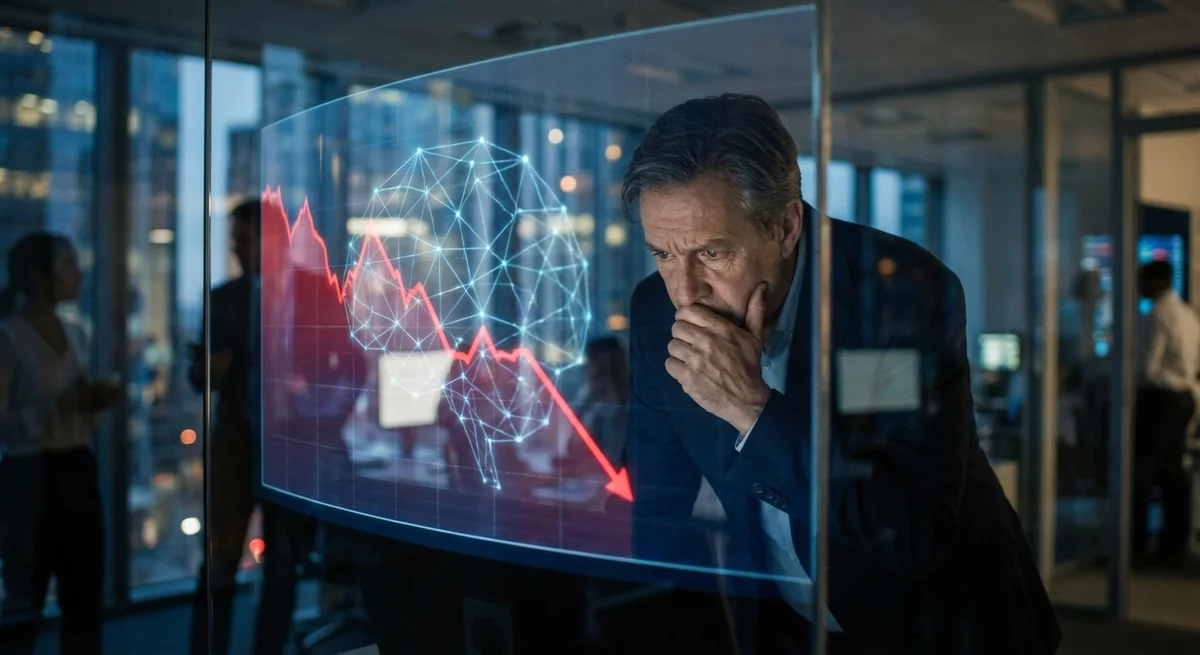
We're used to hearing that AI is the new oil, a source of endless stock gains and broad prosperity. UBS Group AG analysts, however, have decided to add a fly to the digital ointment. By their estimate, if AI starts reshaping the economy too aggressively, the US private credit market could see default rates reach 13%. That isn't an abstract figure. It's a potential financial storm that would hit thousands of companies that failed to jump aboard the automation train before it left the station. While Silicon Valley celebrates, Wall Street is starting to eye mid-sized companies' debt nervously.
Why is this coming up now? Over the past few years, the private credit market has ballooned to an astonishing $1.7 trillion, becoming a safe harbor for investors looking to avoid the volatility of public markets. For years, investors poured billions into it, counting on steady returns from loans to companies too small to issue bonds but too large for a regular bank. UBS, however, offers a reminder: stability ends where technological singularity begins. If a company's business model was built on processes that a single neural network or cloud service can now replace, its odds of repaying the loan rapidly approach zero.
In UBS's worst-case scenario, so-called aggressive disruption would make entire industries unprofitable almost overnight. Bankers fear that generative AI will be adopted far faster than corporate borrowers can adapt. Picture a company that handles outsourced customer support or basic data analysis. It has loans on equipment, offices, and payroll. Then a five-person startup with an annual subscription to an advanced LLM shows up and does the same work ten times cheaper. The old company loses contracts, but its debts don't go anywhere. A 13% default rate is on par with a deep recession, but this time the trigger wouldn't be a mortgage crisis — it would be software code.
The problem is compounded by the fact that private credit is far less transparent than public debt. We don't know exactly how many skeletons are hiding in the closets of funds that lend to mid-sized businesses. AI acts as a catalyst for natural selection here. Those who can't integrate algorithms into their operations will simply die out. The irony is that even successful integration requires massive capital investment, which heavily indebted companies may simply not have. The result is a vicious circle: to survive in an AI-driven world, you need to invest in technology, but to get that funding, you first have to pay off old debts that AI itself has made unmanageable.
UBS analysts point out that today's optimism about productivity gains may be premature for the debt market. Yes, AI will make the economy more efficient in the long run, but the transition period promises to be bloody for balance sheets. Investors should take this warning as a signal to start reshuffling their portfolios.
The era when you could simply lend to any stable business is ending. Lenders will now need to understand transformer architectures and automation capabilities as well as they understand ledgers. If the forecast comes true, we're in for a massive shift of capital from the old economy to the new one, and that process is unlikely to be painless for those used to a quiet life of collecting interest.
The bottom line: AI isn't just a tool for making money — it's also a powerful source of systemic risk to financial stability. Are credit markets ready for the possibility that their borrowers may become obsolete long before they've paid off even the principal?
Test Frontier LLMs & Autonomous Agents in One Workspace
Run Claude Opus 5.5, GPT-6, Gemini 3.1, and DeepSeek side-by-side in Nomad AI (nomadnet.ai) — unified model routing, deep research, and multimodal workflows under one subscription.
The AI world, distilled — once a week
Seven stories that actually mattered, hand-picked. No noise, no reposts, no press releases.
Done! Check your inbox for a confirmation.